
What makes a compressor station a particular challenge
A compressor station moves gas along a pipeline. Many are unmanned or lightly staffed, run by remote control and visited on a schedule. They sit along rural roads, often miles from the nearest town and a long drive from the nearest police station.
That isolation creates a gap. Operations technology tells the control room when pressure, temperature or vibration moves out of range. It does not tell the control room that a vehicle pulled up to the gate ten minutes ago. Equipment, copper, tools, fuel and scrap metal are all attractive to thieves, and trespassers can create safety problems for themselves and for the facility.
Our broader article on oil and gas security cameras covers the industry. The critical infrastructure physical security guide explains the layered approach used across energy sites.
Think in layers, from the road inward
Good security starts outside the fence and works inward.
- Approach. The access road, nearby pull-offs and the line of sight from public roads.
- Perimeter. Fence, gate, lighting and detection along the fence line.
- Yard. Open areas, laydown, storage and vehicles.
- Equipment. Buildings, compressors, meters, valves and control cabinets.
Each layer should give a monitoring team more time. If detection only happens at the building, there is little time to act. If detection begins at the gate, a person can be spoken to before they reach anything valuable.
Perimeter detection that earns its keep
Long fence lines and wide yards are hard to watch with a single camera. Several detection methods exist, and each has strengths and limits.
- Video analytics detect people and vehicles in the camera view and reduce alerts from animals and moving vegetation.
- Thermal imaging shows heat signatures and works in darkness and in some smoke or fog. See thermal security cameras.
- Radar detects movement across a wide area. The principles are covered in our guide to perimeter intrusion detection systems.
Ask any provider how they decide that a detection is a person, how they handle weather, and how many alerts a quiet night typically produces. Fewer, better alerts are more useful than many weak ones.
Hazardous areas and mounting
Compressor stations contain areas classified for flammable gas. Equipment used in or near those areas must meet the applicable standards, and the classification and placement rules are set by the operator, engineers and the authorities who have jurisdiction. Rules vary by state and by site, so confirm with your safety team and qualified engineers before selecting or mounting any device.
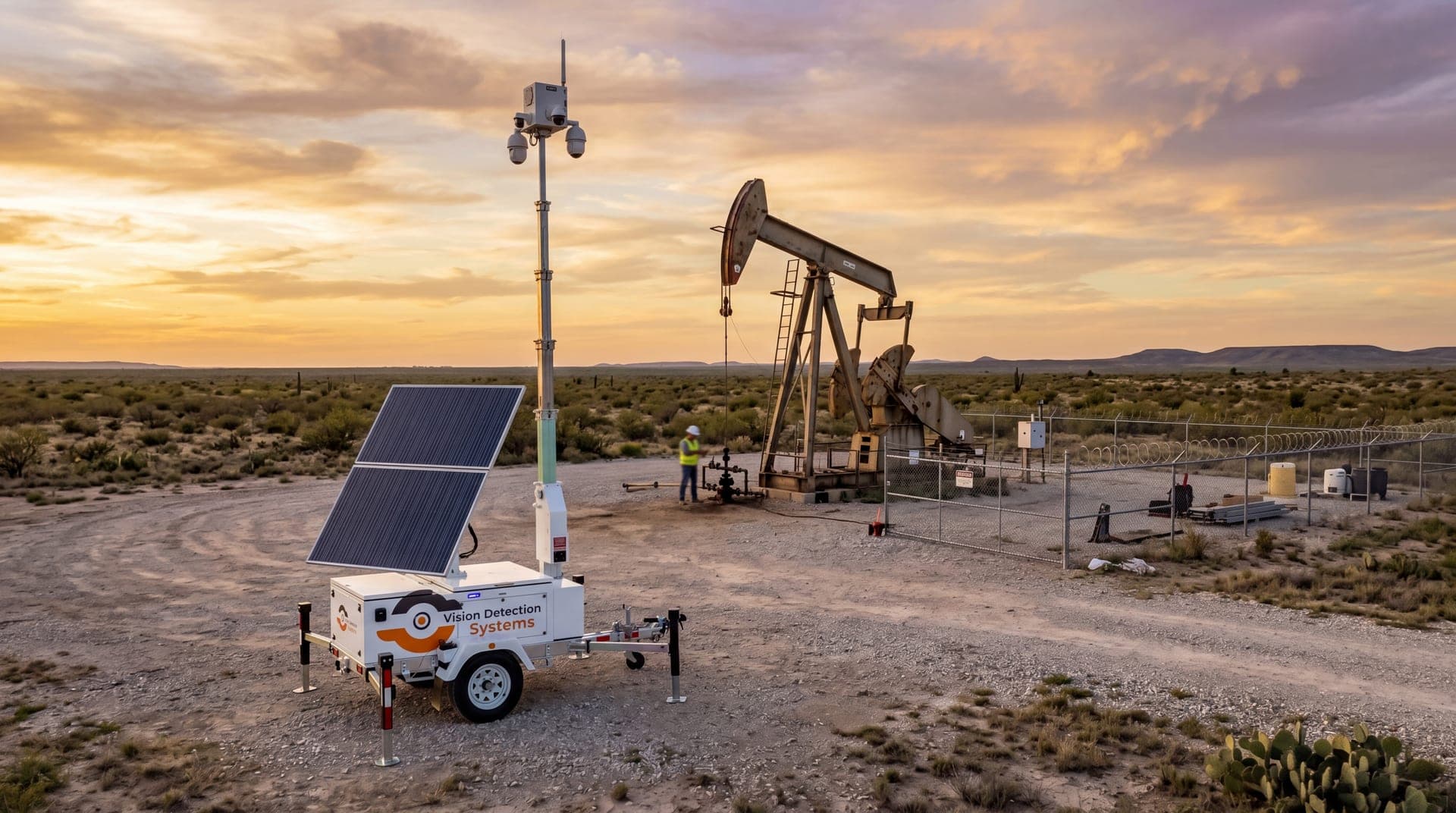
One way to simplify this is to place cameras outside the classified area and look in. A tall mast gives a view over fences and equipment without putting electronics inside the boundary. Higher mounting widens the view but reduces facial detail, so pair wide cameras with a zoom camera for identification.
Quick reference
| Layer | What to detect | Practical tool |
|---|---|---|
| Approach | Vehicles stopping near the site | Wide camera view of road and gate |
| Perimeter | People at or on the fence | Analytics, thermal or radar |
| Yard | People and vehicles after hours | Wide view plus PTZ zoom |
| Equipment | Tampering or theft near assets | Close camera view and live verification |
| Response | Confirmed intrusion | Talk-down, then police dispatch with video |
Power, connectivity and uptime
Remote stations often have power for operations but not necessarily for security systems, and cellular signal can be weak. Check what each camera needs: power, a network path and a plan for outages. Our article on surveillance trailer uptime explains the questions to ask about batteries, solar sizing and connectivity.
A self-powered, cellular-connected unit does not depend on the station's own supply, which is helpful when a station is being built, expanded or taken offline for maintenance. It also keeps working if the site loses power.
Know what normal looks like
Unmanned sites still have scheduled visits from technicians, inspectors and contractors. Give the monitoring team a visit calendar and a list of authorized vehicles and contacts. That prevents unnecessary escalations and makes unexpected activity stand out. It also gives your operations staff confidence that an alert means something. Review the list regularly, because contractors and schedules change.
Response is what makes detection useful
Detection without response is only a log. A research review of closed-circuit television programs found that actively monitored systems were associated with a larger crime reduction than passive recording-only systems, which showed no significant effect.
A response chain for an unmanned station might look like this: the system detects a person, a monitoring team verifies the event on live video, speaks through a loudspeaker, and contacts police with video if the person stays. Your operations staff, or your security partner, then handle the verified incident. The page on remote monitoring describes the process in plain terms.
Write the plan down. Include who is called, who is allowed to authorize police dispatch, what to do when the person appears to be an employee or contractor, and how footage is shared. If your site runs under a security plan or regulatory requirement, confirm what is needed with counsel. Related thinking for linear assets appears in our guide to pipeline right-of-way security.
How VDS fits
VDS builds solar-powered mobile surveillance trailers. Each unit carries a 5MP PTZ camera with 25x optical zoom and three 8MP wide-angle cameras on a 22 ft telescopic mast (30 ft available). A 900W bifacial solar array charges an 11.8 kWh LiFePO4 battery bank with reserve for 3 to 5 consecutive cloudy days, and dual-SIM 4G/5G cellular carries the video. No site power, internet or trenching is needed.
AI detection covers people, vehicles, loitering, objects and license plates. Our 24/7 US-based security operations center verifies events, uses live talk-down through a loudspeaker, then dispatches police with video. Hardware is NDAA Section 889 compliant. Most deployments go from signed quote to live monitoring in about a week, and on-site setup takes one person under 20 minutes. Rental, month-to-month and term subscriptions are available. See the mobile surveillance unit, contact our team, or call (410) 401-1986.
Sources
- Piza, E. L., Welsh, B. C., Farrington, D. P., & Thomas, A. L. (2019). CCTV surveillance for crime prevention: A 40-year systematic review with meta-analysis. Criminology & Public Policy, 18(1). onlinelibrary.wiley.com