
Why mobile home parks are hard to secure
A mobile home park is a residential community laid out like a small town. It has streets, shared amenities, parked vehicles, storage areas and often a few acres of open ground, all under one manager or owner. Unlike an apartment building, there is no single structure to wire, and unlike a retail lot, there is no closing time when everyone leaves.
Several things make coverage difficult:
- Long internal roads and scattered homes mean no single vantage point sees everything.
- Underground utilities are often old, shared or poorly mapped, which makes trenching for camera cable risky and slow.
- Residents come and go at all hours, so motion alone does not tell you who belongs.
- Management offices are often staffed during the day only.
- Budgets are usually tight, and capital projects need owner approval.
None of this is unusual for property managers. It does mean that a plan built for a single building or a fenced yard will not fit as is.
Start with the entrances
Most parks have only one or two vehicle entrances. That is an advantage. Anyone who drives in, and anyone who drives out with something that is not theirs, passes the same point.
Place a camera so it sees each vehicle at a slow, predictable point, such as just inside the entrance where traffic must slow for a speed bump or a turn. If you want readable plates, the camera needs a tight angle and enough pixels on the plate. Setup values like roughly 20 to 30 pixels of plate height and a shutter of 1/1000s or faster for moving vehicles are standard for plate capture.
Plate capture also helps with a common management problem, which is identifying vehicles that dump trash, abandon cars or return after being asked to leave. Keep in mind that retention and sharing rules vary by state, so confirm your policy with counsel.
Fix the lighting before adding more cameras
Cameras need light to produce useful video, and residents need light to feel safe walking at night. Dark corners near mailboxes, laundry rooms, dumpsters and the far ends of streets are common trouble spots.
Walk the park after dark with a manager and a few residents. Note where you cannot see a face at 30 feet. Then work through the basics covered in our security camera lighting guide, including even coverage, avoiding glare into lenses, and white light versus infrared at night. Better lighting helps people and cameras alike.
Choose camera locations by risk, not by square footage
It is tempting to spread cameras evenly. A better method is to list the places where incidents actually happen or would be costly, then cover those first.
| Location | What to watch for | Camera approach |
|---|---|---|
| Entrances and exits | Unknown vehicles, dumping, theft in transit | Plate-capable view of each lane |
| Mailboxes and package areas | Mail theft, tampering | Close, well-lit view, wide field |
| Dumpsters and storage | Illegal dumping, break-ins | Wide-angle with night coverage |
| Office and maintenance yard | Tool and equipment theft | Fixed view plus after-hours monitoring |
| Playgrounds and pools | After-hours trespass, vandalism | Wide view of the approach and fence line |
| Back roads and fence lines | Unauthorized access | PTZ or wide-angle covering long lines |
For more on the shared-space side, see our guide to HOA community security cameras, which covers many of the same common-area questions.
Handle privacy and resident trust openly
Residents live here. Cameras that point at front doors and windows will create complaints and may create legal exposure. Aim cameras at roads, entrances, common areas and parking. Avoid private yards and windows.
Tell residents what is covered, who can view footage, how long it is kept and how to ask questions. Post signs at entrances and common areas, and keep the wording plain. Rules on notice, audio and recording vary by state, so confirm your approach with counsel before you install anything.
Plan for cameras with no power or network
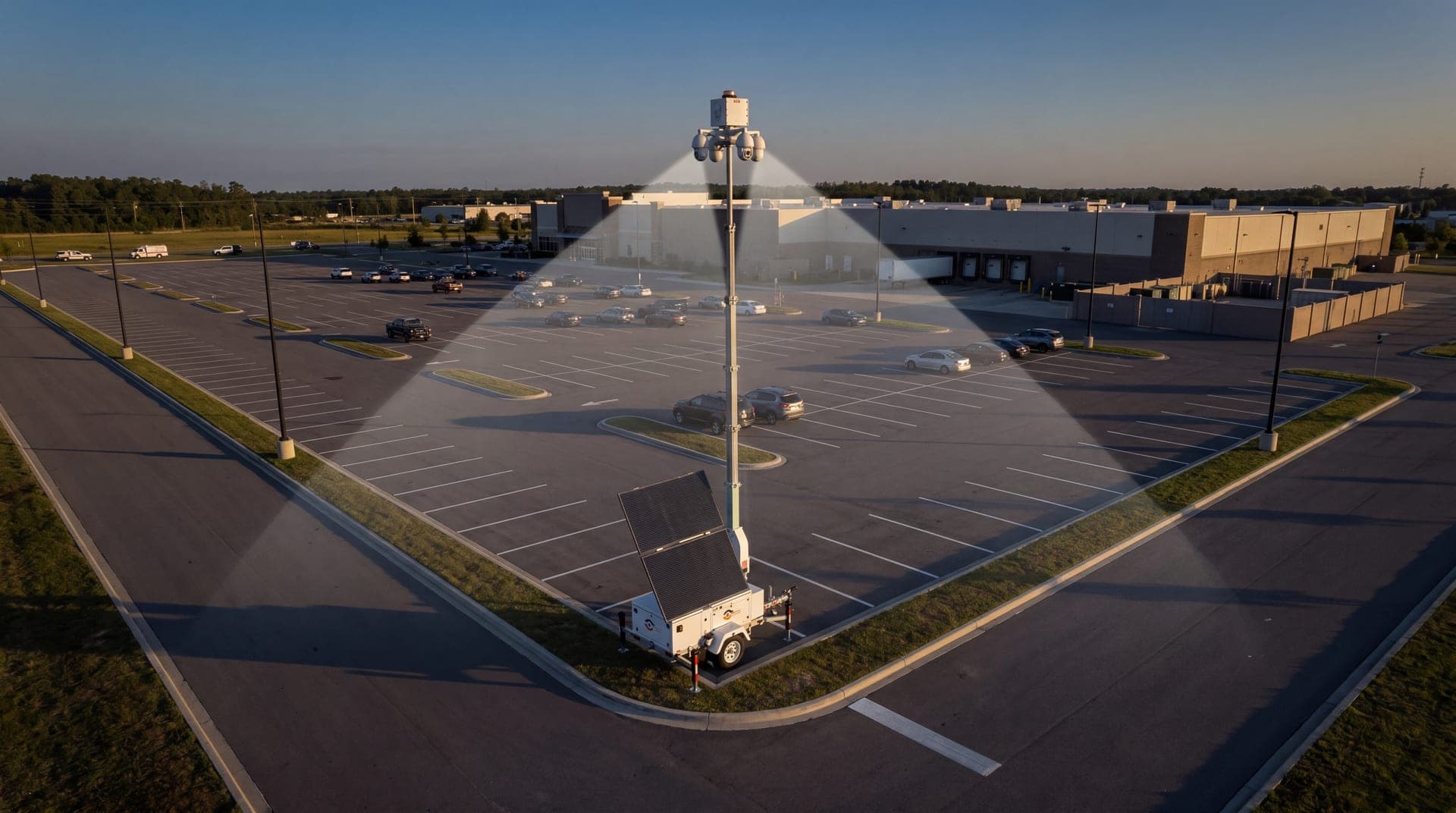
Many parks cannot easily support wired cameras. Trenching across lots and under roads is expensive in time and disruption, and the existing electrical service may not have capacity for extra loads. A trailer that carries its own power and cellular connection removes both problems. Our overview of security cameras without WiFi or power explains how that works and what to ask a provider.
A mobile unit can also move. If a problem area shifts, such as a new dumping spot or a vacant lot that starts attracting trespassers, the unit can be repositioned instead of rewired.
Put someone behind the cameras
A camera that only records helps after the fact. The research on public-area video points the same way. A 2019 systematic review found that actively monitored systems were associated with about a 15% reduction in crime, while passive recording-only systems showed no significant effect.
For a park with a small office staff, that means monitoring matters as much as the camera. A monitoring provider can watch video overnight, verify what an alert is, speak to people through a loudspeaker and call police with video when needed. That way, your manager and any security partner you use can focus on verified incidents instead of watching screens or chasing false alarms. For background on how the model works, read what remote video monitoring is.
Work with residents as partners
A park runs on relationships. Residents see problems first, and they are more likely to report them when management listens and acts. Hold a short meeting when you add cameras or lighting, explain what is covered and what is not, and give residents a number to call for concerns.
Encourage neighbors to report abandoned vehicles, repeated loitering and broken lights. Fix what you can quickly and tell residents what you did. Visible follow-through builds trust and makes the security plan feel like a service, not a surveillance program.
How VDS fits
VDS builds solar-powered mobile surveillance units for places that have no site power, internet or trenching. Each unit carries a 5MP PTZ camera with 25x optical zoom and three 8MP wide-angle cameras on a 22 ft telescopic mast. A 900W bifacial solar array charges an 11.8 kWh LiFePO4 battery bank with reserve for 3 to 5 consecutive cloudy days, and dual-SIM 4G/5G cellular carries the video.
AI detection flags people, vehicles, loitering, objects and license plates. Our 24/7 US-based security operations center verifies events, uses live talk-down through a loudspeaker, then dispatches police with video if needed. Most deployments go from signed quote to live monitoring in about a week. See the mobile surveillance unit page, or talk to our team or call (410) 401-1986 to walk through your park.
Sources
- Piza, E. L., Welsh, B. C., Farrington, D. P., & Thomas, A. L. (2019). CCTV surveillance for crime prevention: A 40-year systematic review with meta-analysis. Criminology & Public Policy, 18(1). onlinelibrary.wiley.com