
What makes a temporary deployment different
A permanent battery storage facility is designed with fencing, lighting, communications and monitoring from the start. A mobile deployment is often the opposite. It may be a containerized or trailer-mounted unit parked for a few weeks or months to support an event, a construction project, a grid need or an outage. The site may be a gravel lot, a corner of a larger property or a roadside parcel.
That creates a set of problems.
- No permanent fence, or one that was not built for this equipment.
- No power or network at the spot where the unit sits.
- Limited lighting.
- No staff on site after hours.
- A short timeline, so the security plan is made after the equipment arrives.
- Changing site conditions as other work goes on nearby.
Our guide to battery energy storage site security covers permanent facilities. This article focuses on what changes when the site is temporary.
The risk picture
Mobile storage units face the same crimes as other valuable equipment, along with concerns specific to energy storage.
| Risk | What it looks like | Why it matters here |
|---|---|---|
| Theft of equipment or cabling | Cut cable, stripped metal, removed components | Valuable metals and parts are attractive targets |
| Vandalism | Graffiti, damage to enclosures, broken lights | Damage can affect operation and safety |
| Unauthorized access | Climbing, opening doors, tampering | Interference with energy equipment is a safety concern |
| Vehicle impact | A vehicle striking the unit | Possible damage to a battery enclosure |
| Fire or smoke | Visible smoke or flame | Early awareness supports an emergency response |
| Trespass and loitering | People spending time near the unit | Often the start of the other events |
None of this means incidents are common. It means the consequences of an incident can be higher than the equipment's price tag suggests, so awareness is worth more than usual.
Safety comes first
Battery equipment has its own safety systems, clearance requirements and emergency procedures. The manufacturer, the site owner and the authority having jurisdiction set those requirements. Security planning has to work within them. Cameras, lights and signs must not block access for firefighters, obstruct ventilation or cross required clearances.
Share the security plan with the local fire authority where appropriate, and agree on how they will be contacted if an alert looks like smoke or fire. Confirm who has the keys, how access is granted in an emergency and what the first responder needs to know. Cameras that detect smoke or flame can add awareness, and our guide to fire and smoke detection cameras explains their role and limits. They do not replace the equipment's own monitoring or a fire authority's requirements.
Define the boundary
Even a temporary site benefits from a clear boundary. Temporary fencing, barriers or bollards mark the area and slow vehicles and people. Place signs that identify the site as monitored and warn against entry. If you cannot fence the whole area, protect the part that matters most and keep a clear zone around the units, since a clear zone makes it easier to see anyone approaching.
Lighting helps in two ways. It deters, and it improves video quality. Temporary light towers or solar lights can fill in where the site has none, though they should be placed so that they do not shine into camera lenses.
Power and connectivity at the site
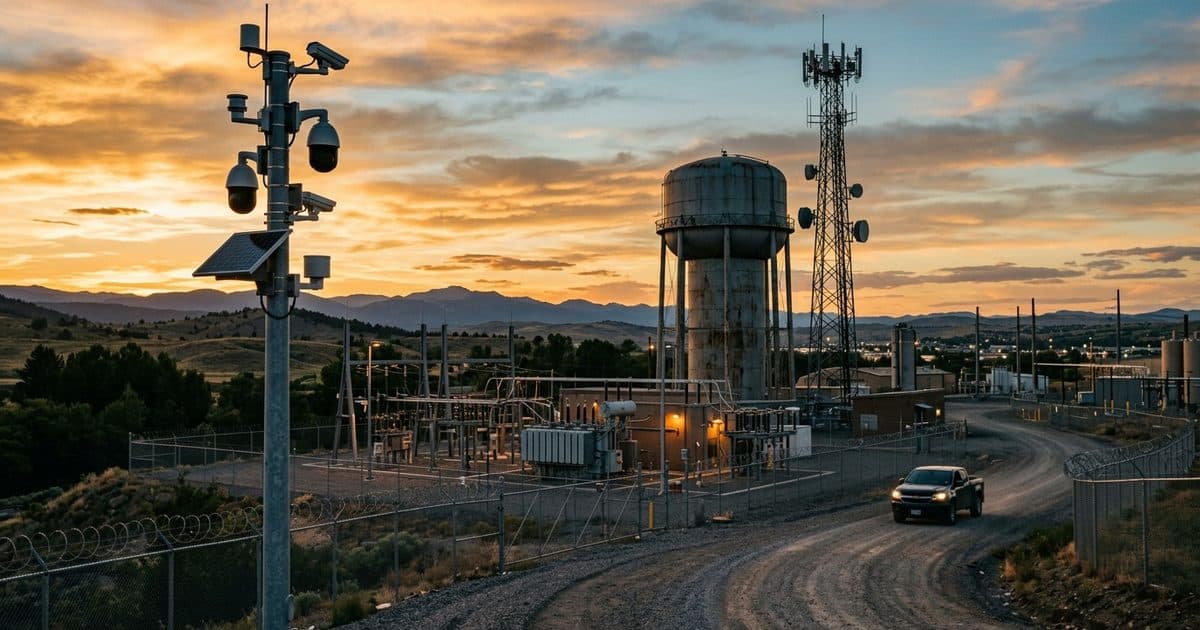
The units may carry their own power, but the cameras that watch them are a separate question. Running cable to a temporary site costs time and money, and the work is wasted when the unit leaves. A solar-powered mobile surveillance unit with cellular connectivity avoids both. Our site selection guide explains how to choose a position with a good view, stable ground and a signal.
For night coverage, thermal imaging can help detect heat and people in darkness. See thermal security cameras for how it works and what to ask a provider.
Monitoring and response
For a temporary site, the response plan matters as much as the hardware. Decide in advance who is called, in what order, and what they are expected to do. Include the equipment owner, the site owner, the monitoring team and local emergency services. Write down the site address in a form that a dispatcher can use, since a gravel lot may not have a street number.
Live monitoring gives the best chance of interrupting an event. A trained operator can see the alert, check the video, speak to a person through a loudspeaker and call for help. A 2019 systematic review found that actively monitored camera systems were associated with about a 15% reduction in crime, while passive recording-only systems showed no significant effect.
Plan for the end of the deployment
A temporary deployment ends, and the security plan should end with it. Set the dates for the cameras and the equipment, plan how the unit will be removed or moved, and make sure monitoring continues until the equipment has left. When the site changes, update the plan and the contacts.
How VDS fits
VDS builds solar-powered mobile surveillance trailers that need no site power, internet or trenching. A 900W bifacial solar array charges an 11.8 kWh LiFePO4 battery bank with reserve for 3-5 consecutive cloudy days, and dual-SIM 4G/5G cellular carries the video. Each unit has a 5MP PTZ camera with 25x optical zoom and three 8MP wide-angle cameras on a 22 ft telescopic mast. AI detection identifies people, vehicles, loitering and objects, and platform analytics pages also exist for fire and smoke.
A 24/7 US-based security operations center verifies events, uses live talk-down and can dispatch police with video. Most deployments go from signed quote to live monitoring in about a week. Rental, month-to-month and term subscriptions are available, which suits short deployments. Read about the utility industry, see the mobile surveillance unit or talk to our team.
Sources
- Piza, E. L., Welsh, B. C., Farrington, D. P., & Thomas, A. L. (2019). CCTV surveillance for crime prevention: A 40-year systematic review with meta-analysis. Criminology & Public Policy, 18(1). onlinelibrary.wiley.com