
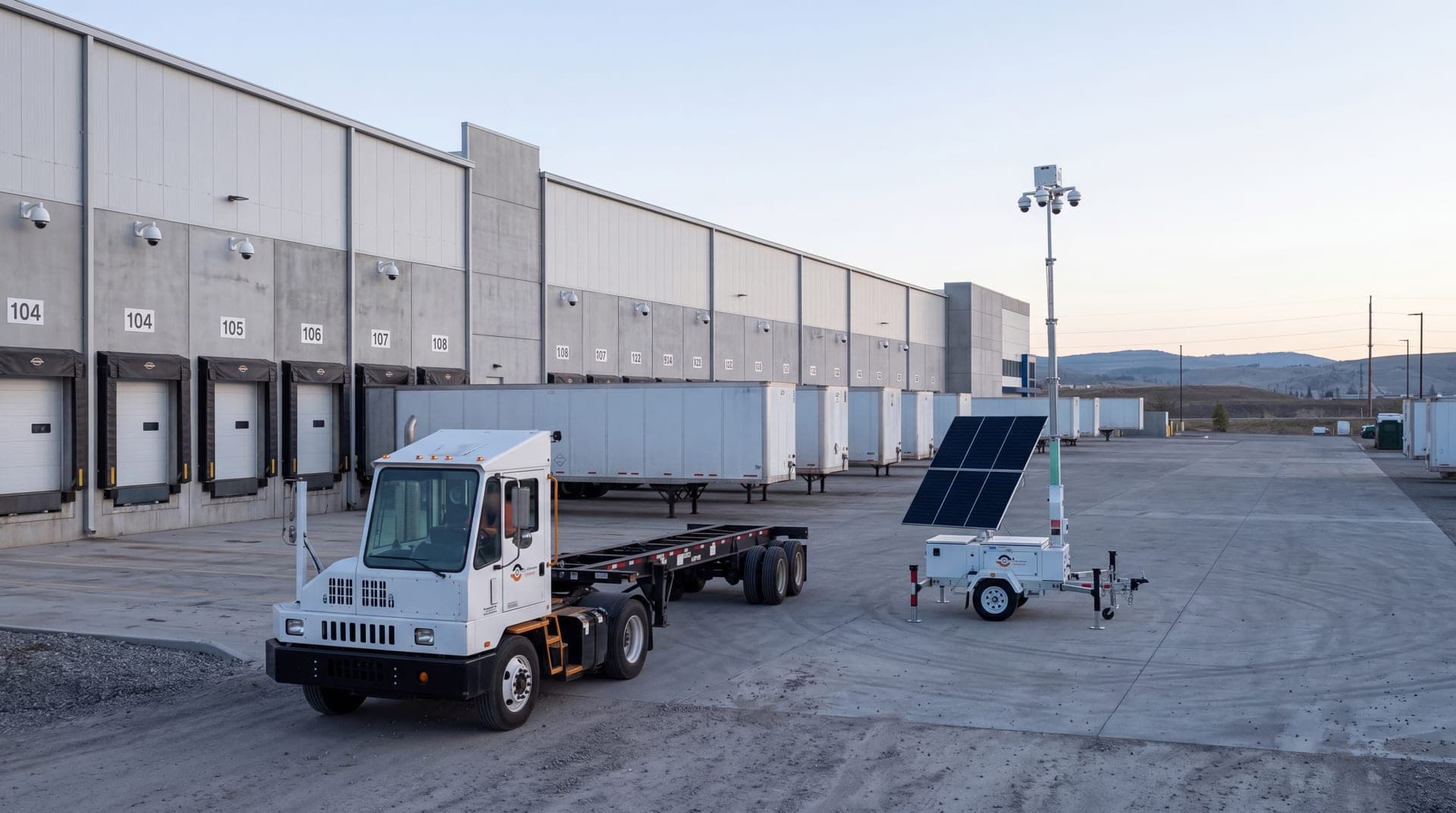
Why plants are harder to secure than they look
A plant is rarely a single tidy building. It is usually a building surrounded by employee lots, truck courts, outdoor storage, utility areas and a long boundary that runs past neighbors, rail spurs or wooded land. Each of those areas has a different risk and a different schedule. A loading dock is busy at 10 a.m. and empty at 2 a.m. The employee lot is full on first shift and nearly empty on third.
Production equipment, finished goods, scrap metal, tooling and raw materials all have resale value, and some of it sits outside. Before buying anything, walk the property and list what is stored where. The site risk assessment template is a good way to turn that walk into a ranked list.
Zone by zone, what to watch
The table below is a starting point for a typical plant. Your own layout will shift the priorities.
| Zone | Main risk | What good coverage looks like |
|---|---|---|
| Main gate and truck gate | Tailgating, unauthorized vehicles, plate-less entries | A view of the approach lane and plate capture angle, with entry and exit logged |
| Shipping and receiving docks | Product theft, trailer tampering, paperwork fraud | Clear views of dock doors, trailer positions and the staging area |
| Fence line | Cutting, climbing, dumping items over the fence | Corner coverage plus a PTZ or mobile unit for long runs |
| Outdoor storage and scrap | Metal theft, pallet and material theft | Wide-angle view with night illumination or infrared |
| Employee lots | Vehicle break-ins, employee safety | Even coverage of rows and walkways, with lighting |
| Utility and roof access | Copper and equipment theft, vandalism | Dedicated view of equipment pads and ladders |
The fence line
Most plants cannot afford a camera every few dozen feet, and they do not need one. The practical approach is to cover the places where a person is likely to cross or stage: corners, gates, spots hidden from the building, and stretches that back onto roads or open land.
For the long gaps in between, a PTZ camera can sweep a wide area, and AI detection can flag a person near the fence at an hour when nobody should be there. Read more about the options in our guide to perimeter intrusion detection systems. Lighting matters here too. A camera can only show what it can see, so confirm your fence line has either white light or infrared coverage that fits the camera.
Shipping docks and the paperwork side of theft
Dock theft is not always a person climbing a fence. It can be a driver loading extra pallets, a trailer left unlocked overnight, or a seal that is swapped. Video helps because it ties a time and a door to an event. Point cameras at the dock doors, the trailer positions and the staging lanes, and keep the view wide enough to show who is standing near the load.
Match your retention period to how long it takes to notice a discrepancy. If inventory counts happen weekly or monthly, a few days of stored video may not be enough. Our article on how long security cameras should keep footage covers the tradeoffs. For related building-level coverage, see warehouse security cameras.
Lighting and camera choice at the dock
Docks often combine bright door lights with dark trailer interiors, a hard scene for any camera. Backlit scenes can turn a person standing in front of a lit doorway into a silhouette. Wide dynamic range processing and well-aimed fixtures reduce that problem, and it is worth testing the view at night, not just on the day of installation. Ask whoever installs the system to show you a nighttime still from each dock camera before sign-off.
After-hours coverage
Nights, weekends and shutdown weeks are when a plant is quiet and a small crew can work unnoticed. A fixed schedule helps. Define when the site is considered closed, and set detection rules to match. A person in the truck court at noon is normal. A person in the same spot at 1 a.m. is not.
Recorded video alone does not stop that event. A monitoring center that sees the alert, verifies it on camera and speaks to the person through an on-site loudspeaker can end the situation in seconds. Our overview of after-hours security for businesses explains how this layering works, and the article on live talk-down audio covers the voice step.
Shift change
Shift change compresses a lot of activity into a short window. The gate is open, vehicles are queuing, people are carrying bags, and attention goes to traffic flow. That is a good time to piggyback through a gate, to pull a vehicle into the lot unnoticed, or to remove material in a personal vehicle.
A few practical steps:
- Put a camera on the gate approach and one on the exit so you can review both directions.
- Stagger gate openings if you can, so arrivals are not bunched up.
- Keep plate capture running at the gate so vehicle entries have a record.
- Review video from shift change after any inventory discrepancy.
None of this requires treating employees as suspects. It simply gives the plant a reliable record when something goes missing.
Checking that coverage actually works
A camera plan is only as good as its follow-through. Once the cameras are up, test them the way a trespasser would. Walk the fence line at night and see which stretch is invisible. Park a vehicle at the far edge of the lot and check whether you can read its plate on playback. Review a week of dock video and see whether you could settle a disputed shipment from it alone. Fix the gaps now, while a gap is only an inconvenience.
Also assign an owner. Someone should be responsible for reviewing alerts, checking that cameras are recording, cleaning lenses and updating the schedule when shifts change. Perimeter systems that nobody owns drift out of focus within a season.
Industrial parks and shared perimeters
Some plants sit inside a larger park with shared roads and neighbors. In that case your perimeter decisions overlap with the park's. Agree on who owns which cameras and how footage is shared. The guide to industrial park security cameras covers common arrangements.
Where VDS fits
Not every corner of a plant has power or network. A VDS mobile surveillance unit is a solar-powered trailer with a 5MP PTZ camera with 25x optical zoom and three 8MP wide-angle cameras on a 22 ft telescopic mast, with dual-SIM 4G/5G cellular. It needs no site power, internet or trenching, so it can cover a remote fence line, a laydown yard or a temporary gap while permanent cameras are planned. AI detects people, vehicles, loitering and license plates, and our 24/7 US-based security operations center verifies events and responds with live talk-down before police dispatch with video. You can see the specifications on the mobile surveillance unit page, or talk to our team about your site.