
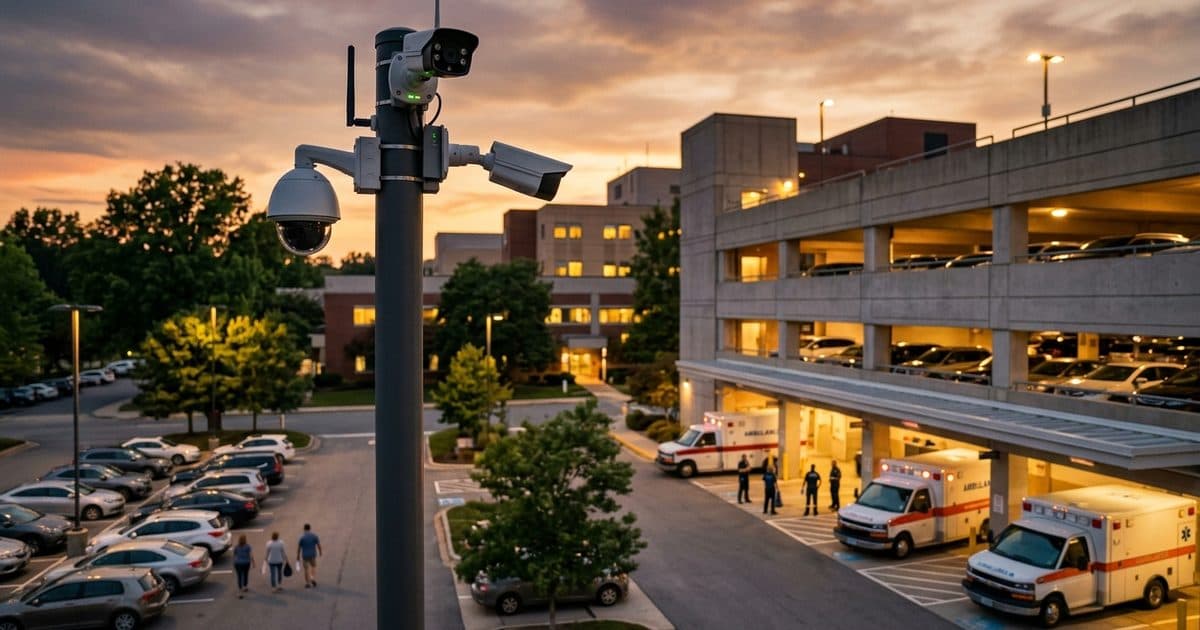
Why healthcare security is a different problem
A hospital or clinic is open around the clock, welcomes the public, and treats people on some of the worst days of their lives. That combination creates real safety concerns. Staff leave at all hours and walk to lots that may be far from the building. Emergency entrances see stressed visitors, people in crisis and sometimes people who are intoxicated or aggressive. Supply areas and pharmacies hold items worth stealing.
At the same time, patients have strong privacy expectations. A camera plan that ignores either side fails. The goal is visible, well-placed coverage of public and exterior areas, a clear policy for anything more sensitive, and a response process that works at 3 a.m.
Campus lots and garages
Parking is where a lot of the risk sits, because it is where people are alone and distracted. Think about the walk from the exit door to the car at the end of a long shift. Cameras should cover the lot rows, the entry and exit lanes, stairwells and elevator lobbies in garages, and the walking routes between buildings.
Lighting and camera choice work together. A camera needs enough light to produce a usable image, or infrared illumination that fits the lens. Our guide to hospital parking garage security goes deeper on garage layouts, and the research on parking lots is encouraging. A 2019 systematic review found parking-lot camera programs associated with about a 37% reduction in crime, though the same review found monitored systems outperform recording-only systems.
Emergency entrances and ambulance bays
The emergency department entrance deserves its own plan. It needs clear views of the doors, the vestibule approach, the drop-off lane and the ambulance bay, with enough resolution to identify what happened if an incident is reviewed. Mounting height matters: higher cameras see more area but show less facial detail, so many sites pair a wide view with a closer one at the door.
Staff in these areas often need to call for help quickly. Cameras do not replace on-site security, but a live video feed gives responding staff a better picture of what they are walking into. Define in advance who is called, in what order, and what the camera operator can see. The security incident escalation matrix is a useful template for that conversation.
Staff safety
Workplace violence is a recognized concern in healthcare, and cameras are one layer among several. Others include lighting, door controls, staff training, panic buttons and security presence. For cameras, a few principles help:
- Cover entry points, waiting areas that are open to the public and approaches to staff entrances.
- Make cameras visible. Signage and visible equipment support deterrence and set expectations.
- Keep a clear record of incidents so they can be reviewed with HR, security and, when needed, police.
- Use live monitoring where it fits, so someone is watching during the hours when staff are most isolated.
Privacy considerations
This is the part that most needs a careful, local answer. Rules on video in healthcare settings vary by state, by facility type and by what the camera can see and record. Audio recording is often regulated separately from video. Policies on patient rooms, restrooms, changing areas and behavioral health units are typically much stricter than on exterior lots. Confirm your approach with counsel and your privacy officer before you install anything beyond public and exterior areas. Our overview of business security camera laws covers the general landscape.
Several practical tools reduce risk:
- Aim cameras so they do not capture windows, treatment rooms or private areas.
- Use privacy masking to block out parts of the image that should never be recorded.
- Limit who can view and export footage, and keep an access log.
- Set retention periods in writing and follow them.
Building the response plan
Cameras are only half of the picture. Decide, in writing, who receives an alert, who is allowed to view live video, what a monitoring operator may say through an outdoor speaker and when police are called. Healthcare campuses often have their own security staff, local police relationships and sometimes a mix of owned and leased buildings, so responsibilities need to be clear before an incident, not during one.
Test the plan with a drill. Ask what a night-shift nurse should do if she sees someone following her to her car, and make sure the answer involves a camera someone is actually watching.
Quick reference for planning
| Area | Typical goal | Notes to confirm |
|---|---|---|
| Staff and visitor lots | Deterrence and incident record | Lighting, plate coverage at lot entries |
| Garages and stairwells | Staff and visitor safety | Camera height, blind corners |
| ER entrance and ambulance bay | Incident review, situational awareness | Audio rules, signage |
| Pharmacy and supply docks | Theft prevention | Access control and retention |
| Interior patient areas | Case by case | Counsel and privacy officer approval |
| Temporary and overflow areas | Short-term coverage | Mobile units, construction zones |
Hospitals are often under construction somewhere. A new wing, a parking structure or a utility upgrade creates a work zone with equipment, materials and open access points next to an occupied campus. See hospital construction site security for how to handle that overlap.
Where VDS fits
For lots, overflow areas, construction zones and any part of a campus that lacks power or network, a VDS mobile surveillance unit can provide coverage. It is a solar-powered trailer with a 5MP PTZ camera with 25x optical zoom and three 8MP wide-angle cameras on a 22 ft telescopic mast, with dual-SIM 4G/5G cellular and no need for site power, internet or trenching. AI detects people, vehicles, loitering and license plates, and our 24/7 US-based security operations center verifies events, speaks through a loudspeaker, then dispatches police with video if needed. VDS hardware is NDAA Section 889 compliant. Learn more about our healthcare solutions, see the mobile surveillance unit, or talk to our team.
Sources
- Piza, E. L., Welsh, B. C., Farrington, D. P., & Thomas, A. L. (2019). CCTV surveillance for crime prevention: A 40-year systematic review with meta-analysis. Criminology & Public Policy, 18(1). onlinelibrary.wiley.com