
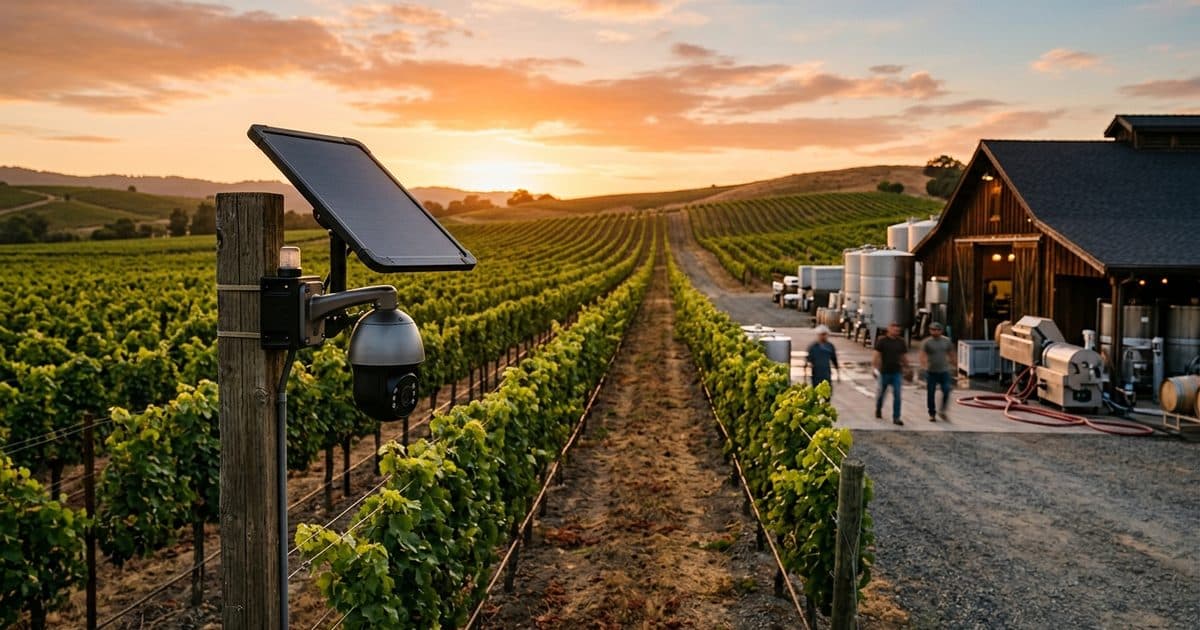
Wine estates are built to be beautiful and open, which is exactly what makes them hard to secure. The tasting room sits at the front, wired for power and usually the only building with cameras. Behind it, acres of vineyard blocks, a remote equipment barn, a barrel room or cellar, and miles of drip irrigation stretch out with no fence line, no lighting, and often no power at all. A thief who wants a tractor, a spool of copper, or a case of finished wine doesn't need to beat a security system — they just need to walk past the one building anyone's watching. This post covers the threats specific to vineyards and wineries, why fixed CCTV never gets past the tasting room, what a coverage plan for the whole estate looks like, and how solar-autonomous surveillance with gate LPR, fire & smoke detection, and live monitoring closes the gap.
The Threat Landscape at Vineyards and Wineries
The most common loss at a wine estate starts at the equipment barn. Tractors, sprayers, and other vineyard equipment sit in an outbuilding that's often the least protected structure on the property — no power run to it, no cameras, no one nearby after the crew leaves for the day. A trailer backs up, a tractor gets hitched, and it's gone before anyone notices it's missing, sometimes not until the next morning's work is supposed to start.
The vineyard blocks themselves carry a quieter but steady loss: copper wiring and drip irrigation line run for miles through the rows, entirely out of sight of any building, and a few hours of undisturbed work can strip a row bare. During harvest, the exposure changes shape — ripe fruit itself becomes a target for opportunistic picking, and the seasonal labor and contractor traffic that harvest brings make it harder to tell who's supposed to be on the property at all. Meanwhile the barrel room, cellar, and tasting-room retail floor hold the estate's highest-value finished product: cases of wine and barrel inventory that represent months of work, sitting in buildings that close for the night with a lock and not much else. Add trespass across open acreage with no perimeter to speak of, and a wine estate ends up exposed on every front at once — equipment, infrastructure, inventory, and the land itself.
There's a fifth risk layered on top of all of it in fire-prone wine country: wildfire. A vineyard estate's remote structures and open acreage put it on the front line of smoke and fire exposure, and the same lack of on-site staff that lets theft go unnoticed for hours can just as easily let a fire go undetected until it's already spreading.
Why Fixed CCTV Never Gets Past the Tasting Room
Most estates that install security start with the tasting room, because that's where the power and the network connection already are. It's a reasonable starting point and a real gap everywhere else. The equipment barn, the far vineyard blocks, and the cellar are exactly the structures a fixed CCTV system struggles to reach, because getting a wired camera to a remote outbuilding means trenching conduit and running power across ground that was never built for it.
| Capability | Fixed CCTV | Solar Mobile Surveillance |
|---|---|---|
| Coverage | Clustered at the tasting room; barns and blocks go unwatched | Elevated wide-area coverage across barns, blocks, and the gate |
| Remote structures | Requires trenching and power runs to reach — rarely done | Solar and cellular — deploys at the barn or block with no power hookup |
| Response | Passive recording reviewed after equipment or inventory is missing | Live SOC verification and audio warning in real time |
| Wildfire exposure | Not addressed; separate system, separate cost | Fire & smoke analytics on the same units already deployed |
| Seasonal flexibility | Fixed; new blocks or a new barn mean new install work | Relocatable as harvest season and risk shift |
The deeper gap, as with any fixed system, is response. Footage that confirms a tractor was hitched and towed away overnight documents a loss it does nothing to prevent. What changes the outcome is a system that detects the movement as it happens, verifies it, and puts a voice on the property before the equipment ever leaves the barn.
Tip: Don't stop coverage at the tasting room. The equipment barn and the vineyard blocks nearest the road are where losses actually happen, and they're usually the structures with the least existing infrastructure — which makes solar-autonomous coverage, not another wired camera, the right tool for exactly those locations.
What a Coverage Plan Looks Like for a Wine Estate
An effective plan treats the estate as more than the tasting room. For a typical vineyard property it includes:
- The estate gate, with LPR: The one point nearly every vehicle passes through. License plate recognition at the gate ties every entry and exit to a plate and a timestamp, so tractors, delivery trucks, seasonal crews, and visitors are all logged, and unfamiliar traffic stands out immediately.
- The equipment barn and outbuildings: The highest-loss structure on most estates. Object detection classifies people versus vehicles and flags movement around the barn after hours, before a piece of equipment is hitched and gone.
- Vineyard blocks and irrigation runs: Open acreage where loitering detection flags people lingering along a row or near irrigation infrastructure when the property should be empty — especially valuable during harvest, when normal foot traffic in the blocks makes unusual activity harder to spot by eye.
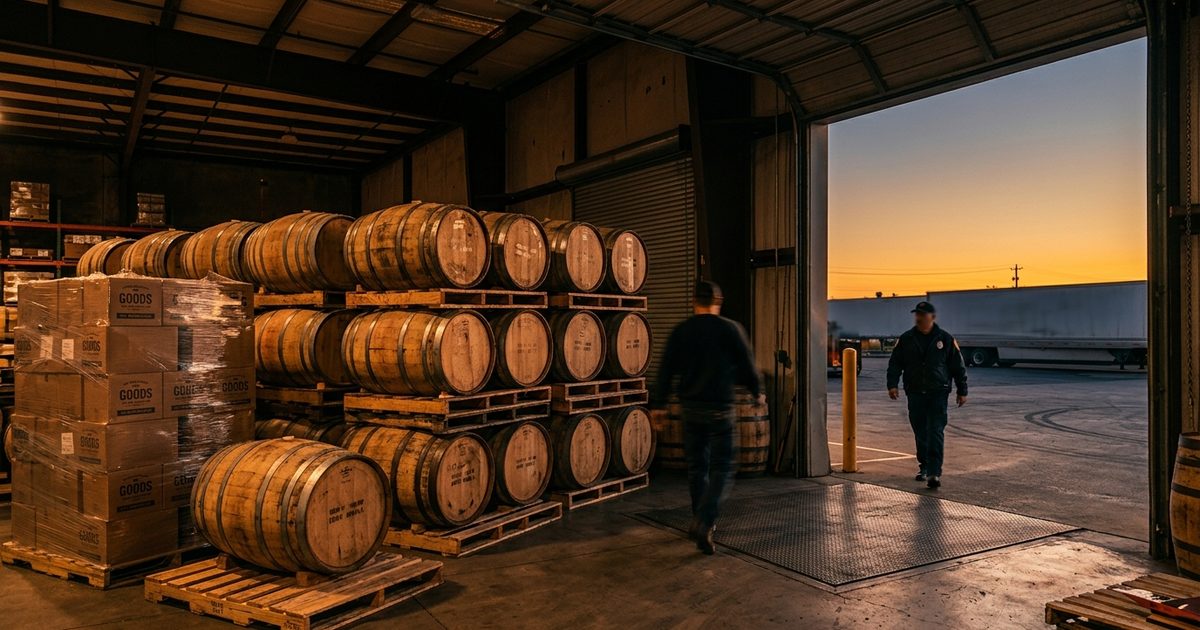
- The barrel room, cellar, and tasting-room retail floor: Where finished inventory concentrates. Dedicated coverage closes the after-hours window once the doors are locked and the crew has gone home.
- Fire & smoke monitoring across the estate: In wildfire-prone regions, fire & smoke detection runs on the same units already covering the barn and blocks, adding an early-warning layer without a separate system or a separate cost.
The element that turns this from a list of cameras into actual protection is on-property presence backed by live response: a visible Mobile Surveillance Unit changes how the estate reads to anyone scoping it, and because it runs on solar power with no grid connection required, it goes wherever the risk is — the barn this month, the far block during harvest — not just wherever the wiring already runs.
Remote Monitoring: A Live Response Where There's No Guard
Staffing a guard across acres of vineyard blocks and a remote equipment barn isn't practical for most estates, and a camera no one is watching stops nothing on its own. Live remote monitoring is the model that actually works at this scale.
Remote video monitoring routes every alert — a vehicle idling near the barn at 1am, movement along a block after close, a smoke signature on a distant ridge — to a SOC operator who verifies it in real time. Once confirmed as a genuine event, the operator issues a live audio warning through the unit's speaker, which alone is often enough to send an intruder back to their vehicle, and escalates to law enforcement or fire response with time-stamped footage and the gate's LPR record of who came onto the property and when. That's a materially different outcome than a recording reviewed the next morning after a tractor is already gone.
The same model scales cleanly for estates with multiple parcels or a portfolio of properties: one SOC standard covers every site, every block, and every barn without hiring and training a guard for each location, and every alert produces a documented record — useful for insurance claims, law enforcement reports, and simply knowing what happened on the property overnight.
Deployment That Matches the Vineyard Calendar
A wine estate's risk doesn't sit still through the year. Harvest brings seasonal crews and contractor traffic. Pruning season shifts activity to different blocks. A dry summer raises wildfire exposure across the whole property at once. A fixed camera system installed once can't follow any of that — it protects wherever it was bolted down on install day and nowhere else.
A relocatable solar-autonomous unit keeps pace with the calendar instead. It can sit at the equipment barn through the off-season, move to cover harvest-season block access and crew traffic, or reposition toward elevated fire risk during a dry stretch — all without trenching, conduit, or waiting on an electrician. Coverage becomes something an estate positions where the risk is this month, not infrastructure frozen in place from the day it went in.
Common Mistakes in Vineyard and Winery Security
- Stopping coverage at the tasting room. The losses happen at the barn, in the blocks, and along the irrigation runs — exactly where fixed coverage never reaches. Weight coverage toward the remote structures and open acreage, not just the building with power already run to it.
- Leaving the equipment barn unwatched. Tractors and vineyard equipment are high-value, mobile, and often sitting in the least protected structure on the property. Treat the barn as a priority, not an afterthought.
- Skipping LPR at the gate. The estate gate is the one chokepoint most vehicles pass through. Without a plate-and-time record, there's no starting point when equipment or inventory goes missing.
- Treating wildfire and theft as separate problems. Fire & smoke detection can run on the same units already covering the estate for theft and trespass — skipping it means paying for coverage twice, or not covering wildfire risk at all.
- Installing once and never repositioning. Harvest, pruning, and dry-season fire risk all shift where an estate's exposure sits through the year. A fixed system installed once falls behind the calendar; a relocatable strategy keeps coverage where the risk actually is.
Wine estates share the same underlying problem as row-crop and ranch operations covered under agriculture security: a lot of valuable, exposed ground, remote structures with no power, and no one on site most hours of the day. The same solar-autonomous, live-monitored model that protects an equipment barn also protects a grain shed or a cattle gate — it's a pattern, not a one-off, for any operation spread across acreage no fixed camera system was ever going to reach.