
Why municipal events need their own plan
A parade, holiday festival, street fair or town celebration turns ordinary public space into a crowded, temporary venue. Streets close, barricades go up, vendors and floats stage in parking lots, and crowds line sidewalks that were not built for them.
Most of the infrastructure that a permanent venue has is missing. There are few fixed cameras along the route, no dedicated command network and no easy way to see across blocks. The people responsible include police, fire, EMS, public works, parks staff, event organizers and volunteers, all working from different radios and plans.
That makes coordination as important as equipment. Before you place any camera, decide who is in charge, who sees video and what each team will do when something happens.
Start with a simple event map
Draw the footprint on one page and mark the following:
- The route, start and end points, and any reviewing stand or stage
- Staging areas for floats, bands, vehicles and vendors
- Barricade and road-closure points
- Public gathering areas, parks and viewing locations
- Parking, shuttle drop-offs and detour routes
- First aid, command post and emergency access lanes
- Places where equipment or barricades will stay overnight
Then mark the hardest places to see by eye, such as bends, bridges, overflow lots and the back of staging areas. Those are the first candidates for temporary cameras. Our overview of mobile surveillance trailers for events explains how to position units on a layout like this.
Decide what cameras are for
Cameras can support several goals, and it helps to pick which ones apply.
| Goal | What cameras provide | Who uses it |
|---|---|---|
| Crowd awareness | Wide view of density and flow | Command post, traffic staff |
| Staging and parking | Visibility of vehicles and gates | Event staff, police |
| Property protection | Overnight watch on stages and barricades | Public works, organizers |
| Incident review | Recorded video of an event | Police, risk managers |
| Deterrence | Visible units with talk-down | Everyone on site |
Be clear that cameras do not replace officers. They extend what a small team can see so people respond to verified incidents instead of scanning crowds. For the broader public safety picture, see our article on how police security cameras enhance public safety.
Use temporary units for public streets and parks
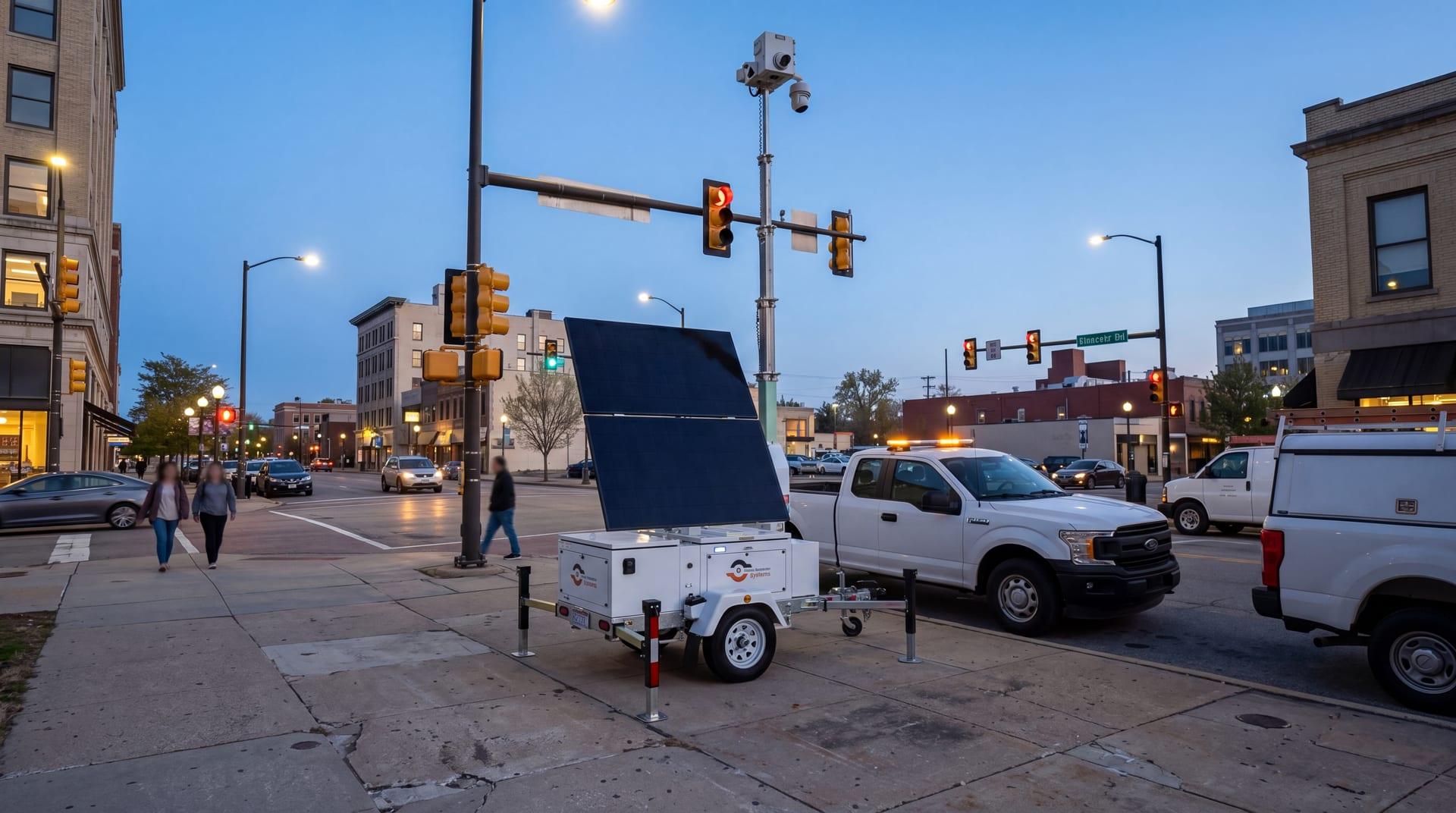
Public streets and parks seldom have power points where you need a camera, and trenching a street for a one-day event makes no sense. A solar-powered trailer brings its own power and cellular connection and can be placed at a staging lot, an intersection, a park entrance or the end of a route.
Because it is mobile, the same unit can serve a different event next month. That is a useful property for a city that runs several large events a year and does not want to install permanent poles at every location. Law enforcement agencies already use trailers like this for many missions. See mobile surveillance trailers for law enforcement for typical uses and what to ask a provider.
Check line of sight, ground conditions, overhead wires and cellular signal when picking spots, and coordinate placement with public works and traffic control so units do not block emergency lanes.
Plan privacy, access and footage sharing
Public events involve public spaces, so transparency matters. Post notice where cameras are in use, and publish a short policy that states who can view live video, how long recordings are kept and how clips are requested.
- Name one point of contact for video requests.
- Decide who at the command post can view live feeds.
- Set a process for handing clips to police, and log each handoff.
- Keep video of the event only as long as your policy and local rules require.
Our guide to how to share security footage with police lists the practical steps. Rules on public-space recording, audio and retention vary by state and locality, so confirm your plan with counsel.
Cover the overnight hours
The parade passes in an afternoon, but the setup does not. Barricades, stages, fencing and sound equipment may arrive a day or two earlier and stay a day after. Those hours have fewer people on site and a higher chance of theft or vandalism.
A 2019 systematic review of 76 studies found actively monitored systems were associated with about a 15% reduction in crime, while passive recording-only systems showed no significant effect. For overnight event protection, that points to monitored coverage rather than recording alone. A monitoring center can verify a person at a stage at 2 a.m., use a loudspeaker and call police with video, so your team deals with verified incidents.
If funding is a barrier, see our overview of security camera grants for public safety, and check current program rules and eligibility directly.
Debrief after the event
When the parade is over, hold a short debrief with police, fire, public works, parks and organizers. Review what the cameras showed, which locations helped and which did not, and what questions came up about video access or sharing.
Write down what to change next time and file it with the event plan. Over several events, those notes become a practical playbook for your city, and they make it easier to explain the program to elected officials and residents. Keep the debrief focused on the plan and the process, not on blame.
How VDS fits
VDS builds solar-powered mobile surveillance units that need no site power, internet or trenching. Each unit has a 5MP PTZ camera with 25x optical zoom and three 8MP wide-angle cameras on a 22 ft telescopic mast. A 900W bifacial solar array charges an 11.8 kWh LiFePO4 battery bank with reserve for 3 to 5 consecutive cloudy days, and dual-SIM 4G/5G cellular carries the video.
AI detection covers people, vehicles, loitering, objects and license plates. The 24/7 US-based security operations center verifies events, uses live talk-down through a loudspeaker and dispatches police with video. NDAA Section 889 compliant hardware matters for agencies using federal funds, and rental, month-to-month and term subscriptions are available. Visit the public safety page, talk to our team or call (410) 401-1986.
Sources
- Piza, E. L., Welsh, B. C., Farrington, D. P., & Thomas, A. L. (2019). CCTV surveillance for crime prevention: A 40-year systematic review with meta-analysis. Criminology & Public Policy, 18(1). onlinelibrary.wiley.com