
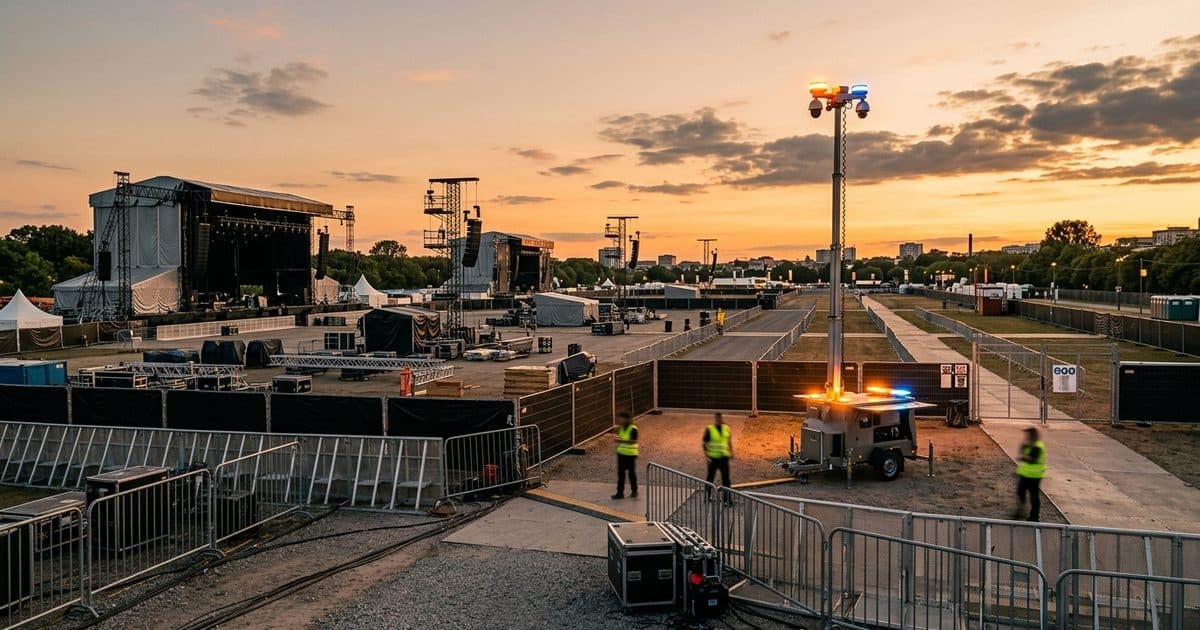
Two security problems in one event
A fair is a temporary city. Large crowds may pass through the gates over a few days, then the grounds go quiet while expensive equipment sits under lights or tarps. The day problem and the night problem need different tools.
Daytime security is about people. Organizers, local police and event staff manage lines, lost children, medical calls, fights and traffic. Cameras help by giving a wider view, but the work is done by staff and officers.
Nighttime security is about property. Rides and trailers are expensive, generators and fuel are attractive targets, and cash-handling booths may hold receipts. Staff are few or absent. This is where monitored cameras add the most.
Map the grounds before you place anything
Before the event, walk the site with the fair manager, the ride operators and public safety contacts. Draw a simple map and mark:
- Public entrances and exits, and any gates for vendors and rides
- The midway, food areas, stages and exhibit buildings
- Ride staging, back lots, storage and where operators park their trailers
- Generator and fuel locations
- Parking areas and drop-off zones
- Fences, open edges and places where visitors could enter without paying
A fair often sits on ground that has some fencing, some open edges and a lot of temporary barriers. Gaps between those are where after-hours trespass happens. See our guide to temporary security cameras for placement thinking that applies when layouts change.
Cover the midway and back lots
The midway is the public face of the event. Cameras with a wide view of the main walkway and the entrances give organizers a view of crowd levels and incidents. A PTZ camera can zoom in on something specific when staff need a closer look.
The back lots are different. Ride trailers, generators and storage are the highest-value assets on the grounds. They are often closely parked, poorly lit and unattended at night. Place cameras so they see the approaches to this area and the vehicles that enter and leave.
Detection tuned for after-hours helps here. When no one should be on the midway or in the back lot, a person or vehicle in view is worth a look. Time-in-zone alerts flag people who linger where they should not.
Handle parking and traffic
Parking is where many visitors have their first and last interaction with the event. Fields and temporary lots do not have cameras, lights or fences, and vehicle break-ins are a common complaint.
A 2019 systematic review of 76 studies found parking lots showed about a 37% reduction in crime associated with CCTV, the strongest result among the settings it examined. Camera coverage of lots is a sound investment for most fairs. For more on layout, see our guide to parking lot security.
Quick reference
| Area | Day concern | Night concern |
|---|---|---|
| Main gates | Crowd flow, queues | Forced entry, trespass |
| Midway | Fights, lost children, medical calls | Vandalism, theft from games |
| Ride staging and back lots | Restricted access | Equipment, fuel and generator theft |
| Parking | Break-ins, traffic | Vehicle theft, loitering |
| Exhibit buildings | Valuable displays | After-hours break-in |
| Perimeter and fence | Gate crashing | Unseen entry |
Work with public safety teams
A fair is a public event, and local police, fire and EMS are usually involved. Share your camera plan with them before the event. Decide who can view video, how to request clips and how to hand off footage after an incident.
Our guide on how to share security footage with police covers the practical side. Rules on recording, retention and sharing vary by state, so confirm your policy with counsel.
Cameras do not replace officers or event staff. They help them see more of the grounds so they can respond to verified incidents faster.
Use mobile units on temporary grounds
Fairgrounds often have power only at certain buildings, and a traveling carnival brings its own generators. Running new cable across a field for a few days is not realistic. A solar-powered trailer is placed once, connects by cellular and can cover a lot, a midway section or a ride area without wiring.
Because the unit is mobile, it can also move with the event. A county fair that runs for a week can have a unit on the midway during the day and shifted to the back lot at night if that is where the risk is. More on this approach is in our article on mobile surveillance trailers for events and the event and temporary sites page.
Coordinate with ride operators and vendors
Carnival operators and fair vendors bring their own equipment, and many have their own routines for locking up. Ask each of them what they leave on site overnight, who holds keys and who to call if an alarm or camera alert involves their gear.
Share the camera plan with them, including where units will sit and what the monitoring center will do if someone is seen near their equipment. A short meeting before opening day prevents confusion later and gives operators a reason to cooperate. Keep a contact sheet for every operator, vendor and fair staff member at the command post.
How VDS fits
VDS builds solar-powered mobile surveillance units for places without site power, internet or trenching. Each unit has a 5MP PTZ camera with 25x optical zoom and three 8MP wide-angle cameras on a 22 ft telescopic mast. A 900W bifacial solar array charges an 11.8 kWh LiFePO4 battery bank with reserve for 3 to 5 consecutive cloudy days, and dual-SIM 4G/5G cellular carries the video.
AI detection covers people, vehicles, loitering, objects and license plates. The 24/7 US-based security operations center verifies events, uses live talk-down through a loudspeaker and dispatches police with video, so your staff and officers handle verified incidents. On-site setup takes one person under 20 minutes. See the mobile surveillance unit, talk to our team or call (410) 401-1986.
Sources
- Piza, E. L., Welsh, B. C., Farrington, D. P., & Thomas, A. L. (2019). CCTV surveillance for crime prevention: A 40-year systematic review with meta-analysis. Criminology & Public Policy, 18(1). onlinelibrary.wiley.com