
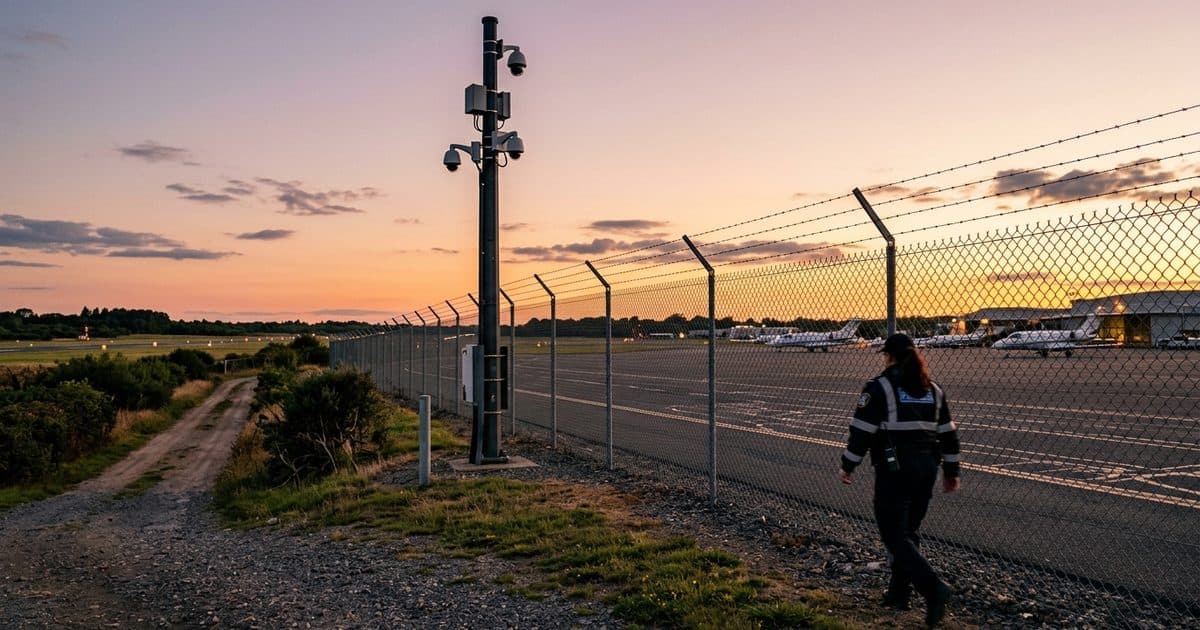
The problem compounds because a fence breach at an airport isn't purely a property-crime question the way it is at most other sites. A person or animal on the airfield is a safety hazard next to an active runway or taxiway, which puts general aviation airports and FBOs under a different kind of pressure than most commercial properties — airport authorities, insurers, and in many cases federal grant conditions expect a real perimeter-monitoring program, not just a fence and a hope. Meanwhile the budget and staffing at a typical regional field or FBO look nothing like a Part 139 commercial airport's security operation. That gap between expectation and resources is exactly where VDS fits.
The Threat Landscape at General Aviation Airports
The defining risk at a GA airport is the perimeter itself. Airfields sit on large, flat parcels with long unbroken fence runs, and the terrain that makes a great runway also makes an easy approach for anyone on foot or in a vehicle looking to get onto the field unseen. A breach isn't abstract — it's a person, a vehicle, or wildlife on active airfield ground, within reach of a taxiway or runway, and every minute that incursion goes undetected is a minute closer to a serious incident rather than a caught one.
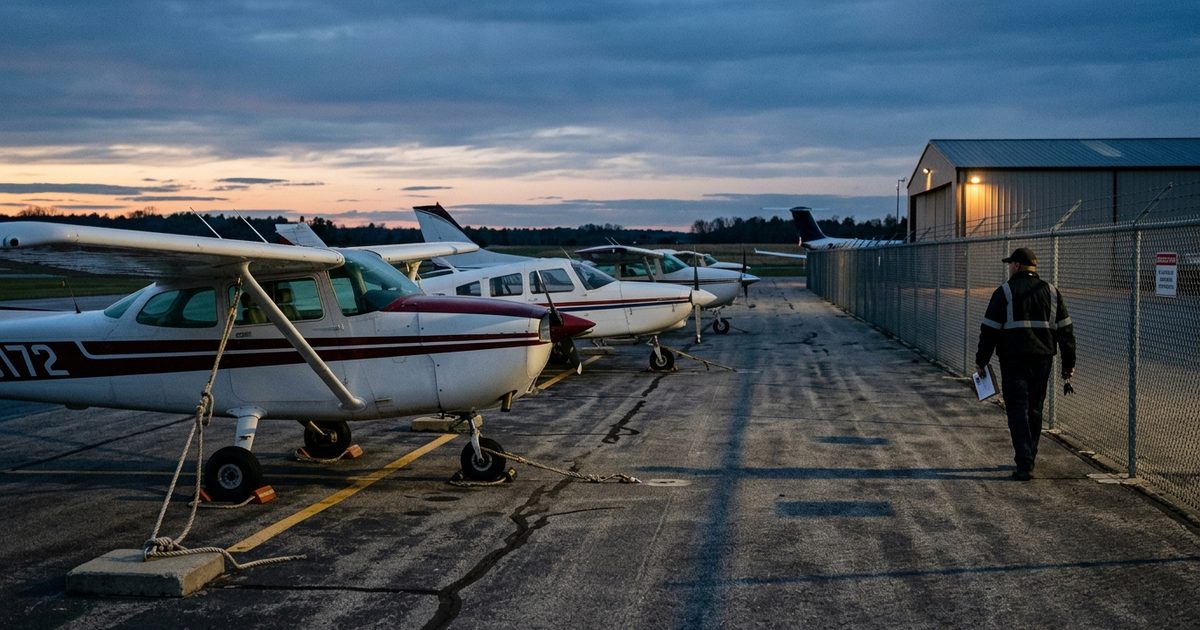
Parked aircraft are the second major exposure. Tie-downs and open ramps hold aircraft worth hundreds of thousands of dollars, and the avionics, batteries, GPS units, and tools inside and around them are portable, resellable, and rarely locked down at the level a fixed-wing owner would want. A ramp with no camera coverage and no overnight staff is, in practice, an unattended inventory of high-value electronics sitting outside all night.
Fuel farms and hangar rows sit at the third layer of risk, usually at the edge of the property, away from the terminal and away from whatever camera coverage exists near the FBO office. Fuel theft is a recurring problem at exactly these isolated tanks, and hangar rows — individual owner hangars as much as corporate ones — see forced entry when a facility goes quiet overnight. Layer on unauthorized ramp access, where a vehicle or individual tailgates through a gate behind a badged car and ends up walking distance from an active aircraft with no one having verified who they are, and a general aviation airport is exposed on every side of the property at once, concentrated in the hours nobody's watching.
Why Fixed CCTV and Fence-Only Security Fail at Airports
Airports are not short on security theory — fencing, lighting, sometimes a card-access gate — but most of that infrastructure was built to a baseline standard years ago and hasn't been extended as the risk picture or the airport's footprint changed. Fixed cameras, where they exist, cluster near the terminal and the main ramp gate because that's where power and conduit were already run. The back half of the perimeter fence, the far tie-down row, and the fuel farm are frequently outside any camera's field of view entirely.
| Capability | Fixed CCTV / Fence Only | Solar Mobile Surveillance |
|---|---|---|
| Coverage | Clustered near terminal/ramp gate; long fence runs unmonitored | Elevated wide-area coverage along the fence line and ramp from one position |
| Far perimeter | Requires trenching and conduit across airfield ground — rarely done | Solar and cellular — deploys anywhere on the property, no wiring |
| Response | A fence slows entry; nobody's notified when it's breached | Live SOC verification and audio warning as the incursion happens |
| Nighttime detection | Unlit fence runs are effectively blind after dark | Thermal and low-light coverage across the whole perimeter |
| Expansion & incidents | Fixed; a new hangar row or an incident means a new install project | Relocatable to a new gap or exposure within days |
The deeper issue is that a fence alone doesn't detect anything — it only slows a determined intruder down, and camera coverage that stops at the ramp gate leaves the rest of the perimeter as a fence with no eyes on it. A recording of an incursion reviewed the next morning does nothing to stop the person from reaching a taxiway that night. What actually changes outcomes is detection that happens in real time, gets verified by a person, and produces an audio challenge before the subject gets any closer to an active surface.
Tip: Weight coverage toward the stretches of fence farthest from the terminal, not the ramp gate you can already see from the FBO office. The gap that gets someone onto the field almost never happens where the lights already are — it happens on the dark, unmonitored run of fence a wired camera system was never extended to reach.
What a Coverage Plan Looks Like for a General Aviation Airport
An effective plan treats the perimeter as the primary asset to protect, not an afterthought behind the ramp. For a typical FBO or regional field it includes:
- The perimeter fence line, especially the unlit runs: Elevated coverage with object detection that classifies person, vehicle, and wildlife, flagging an incursion the moment it happens rather than after a subject is already near a taxiway.
- The vehicle and ramp gates, with LPR: The universal chokepoint onto the airfield. License plate recognition ties every entry and exit to a plate and a timestamp, exposes tailgating, and flags hotlisted vehicles.
- Open ramps and tie-down rows: Where parked aircraft and their avionics sit exposed overnight, covered with loitering detection to flag anyone lingering near an aircraft after hours.
- Fuel farms and hangar rows: The isolated, high-value targets at the edge of the property that deserve dedicated coverage rather than whatever spillover a terminal-area camera happens to catch.
The element that converts a fence and a camera into an actual protection system is on-field presence backed by live response: a visible Mobile Surveillance Unit, paired with a lighting trailer on the darkest stretches of fence, changes how the property reads to anyone probing the perimeter — and it reaches the runs a wired system never got extended to, because a solar-autonomous unit goes where the fence is, not where the conduit runs. The same approach applies directly to critical infrastructure sites and public safety agencies that share the same long-perimeter, low-staff problem.
Remote Monitoring: A Verified Response Instead of a False Dispatch
Airports don't get a pass on a slow response the way a lower-stakes property might — a fence-line alert that turns out to be a deer isn't a problem, but a fence-line alert that turns out to be a person and gets no response is. The model that solves for both sides of that trade-off is live remote video monitoring.
Every perimeter or ramp alert routes to a SOC operator who verifies it in real time before anyone gets dispatched. If it's wildlife, the alert closes with no call to the airport manager at 3am. If it's a person at the fence line, the operator issues a live audio warning through the unit's speaker — an immediate, human challenge that clears most incursions on its own — and escalates to the airport authority or law enforcement with time-stamped footage and, if a vehicle was involved, the gate's LPR record. That verification step is what keeps false dispatches down while making sure a genuine incursion gets an actual response instead of a recording nobody reviews until morning.
For an airport authority managing several fields, or an FBO chain running multiple locations, the same SOC covers every site to the same standard, with monthly incident and access reporting that documents exactly what happened at each gate and each stretch of fence — useful both for insurance and for demonstrating a real perimeter-monitoring program to a granting authority or oversight body.
Deployment: Coverage That Follows the Airfield, Not the Other Way Around
Airfields change — a new hangar row goes up, a taxiway gets reconfigured, a construction project leaves a gap in the fence for months, or an incident exposes a stretch of perimeter that was never a problem before. Fixed camera infrastructure doesn't move with any of that; it stays exactly where the conduit was run on day one.
A relocatable solar-autonomous unit follows the actual risk instead. It covers a construction gap in the fence the week it opens, shifts to the fuel farm after a theft, or provides interim coverage for a stretch of perimeter while a permanent fencing or lighting upgrade is designed and funded — deploying in under 20 minutes with no trenching, no conduit, and no reliance on the airfield's existing electrical infrastructure. For public and federally funded airports, VDS hardware is NDAA-compliant, which matters directly for grant-funded procurement and any airport authority operating under federal restrictions on camera and networking components.
Common Mistakes in Airport Perimeter Security
- Treating the fence as the security system. A fence slows an intruder down; it doesn't detect or respond to one. Without active monitoring, a breached fence is just an open gate nobody knows about.
- Clustering cameras near the terminal. The exposure is at the far fence runs, the fuel farm, and the tie-down rows — exactly where coverage typically thins out or stops entirely.
- Leaving long fence runs unlit and uncovered at night. Airfields are wide open after dark, and an unlit perimeter with no thermal or low-light coverage is effectively invisible until sunrise.
- Skipping LPR at the ramp gate. Without a plate-and-time record of every vehicle onto the airfield, tailgating goes unnoticed and investigations start from nothing.
- Treating perimeter coverage as a one-time install. Airfields expand, construction creates temporary gaps, and risk shifts after an incident. A fixed system installed once falls behind the footprint; a relocatable strategy keeps coverage where the exposure actually is.
General aviation airports sit alongside a small set of long-perimeter, low-staff environments — border and rural land, critical infrastructure sites, and public agencies — where the same solar-autonomous, live-monitored model closes the after-hours gap. See how the same approach applies to border and rural perimeter security, or browse VDS case studies for how it plays out on the ground. If you manage a field or an FBO and want a coverage plan built around your specific perimeter, reach out and we'll walk the layout with you.