
Who Should Own, Lease, or Use Managed Service
There is no universal answer. The right procurement model depends on your staffing, your project timeline, and whether you want to be in the hardware business.
Ownership Makes Sense When
Some organizations genuinely benefit from owning their units. Law enforcement agencies with dedicated operations staff and maintenance capability can absorb the ongoing work. Large construction firms with permanent, in-house security teams who run active sites year-round get utilization rates that justify capital expenditure. Municipalities with in-house IT and maintenance infrastructure can manage connectivity, repairs, and storage without contracting it out. If you have the staff, the technical depth, and consistent deployment demand—ownership can work.
Leasing Fits Specific Scenarios
Leasing is most appropriate when coverage needs are temporary or seasonal, when your team wants to evaluate the technology before committing capital, or when CapEx constraints force an OpEx approach. It preserves cash, shifts some maintenance obligations to the lessor (depending on the agreement), and gives you an exit when the project ends. Read the lease terms carefully—maintenance responsibility and end-of-term options vary widely between vendors.
Managed Service Fits Most Private-Sector Operators
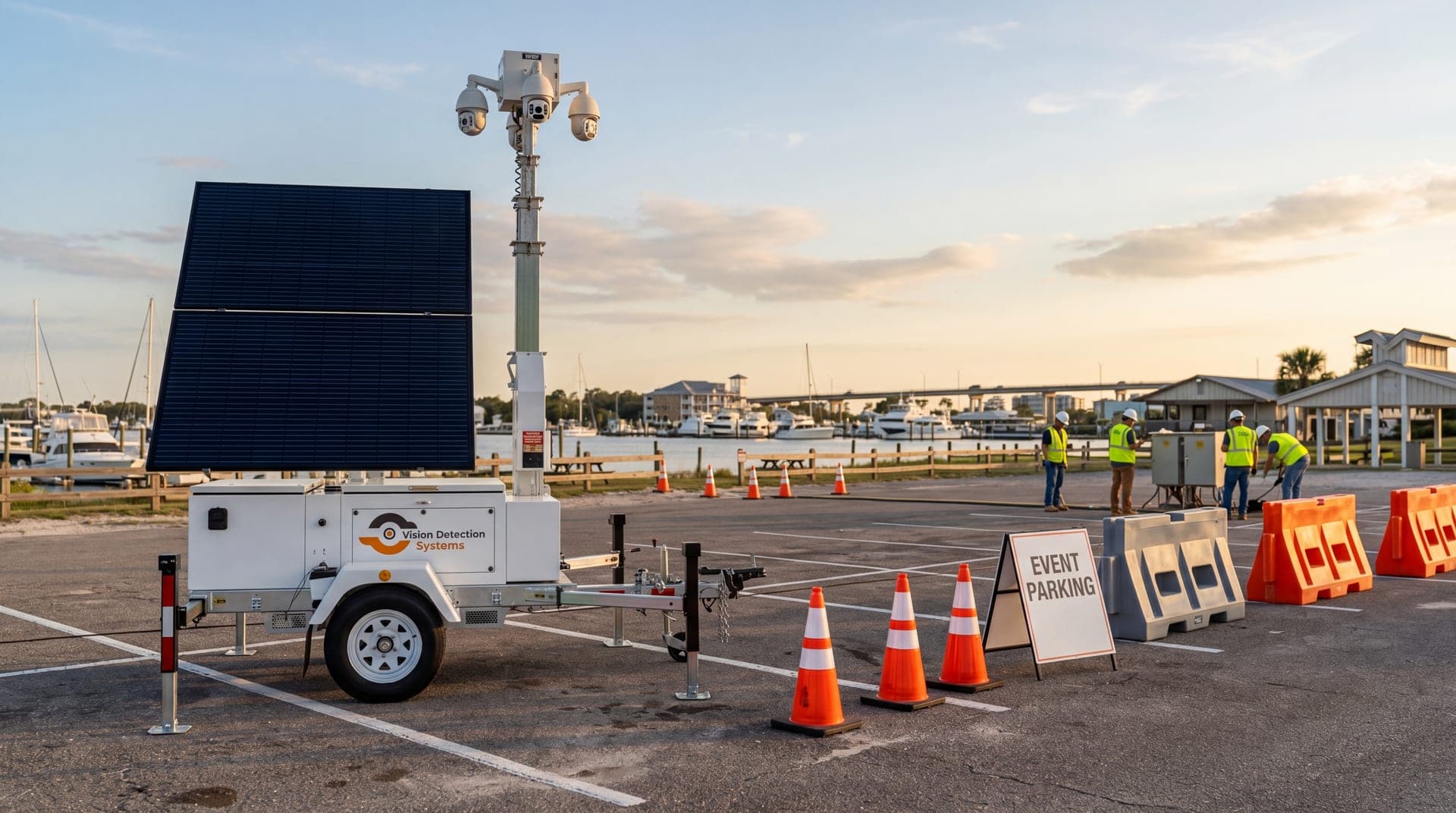
For most businesses—retail operators, property managers, logistics yards, mid-size construction firms—the goal is coverage and documented response, not hardware ownership. A managed service bundles the unit, connectivity, maintenance, monitoring, and logistics into a monthly cost. You get outcomes without building an internal security operations function. For construction site security, where the risk profile shifts with project phases and equipment moves to new locations, this flexibility is often the deciding factor.
Key Specs to Evaluate on Any Mobile Surveillance Trailer
Whether you are buying or evaluating a provider, these are the specifications that determine whether a unit actually performs on site—not just on a data sheet.
- Camera count and type: PTZ cameras cover wide areas with patrol and zoom capability. Fixed cameras cover defined chokepoints reliably. Most well-configured trailers carry a combination. Minimum 1080p resolution for evidential quality—4MP or higher is preferred for incidents that may go to court.
- Tower height: Entry-level units start around 20 feet. Standard deployments use 30-foot towers. For high-visibility deterrence across open lots or large perimeters, 40-foot towers provide significantly better coverage angles and visible presence.
- Power system: Solar panel wattage matters less than the battery bank capacity behind it. Ask specifically for the power autonomy spec—how many consecutive days of low sun or overcast conditions can the unit sustain full 24/7 operation? Three days minimum is a reasonable threshold. Anything less creates real blind-spot risk in winter deployments or northern climates.
- Connectivity: 4G/LTE is standard. For reliable uptime, dual-SIM with automatic carrier failover is worth requiring. For genuinely remote sites—utility infrastructure, rural construction—ask about satellite backup options.
- Night vision: Look for IR range in meters and the camera's low-light lux rating. A unit with strong daytime specs but poor lux performance misses most incidents—they happen at night.
- License plate recognition: LPR camera systems are either integrated or available as an add-on depending on the unit configuration. If vehicle access control or post-incident vehicle investigation is part of your use case, confirm whether LPR is fixed-mount or adjustable, and whether reads are logged locally or to the cloud.
- Weatherproofing: IP66 or higher for cameras. Confirm the electronics enclosure rating—a unit that fails during a storm is worse than no unit at all.
- Lighting and PA: Built-in LED floodlights improve night footage quality and serve as a visible deterrent. A PA speaker adds verbal challenge capability—the ability to address individuals in real time during a monitoring event. This is a significant deterrence multiplier that hardware-only setups often skip.
The Real Cost of Ownership (What Spec Sheets Don't Show)
A new mobile surveillance trailer runs $25,000 to $80,000 depending on configuration. That purchase price is the starting point, not the total cost. Here is what operators consistently underestimate when they run the numbers:
- Connectivity: Cellular data plans for surveillance units typically run $100—$300 per unit per month. That's $1,200—$3,600 per year, per unit, before anything else.
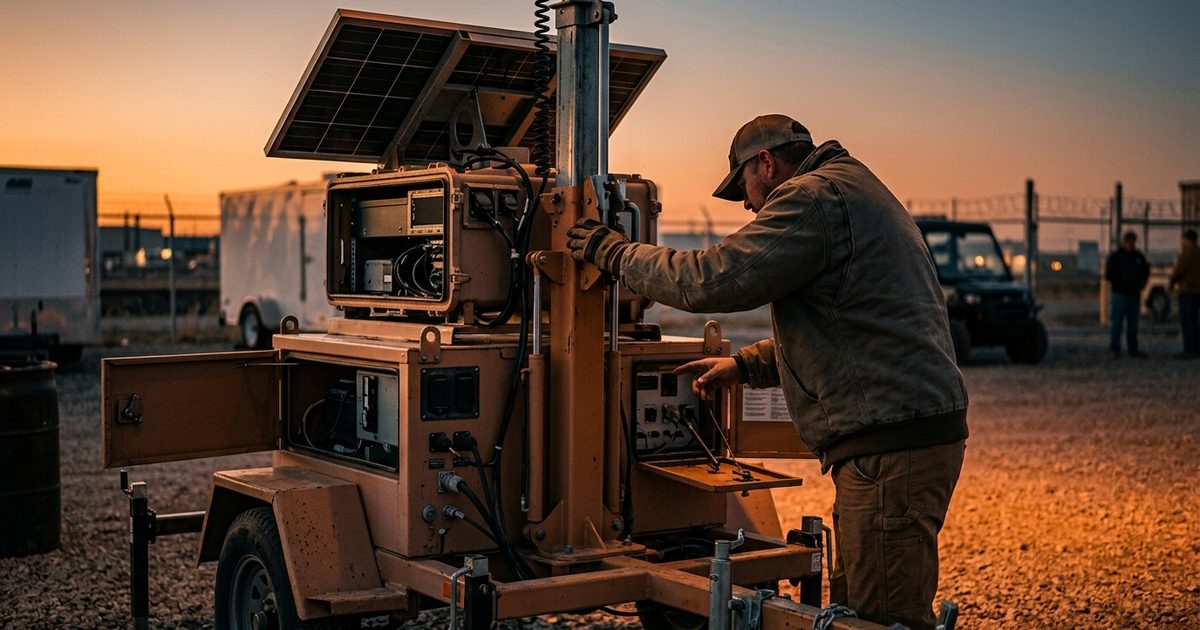
- Maintenance: Cameras, batteries, and solar panels degrade. Budget $500—$2,000 per year in parts and labor for a well-maintained unit—more if you are operating in harsh climates or high-use conditions.
- Storage and retrieval: Local NVR storage requires someone to manage footage retrieval, confirm backups are running, and handle retention schedules. When a clip is subpoenaed or an incident is disputed, that workflow needs to exist before the incident happens, not after.
- Monitoring: The trailer records. Someone still has to watch it. Remote video monitoring is a separate operational function—and if you self-operate, staffing it is expensive. An unmonitored trailer is a recording device, not a security system.
- Deployment logistics: When the hotspot shifts—a new construction phase, a different parking area, an event—who moves the unit? Transport, leveling, reconnection, and any permit requirements fall on you as the owner.
- Insurance: Specialized equipment floaters for mobile surveillance trailers typically run $1,500—$3,000 per year per unit.
Add it up and a self-operated unit carries $8,000—$18,000 in annual operating costs on top of the purchase price. For organizations that can absorb that with existing staff and infrastructure, it pencils out. For most private-sector operators, it doesn't.
Managed Service Economics
A fully managed deployment—unit, monitoring, maintenance, connectivity, and logistics included—typically runs $1,500—$4,000 per month depending on configuration, coverage hours, and monitoring tier. Compared against a purchased unit with $8,000—$18,000 in annual operating costs plus capital depreciation, the math shifts quickly. The mobile surveillance units in a managed program are also redeployable—when your risk shifts, the coverage moves with it, without a logistics project on your end.
The Security Industry Association notes that mobile surveillance deployment has grown substantially as organizations look for flexible, infrastructure-light security options—a trend that reflects exactly this economics shift away from capital-intensive ownership models.
Six Questions to Ask Any Vendor or Provider
Before signing anything—purchase, lease, or service agreement—get clear answers to these:
- What is the power autonomy in winter conditions? Low sun angle and higher heating loads stress solar systems hardest in winter. Get a specific number of days, not a general assurance.
- What connectivity does the unit use—and what happens during an outage? Dual-SIM failover, local recording continuity, and alerting behavior during a connectivity gap should all be defined.
- Who is responsible for maintenance and repairs? Hardware purchase agreements vary. Know whether you own the maintenance obligation entirely or whether the vendor provides any coverage.
- What is the video retention period and footage access procedure? Retention duration and how you export clips for an incident, insurance claim, or legal hold are operational details that matter before you need them.
- Is remote monitoring included, or is that an additional cost? Many trailer vendors sell hardware only. Monitoring is a separate contract. Make sure you understand what you are buying.
- How quickly can the unit be redeployed? If your coverage needs shift, how fast can the unit move? What is the logistics process and who manages it?
If you are evaluating mobile surveillance for an upcoming deployment—whether that is a construction project, a parking facility, or a multi-site security program—Vision Detection Systems can walk through the right configuration and procurement model for your situation. We offer fully managed deployments with hardware, monitoring, connectivity, maintenance, and logistics included, as well as consultation for organizations evaluating purchase or lease options. Contact our team to discuss what makes sense for your sites.