
How to use this checklist
Ask each provider the same questions and write down the answers. Where a provider gives a vague answer, treat it as a gap rather than a pass. If you are still deciding between renting and buying, the buyer's guide and the rental guide cover the decision itself. For a shorter overview of what matters, see what to look for in a mobile surveillance trailer.
Cameras
Camera choice decides what you can see and what evidence you end up with. A common setup mixes camera types so one device handles awareness and another handles detail.
- What camera types are included, and how many?
- Is there a pan-tilt-zoom camera, and what is its optical zoom (not digital)?
- Are there fixed wide-angle cameras for continuous coverage?
- How do the cameras perform at night, and what illumination is included?
- Can you add or reposition cameras later?
Fixed cameras watch one view all the time, while a PTZ can look closely at one spot but leaves other areas unwatched while it does. Our comparison of PTZ versus fixed cameras explains why many trailers combine both.
Power
Power is where trailers most often fall short, because a dead battery means a blind site. Ask for numbers and assumptions, not adjectives like "long-lasting."
- Solar array size, and whether it is sized for winter output.
- Battery capacity and chemistry, and the usable fraction.
- Reserve in days of cloudy weather, and what load that assumes.
- What happens when the battery runs low, and how you are alerted.
- Whether a generator or other backup is part of the design.
Connectivity
A trailer without a reliable link is a recorder in a field. Cellular is the usual connection for sites with no network.
- Which cellular technologies it supports and whether there are two carrier connections for redundancy.
- How the unit behaves if signal drops, including local recording.
- Whether data costs are included or billed separately.
- How video is transmitted, and whether it is encrypted.
Mast and mounting
Mast height controls the view, but more height also adds wind load and reduces detail at the same distance. Ask these specifics.
- Maximum and standard mast height, and whether a taller option exists.
- How the mast is raised, and how fast.
- Rated wind limits, and the procedure for lowering in storms.
- What stabilizers or jacks come with the trailer, and how it is leveled.
- Weight and towing requirements.
Analytics
Analytics decide how much of the watching is done by software. Detection should reduce false alarms, not add to them.
- What the system can detect, such as people, vehicles, loitering, objects and plates.
- Whether analytics run on the unit, in the cloud or both.
- How false alarms are managed before anyone is contacted.
- Whether detection zones and schedules can be adjusted.
For background, read about AI video analytics for security cameras and how to reduce false alarms.
Monitoring and response
The same hardware performs very differently depending on whether anyone acts on what it sees. Research on camera systems has found that actively monitored systems show a larger effect than passive, record-only ones, as noted in the sources below.
- Is monitoring included, or are you receiving raw alerts?
- Is the operations center staffed 24/7, and where is it located?
- What can operators do, such as talk-down through a speaker?
- When do they contact police, and with what information?
- What reports and video exports do you receive?
Details on this part of the decision are in our guide to remote video monitoring.
Compliance and support
- Is the hardware NDAA Section 889 compliant? See the buyer's guide to NDAA compliant cameras.
- Who services the unit, and how quickly?
- How long does delivery and setup take?
- What are the contract terms, and can you scale up or down?
Comparison table
| Area | Key spec | Why it matters |
|---|---|---|
| Cameras | Optical zoom, wide-angle coverage, night performance | Determines usable evidence |
| Power | Array, battery, cloudy-day reserve | Determines uptime |
| Connectivity | Carrier redundancy, local recording | Determines whether video reaches you |
| Mast | Height, wind rating, stabilizers | Determines coverage and stability |
| Analytics | Detection types, false-alarm control | Determines alert quality |
| Monitoring | Staffing, talk-down, police dispatch | Determines response |
| Compliance | NDAA status, service terms | Determines eligibility and support |
Turning answers into a decision
Once you have answers from each provider, put them side by side in a simple grid, with one column per provider and one row per question. Mark each cell as clear, vague or missing. Clear answers with stated assumptions deserve more weight than confident but vague ones. Missing answers are not neutral. They often point to something the provider would rather not discuss.
Then weight the rows by what matters at your site. A remote yard with no network cares most about power and connectivity. A busy site with frequent visitors may care most about analytics quality and response. A project funded with public money may put compliance first. Share the grid with your security team or partner, since they will see gaps you may miss. Finally, ask for a reference or a short trial where possible, because a live unit on a real site shows what a specification sheet cannot.
How VDS fits
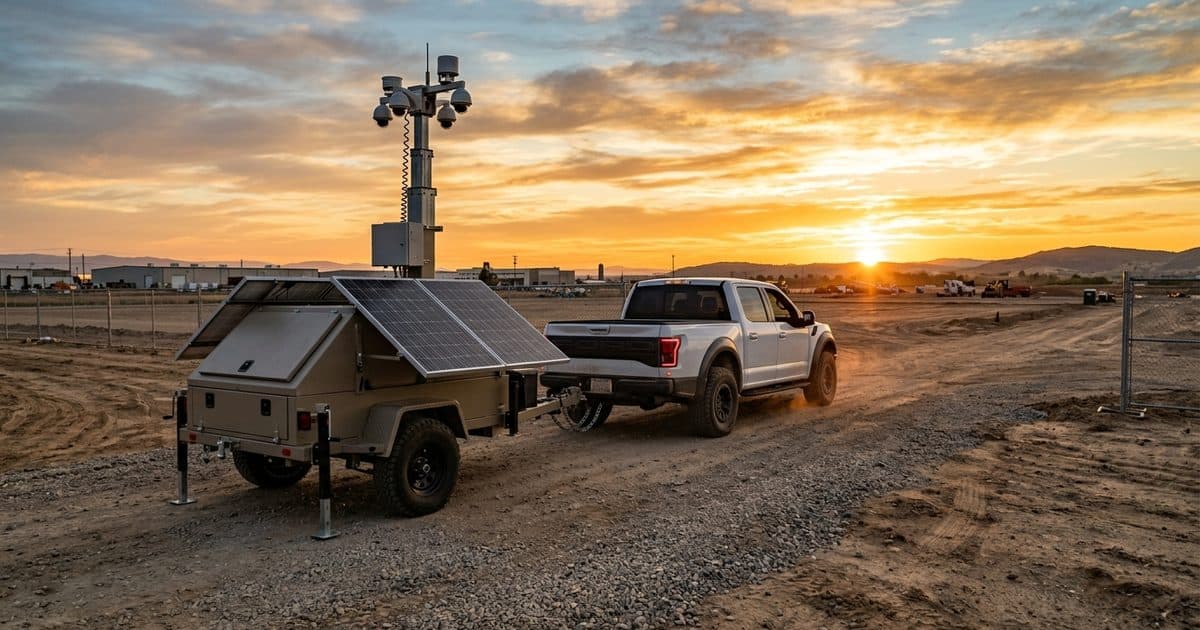
The VDS mobile surveillance unit combines a 5MP PTZ with 25x optical zoom and three 8MP wide-angle cameras on a 22 ft telescopic mast (30 ft available). A 900W bifacial solar array charges an 11.8 kWh LiFePO4 battery bank with reserve for 3-5 consecutive cloudy days, and dual-SIM 4G/5G cellular carries the video. AI detects people, vehicles, loitering, objects and license plates, and a 24/7 US-based security operations center verifies events, uses live talk-down through a loudspeaker and dispatches police with video. The hardware is NDAA Section 889 compliant. Most deployments go from signed quote to live monitoring in about a week. Visit the mobile surveillance unit page or talk to our team.
Sources
- Piza, E. L., Welsh, B. C., Farrington, D. P., & Thomas, A. L. (2019). CCTV surveillance for crime prevention: A 40-year systematic review with meta-analysis. Criminology & Public Policy, 18(1). onlinelibrary.wiley.com