
Start with the problem, not the product
Write down what you are protecting and what you are afraid of. Equipment theft at night, trespassing in a staging area, vandalism in a lot and unauthorized after-hours access all call for different coverage. Note the size of the area, how far the farthest point is from where the trailer will stand, whether the site has power or internet, and how long you need coverage. A provider who asks these questions first is more likely to recommend something that fits. For a wider view of the buying process, see our buyer's guide to surveillance trailers for sale.
Cameras and mast
Cameras should do two jobs. Fixed wide-angle cameras watch the whole scene continuously, so nothing happens in a blind spot. A pan-tilt-zoom (PTZ) camera zooms in to identify a person, read a vehicle or follow movement. Ask what the zoom range is and whether the image at the far edge of your site is still useful at night.
The mast matters as much as the lens. A taller mast sees over trucks, stacked materials and fences and keeps the cameras out of easy reach. The trade-off is that very high mounting widens the view but reduces facial detail at close range. Ask how tall the mast extends, how it is secured when raised, and what happens in high wind.
Night performance deserves its own question. Ask to see night footage from a real deployment, not a brochure image, and ask how the unit lights the scene.
Power and connectivity
Solar panels get the attention, but the number that matters is autonomy: how many consecutive cloudy days the unit keeps running on its battery bank with little or no charging. Ask how that figure was derived, what loads it assumes, and what happens when the reserve runs low. Is there an alert, a backup source, or does the unit simply go dark? Our guides to solar security camera battery life and surveillance trailer uptime explain how to read these claims.
For connectivity, most trailers use cellular. Ask about coverage at your address, not the carrier's national map. Dual-SIM units can use more than one carrier. Ask whether video is stored on the unit if the link drops and uploads later, so a signal gap does not become a gap in the record.
Detection and deterrence
Detection software decides whether you get a handful of useful alerts or hundreds of false ones. Ask what the system detects (people, vehicles, loitering, plates), how it handles animals, shadows, rain and moving vegetation, and who tunes it for your site. Be wary of any provider that cannot say how false alerts are reduced.
Deterrence works best before a crime starts. Lights, strobes and a loudspeaker let the system, or an operator, warn someone off. Ask whether the voice is live or recorded. A live voice that references what the person is doing is far more convincing than a looped siren.
Monitoring and support
This is the choice with the largest effect on results. Record-only systems tell you what happened. Self-monitored systems send alerts to you and rely on your phone being in your hand. Professionally monitored systems have operators who verify an event, talk to the person on site, and contact police with video when it is a real incident.
Research points the same direction. A 2019 systematic review of 76 studies found that actively monitored camera systems were associated with about a 15% reduction in crime, while passive recording-only systems showed no significant effect. Monitoring also works alongside people already on your site. The cameras do the watching, so people, yours or your security partner's, handle verified incidents. Read more about remote video monitoring.
Ask about support in plain terms. Who notices when a unit goes offline, what is the process to fix it, and who relocates or repairs hardware?
Compliance and terms
If federal funds, a federal contract or a government customer is involved, ask for written NDAA Section 889 compliance documentation covering the cameras and related video equipment. Verbal assurances are not enough.
On terms, find out whether you can rent month to month, subscribe for a term, or buy. Ask what is included in each: monitoring, cellular data, software, maintenance, and delivery and pickup. Ask how long footage is kept, how you get a clip to police or an insurer, and what happens to your data if you end the contract. Always compare total cost for the same coverage hours and term rather than comparing a hardware price to a monthly fee.
Quick-reference checklist
| Area | Ask the provider | Good sign |
|---|---|---|
| Cameras | What can I identify at the far edge, at night? | Sample night footage from a real site |
| Mast | How tall, and how is it secured? | Stable in wind, cameras out of reach |
| Power | How many cloudy days of reserve? | A tested number and a low-power alert |
| Connectivity | One carrier or two? Stored footage if link drops? | Dual SIM and on-board storage |
| Detection | How are false alerts reduced, and by whom? | Named people and vehicles, not just motion |
| Deterrence | Is the voice live? Are there lights? | Live talk-down and visible lighting |
| Monitoring | Who watches, when, and what do they do? | 24/7 operators who verify, then escalate |
| Support | Who notices when the unit has a fault? | Remote health checks and a service process |
| Compliance | Is there NDAA paperwork? | Written documentation on request |
| Terms | What is included, and how do I exit? | Clear scope and no surprise add-ons |
How VDS fits
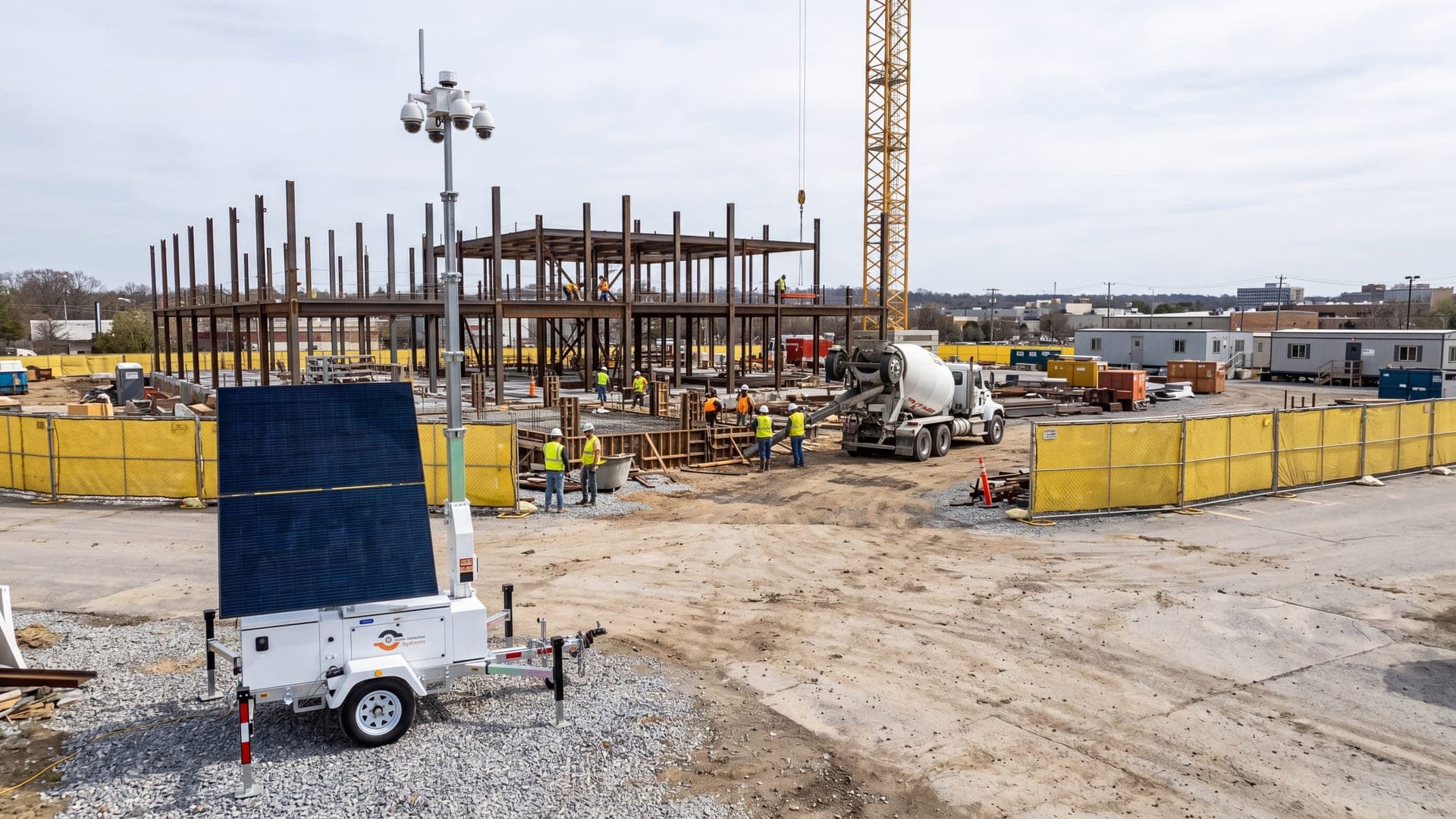
The VDS mobile surveillance unit is a solar-powered trailer built around the monitored model.
- A 5MP PTZ with 25x optical zoom plus three 8MP wide-angle cameras on a 22 ft telescopic mast (30 ft available).
- A 900W bifacial solar array charging an 11.8 kWh LiFePO4 battery bank, with reserve for 3-5 consecutive cloudy days, and dual-SIM 4G/5G cellular.
- AI detection for people, vehicles, loitering, objects and license plates.
- A 24/7 US-based security operations center that verifies events, responds with live talk-down through a loudspeaker, then dispatches police with video.
- NDAA Section 889 compliant hardware.
No site power, internet or trenching is needed. Most deployments go from signed quote to live monitoring in about a week, and on-site setup takes one person under 20 minutes. Rental, month-to-month and term subscriptions are available. Tell us about your site or call (410) 401-1986.
Sources
- Piza, E. L., Welsh, B. C., Farrington, D. P., & Thomas, A. L. (2019). CCTV surveillance for crime prevention: A 40-year systematic review with meta-analysis. Criminology & Public Policy, 18(1). onlinelibrary.wiley.com