
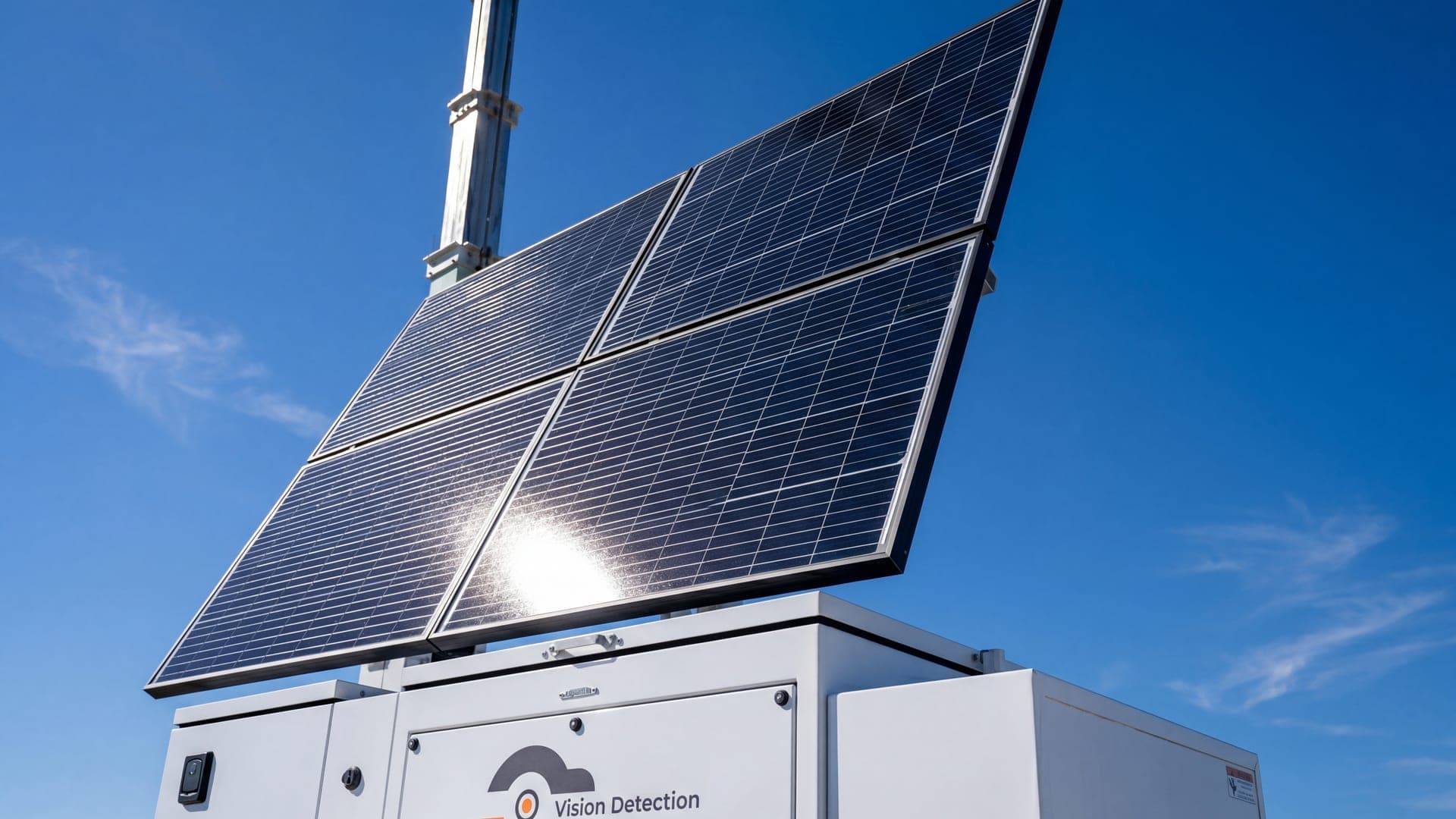
Solar units aren't new, but the engineering behind them has improved enough that they now compete directly with diesel and hybrid trailers on uptime, not just on sustainability. The question most security directors and project managers actually need answered isn't "does solar work"—it's "does it work reliably enough for my site, in my climate, at my risk level." That's what this guide covers. For runtime and range specifics, see our solar surveillance trailer guide.
What Makes a Solar Security Camera Trailer Different
A standard mobile surveillance trailer needs a power source: shore power, a diesel generator, or a battery bank that someone recharges on a schedule. A solar-powered unit replaces that dependency with photovoltaic panels mounted on the trailer frame, feeding a battery system sized to carry the cameras, cellular modem, and any lighting or PA components through overnight hours and cloudy stretches.
The core hardware is the same as any other mobile surveillance trailer: high-resolution cameras, infrared or low-light sensors, a cellular uplink for remote access, and often a telescoping mast for elevated coverage. What changes is the power architecture and, by extension, the logistics around deployment. No fuel delivery schedule means fewer site visits, fewer interruptions in coverage, and fewer variables a site manager has to track.
That matters most for sites without existing infrastructure—vacant lots, perimeter fence lines, construction phases before utility hookup exists. Solar removes the single biggest limiting factor on how long a unit can stay deployed unattended.
How Solar Power Keeps Coverage Running
Panel wattage and battery capacity are sized against expected draw, not just advertised runtime. A trailer running four cameras, a cellular router, and infrared illumination at night pulls a predictable load, and the battery bank needs enough reserve to cover multiple consecutive overcast days—not just a single average day.
Battery chemistry matters here. Lithium iron phosphate (LiFePO4) batteries have become standard on newer units because they handle deep discharge cycles better than older lead-acid designs and hold capacity longer in temperature swings. According to the National Renewable Energy Laboratory, solar panel output in the U.S. can vary by more than 30% between peak summer months and winter in northern latitudes, which is exactly why reputable vendors size battery reserve for worst-case solar input, not best-case.
Most systems also include a solar charge controller that manages input and protects the battery from overcharge, plus remote diagnostics that flag low battery states before a camera actually goes dark. That last piece is what separates a reliable deployment from a gamble—a monitoring platform that alerts a technician at 40% charge, not a site manager who discovers a dead unit after an incident.
Where Solar Surveillance Trailers Make the Most Sense
Not every site needs solar, but a few patterns show up consistently across the sites where it's the obvious choice.
- Construction sites before utility hookup: Early-phase jobsites often have no power infrastructure for months. Solar covers that gap without a generator running 24 hours a day next to a crew.
- Remote perimeters and rural sites: Pipeline corridors, substations, agricultural land, and other sites far from fuel delivery routes benefit most from a unit that doesn't need regular servicing.
- Sunbelt metros: Markets like Phoenix, Houston, and parts of the Southeast get enough consistent solar input that battery reserve rarely runs tight, even with heavy infrared use overnight.
- Noise- or emissions-sensitive sites: Residential-adjacent lots, parks, and municipal properties where a running generator creates complaints or violates local ordinances.
- Extended deployments: Any site where the trailer is expected to stay put for 60+ days benefits from removing fuel logistics from the maintenance plan entirely.
Sites that see heavy winter cloud cover for extended stretches, or locations in far northern latitudes, sometimes need a hybrid setup—solar paired with a backup battery swap plan—rather than pure solar. A deployment plan should account for that before the unit ships, not after a battery alert during week three.
What to Check Before You Deploy One
Three things determine whether a solar trailer performs the way a vendor's spec sheet promises: panel capacity relative to camera load, battery reserve relative to expected cloud cover, and the monitoring layer that catches problems before they become blind spots.
| Factor | What to Ask | Why It Matters |
|---|---|---|
| Panel wattage | Is it sized for your camera count and IR usage, or a generic baseline? | Undersized panels drain the battery faster than they can recharge it |
| Battery reserve | How many consecutive cloudy days can the unit run on stored charge alone? | Determines real-world uptime, not just marketing runtime |
| Remote diagnostics | Does the platform alert on low charge before cameras go offline? | Prevents silent coverage gaps during unattended periods |
| Mounting and theft resistance | Are panels and batteries secured against tampering? | Solar components are valuable and exposed on an unattended trailer |
| Escalation workflow | Who gets notified, and how fast, if an alert triggers at 2 a.m.? | A camera without a response plan is just a recording device |
That last row is the one operators underestimate most. A trailer that stays powered but has no one watching the feed or acting on an alert isn't solving the coverage problem—it's just delaying it. Pairing a solar unit with remote video monitoring closes that gap, because a trained operator verifies activity and escalates based on actual site rules, not just a motion trigger.
Common Mistakes Sites Make With Solar Surveillance
- Sizing the battery for an average day instead of a worst case: A string of overcast days in a row will expose undersized reserve fast, especially with infrared running overnight.
- Placing the trailer in partial shade: Tree lines, building shadows, and nearby structures that block even a few hours of midday sun cut output more than most people expect.
- Treating solar as "set it and forget it": Remote diagnostics still need someone checking alerts. A battery at 20% with no one watching is the same blind spot as a dead generator.
- Ignoring theft risk on exposed components: Solar panels and battery housings on an unattended trailer are a target. Physical hardening and signage matter as much as the camera itself.
- Skipping a retention and retrieval plan: Power uptime solves one problem. If footage gets overwritten before anyone exports it, the coverage was wasted anyway.
- Assuming one trailer configuration fits every site: A jobsite in Phoenix and a perimeter fence in Seattle need different panel-to-battery ratios. A generic spec sheet doesn't account for that.
Construction teams in particular run into the retention issue often—a camera caught an incident, but by the time anyone asked for the clip, the retention window had already cycled past it. Building a construction site security plan around both power reliability and a retrieval workflow avoids that failure mode entirely.
Deploy a Solar Security Camera Trailer With a Coverage Plan Behind It
If you're managing a site with no power infrastructure, a shifting construction phase, or a perimeter too remote for regular fuel runs, a solar-powered trailer solves the uptime problem without the generator logistics. It still needs the right panel-to-battery sizing for your climate, theft-resistant mounting, and a monitoring layer that turns alerts into verified response instead of unwatched footage. Vision Detection Systems builds that coverage plan around the hardware, not just the trailer itself.
Request a deployment quote through our get started page and we'll size the right unit—solar, hybrid, or fixed—for your site's risk window and location.