
Why visible deterrents work
Most property crime is opportunistic. A person looks for a site that is dark, quiet and unattended. Anything that changes that impression raises the cost of trying: more light, more noise, more sign that someone is aware.
The weakness is habit. A siren that goes off every night teaches everyone nearby to ignore it, including the person you want to deter. Deterrents lose force when nothing follows them, so the question is less "which device" than "what triggers it, and what happens next."
Lighting
Lighting is the oldest deterrent and the one that does the most for the rest of your system. Good light makes people easier to see and harder to hide, and it improves camera images because color footage and clear detail need visible light. Infrared helps cameras see in the dark, but it does not make a site look occupied to a person walking up to it.
Points to consider:
- Coverage matters more than brightness. Even light across the area beats one harsh floodlight with deep shadows beside it.
- Aim down and away from neighbors. Glare is a common complaint.
- Motion-activated light draws the eye. A light that comes on when someone approaches is noticed more than one that is always on.
- Remote sites need a power plan. Where there is no grid power, solar lighting units are the practical option. See VDS solar light and lighting trailer options.
Strobes
A strobe flashes bright light in a pattern that is hard to ignore. It works in two ways: it startles a person who thought they were unseen, and it makes the site stand out to anyone passing, including neighbors and patrols.
Strobes are most useful as a response to a trigger, such as a person detected inside a fenced area at night. Left on constantly, they are a nuisance and a sign that nothing is wrong. They also produce glare and flashing that can bother nearby homes, so aim and duration matter.
Sirens
A siren makes noise, which draws attention and signals that the site is reacting. It is the most disruptive of the three, and the one most likely to cause problems.
Sirens carry a real risk of becoming a nuisance. False triggers wake neighbors, and noise ordinances may limit volume, duration or hours. Rules vary by municipality, so check local requirements before installing one. In practice that means:
- Trigger the siren from high-confidence detection, not a simple motion sensor.
- Limit the duration so it stops on its own.
- Test at a reasonable hour and ask what the nearest neighbor hears.
Comparing the options
| Deterrent | What it does | Helps most when | Watch out for |
|---|---|---|---|
| Lighting | Removes cover, improves camera images | Dark lots, yards and perimeters | Glare, spill into neighbor property |
| Strobe | Startles, signals a reaction | Triggered by detection after hours | Flashing in nearby homes, desensitization |
| Siren | Draws attention with sound | Triggered by verified events | Noise rules, false triggers, ignored alarms |
| Live voice | Addresses the person directly | Operator can see and speak | Needs people watching |
Pair deterrents with detection
A deterrent with no detection behind it is a bluff. Anyone who tests it once learns that nothing happens next. The stronger setup connects the device to something that knows what it is reacting to: AI detection of people and vehicles in a defined zone, then a person who confirms what is happening.
That ordering also protects you from nuisance. If a strobe or siren fires only when a person is detected where they should not be, it fires far less often, and each time carries meaning. Our guide on reducing false alarms in video analytics explains why tuning matters here.
Research on cameras supports the same idea. The 2019 review of 76 studies found that programs combining cameras with multiple other interventions were associated with about a 34% reduction in crime, against about 13% for CCTV overall. Lighting, noise and a live response are among the kinds of measures that can sit alongside cameras. For the wider picture, see do security cameras deter crime.
Matching deterrents to the site
The right mix depends on where the site is and who lives nearby.
- Remote yard or compound, no neighbors. Lighting plus a strobe or siren on detection is practical, because few people are affected and the response time to the site may be long.
- Construction site in a built-up area. Lighting and a live voice are usually a better fit than a siren, which can disturb the surrounding blocks.
- Parking lot next to housing. Aim lights carefully, avoid sirens, and rely on a voice or a call to police.
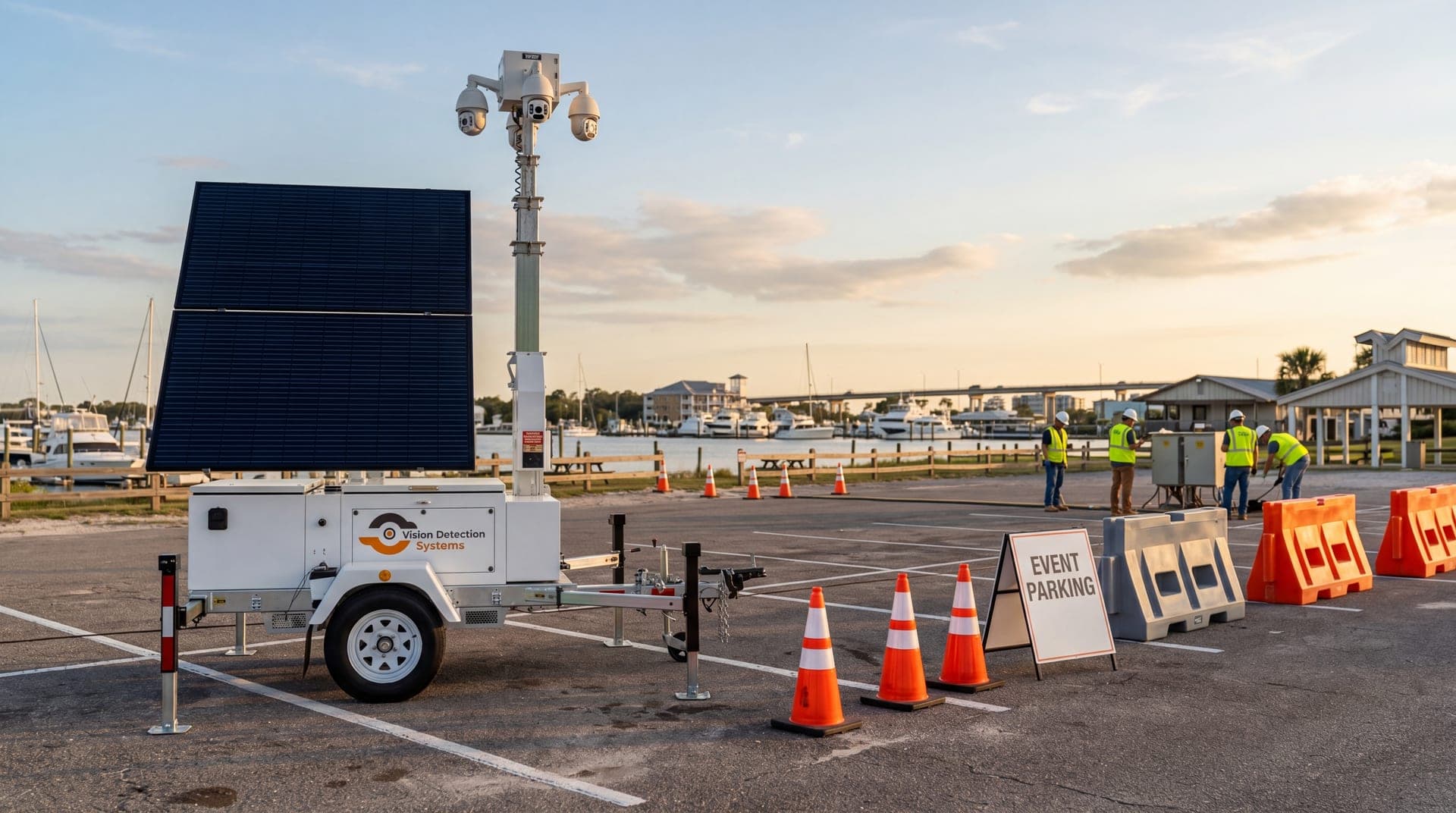
- Temporary event or overflow lot. Mobile lighting that moves with the need can cover it without running power.
Think also about maintenance. A device that fails quietly is worse than none, because you believe you are protected. Test each one on a schedule, and check that it still triggers from detection after any camera or network change. Our security camera maintenance checklist is a useful model for that routine.
Neighbors, ordinances and good practice
Before you add strobes or sirens to a site near homes or businesses:
- Tell neighbors what the system is and who to call.
- Check local noise and lighting rules.
- Choose a duration limit and keep a log of activations.
- Review false triggers and fix their cause instead of silencing the alert.
How VDS fits
VDS builds solar-powered mobile surveillance units: a 5MP PTZ with 25x optical zoom plus three 8MP wide-angle cameras on a 22 ft telescopic mast, charged by a 900W bifacial solar array into an 11.8 kWh LiFePO4 battery bank. They need no site power, internet or trenching. AI detection flags people, vehicles and loitering, and a 24/7 US-based security operations center verifies events, responds with live talk-down through a loudspeaker, and dispatches police with video if needed.
For sites that need light, VDS has a lighting trailer and a solar light product page. See remote video monitoring or talk to our team.
Sources
- Piza, E. L., Welsh, B. C., Farrington, D. P., & Thomas, A. L. (2019). CCTV surveillance for crime prevention: A 40-year systematic review with meta-analysis. Criminology & Public Policy, 18(1). onlinelibrary.wiley.com