
Branch surveillance carries a different risk profile than a retail storefront or a parking garage. Teller stations, vaults, night-deposit boxes, and drive-thru lanes all need usable footage on demand, not just a recording that technically exists. Regulators, insurers, and law enforcement expect footage that's clear, timestamped correctly, and retrievable fast. A maintenance gap at a bank branch isn't a minor inconvenience. It can mean a robbery investigation stalls because a camera was recording a blurred, underexposed frame for three weeks before anyone noticed.
Why Banking Security Cameras Carry Stricter Maintenance Requirements
Most commercial maintenance guides treat every site the same. Banking is different for a few structural reasons. Branches are frequently covered under bonding and insurance requirements tied to the federal Bank Protection Act framework, which pushes institutions toward documented camera coverage and uptime, not just installed hardware. Footage also supports federal and state investigations far more often than retail footage does, which raises the bar on retention length and chain-of-custody handling.
Camera placement at a branch also concentrates risk in a few high-value zones: the teller line, the vault door, the ATM vestibule, and the exterior entrances. A maintenance failure on any one of those cameras creates a gap exactly where an incident is most likely to happen. That's why banking maintenance checklists lean heavier on verification (confirm the feed is actually usable) rather than just confirming the camera is powered on.
Security Camera Maintenance Schedule for Bank Branches
A workable schedule has to be specific enough that staff can run it without a security consultant standing over their shoulder. Use this cadence as a baseline and adjust frequency up for high-risk branches.
Weekly Checks
- Spot-check live feeds on teller line, vault, ATM, and entrance cameras
- Confirm timestamps are accurate against branch clocks
- Confirm camera angles haven't shifted from cleaning, restocking, or furniture moves
- Check for new obstructions: signage, plants, stacked cash bags, holiday displays
Monthly Checks
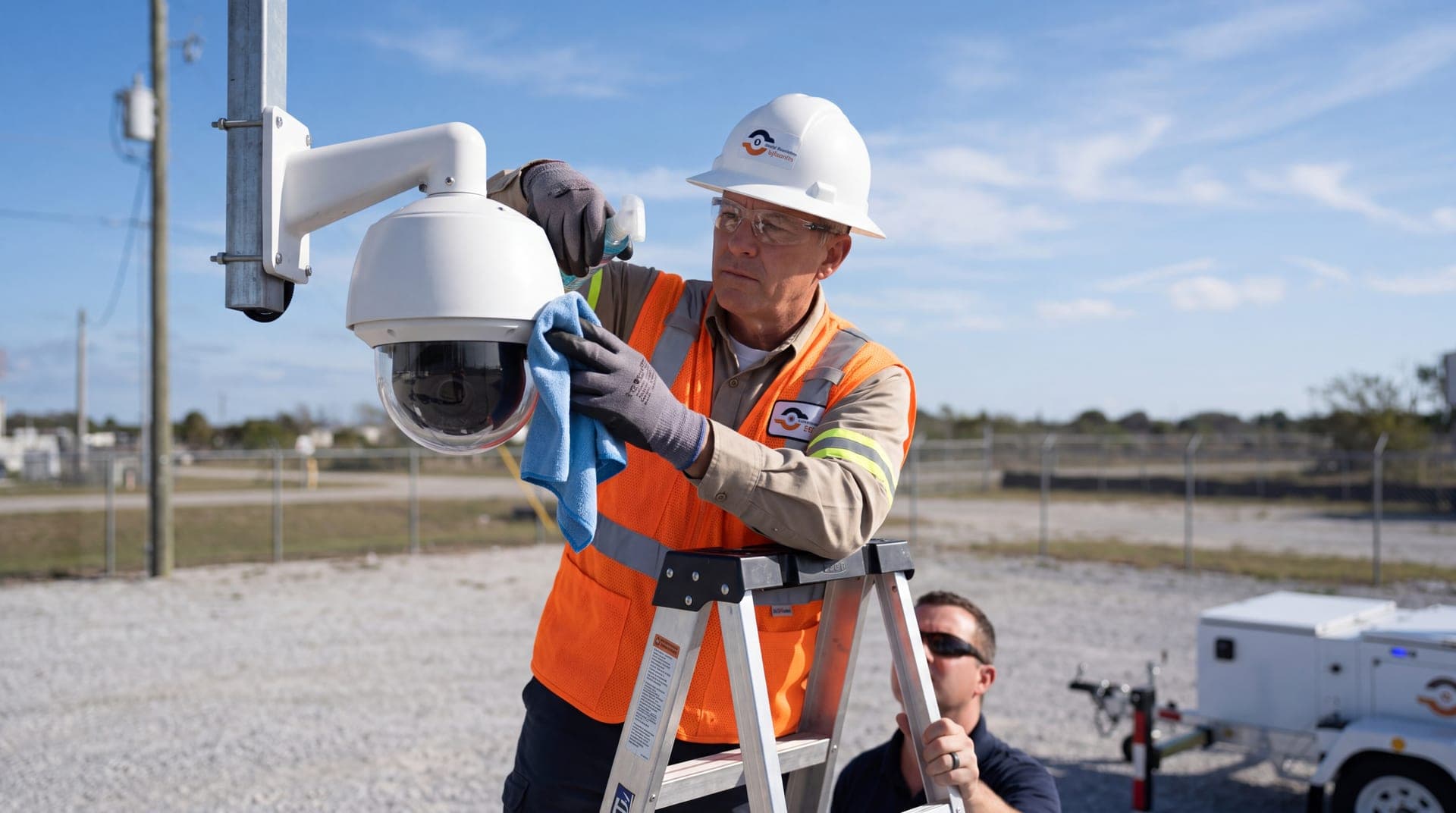
- Clean lenses and housings, especially on exterior ATM and drive-thru cameras exposed to weather
- Pull a night clip from each critical camera and confirm faces and license plates are identifiable
- Confirm recording is active continuously, not just intermittently
- Run a retrieval test, pulling a 60-to-120 second clip to confirm export speed and quality
Quarterly Checks
- Inspect housings, mounts, and cabling for damage or corrosion
- Review storage capacity trends and confirm retention periods meet branch policy
- Audit who has access to view or export footage
- Test backup power and failover in case of outage during a robbery or breach attempt
Image Quality Checks That Matter for Branch Footage
Image quality failures are the most common reason banking footage becomes useless during an investigation. Glare off a teller window, underexposed night footage at a drive-thru, or a camera angle that catches the top of someone's head instead of their face all defeat the purpose of the system. Monthly night clip reviews catch most of these problems before they matter.
ATM vestibules deserve special attention. Fluorescent lighting, reflective card readers, and glass doors create glare patterns that shift with the seasons. A camera that produced clean footage in March can produce washed-out footage by July if nobody rechecks exposure settings.
Recording and Retention Requirements for Banking Footage
Retention is where banking maintenance diverges most sharply from general commercial surveillance. Many branches hold footage for 90 days or longer to satisfy internal audit policy, insurance requirements, or law enforcement requests that arrive weeks after an incident. If storage fills up and the system silently starts overwriting older footage early, that retention commitment is broken without anyone noticing until it's too late.
Quarterly storage audits should confirm actual retention length against policy, not just assumed retention based on drive size. Drives degrade, bitrate settings change after firmware updates, and retention windows shrink without warning. A documented quarterly check closes that gap. For a deeper walkthrough of the full maintenance cadence that applies across commercial sites, see the security camera maintenance checklist.
Network, Connectivity, and Cybersecurity Checks
Banking camera systems increasingly sit on networks that also touch core banking infrastructure, which raises the stakes on cybersecurity hygiene. Default passwords, unpatched firmware, and unsecured remote access points on camera systems have become a known entry vector for attackers targeting financial institutions. Quarterly reviews should include firmware updates, password rotation, and access log review alongside the physical hardware checks.
The NIST Cybersecurity Framework offers a useful baseline for financial institutions structuring these reviews, particularly around access control and continuous monitoring. Branches running camera systems with remote viewing capability should treat that access path with the same scrutiny as online banking credentials. VDS documents its approach to this layer in detail on the cybersecurity trust center.
When to Add Remote Video Monitoring at a Branch
A maintenance schedule keeps cameras working. It doesn't tell anyone what to do when an alert fires at 11 p.m. Remote video monitoring adds a human verification layer: trained operators watch for triggered zones, confirm whether an alert is real, and escalate to police or branch management based on pre-set rules. Branches running overnight deposit boxes or standalone ATM kiosks benefit most, since those zones have no staff present to notice a problem in real time.
Regulatory exposure is part of why the Bank Protection Act framework, overseen in part by the FDIC, pushes institutions toward documented, verifiable coverage rather than passive recording alone. Monitoring doesn't replace the maintenance checklist. It closes the gap between "camera recorded something" and "someone responded to it."
Banking Security Camera Maintenance Checklist
| Frequency | Task | Why It Matters for Banking |
|---|---|---|
| Weekly | Live feed spot-check on teller, vault, ATM, entrance cameras | Catches shifted angles or obstructions before an incident |
| Weekly | Timestamp accuracy | Incorrect timestamps weaken footage in legal proceedings |
| Monthly | Lens and housing cleaning | Weather and glare degrade ATM and drive-thru footage fastest |
| Monthly | Night clip review | Confirms faces and plates are identifiable after dark |
| Monthly | Retrieval test | Confirms footage can actually be exported quickly when requested |
| Quarterly | Housing, mount, and cable inspection | Prevents hardware failure during high-risk periods |
| Quarterly | Storage and retention audit | Confirms the branch's actual retention policy is being met |
| Quarterly | Firmware updates and password rotation | Closes known cybersecurity vectors tied to camera systems |
| Quarterly | Access audit | Confirms only authorized staff can view or export footage |
Note: High-risk branches, standalone ATMs, and overnight deposit locations should run the weekly checklist twice a week and add monthly retention audits instead of quarterly ones.
Maintenance Needs Vary Across Regulated and Remote Environments
Banking isn't the only sector where maintenance requirements are shaped by regulation rather than convenience. Cannabis dispensaries face some of the strictest camera mandates in commercial security, and the specifics vary by state. Operators asking what security camera requirements does my state have for cannabis dispensaries? will find rules covering minimum camera count per entrance and point-of-sale station, resolution and frame rate minimums, and retention periods that often run 30 to 90 days depending on the licensing authority. The National Conference of State Legislatures tracks how these cannabis regulatory frameworks differ state to state, and maintenance schedules need to be built around the specific retention and resolution rules in that jurisdiction, not a generic template.
Remote and temporary sites present a different maintenance challenge entirely. Construction firms and logistics operators searching for top-rated remote jobsite security cameras are usually solving for connectivity and power reliability first, since there's no fixed infrastructure to fall back on. Solar-powered mobile trailers with cellular backhaul need connectivity checks built into the maintenance cadence, since a dropped signal is functionally the same as a dead camera. The deployment and uptime considerations behind that approach are covered in more depth in why deployable security works for remote and temporary sites.
The common thread across banking, cannabis, and remote jobsite deployments is the same: maintenance has to match the specific risk and regulatory profile of the site, not a one-size-fits-all checklist borrowed from a different industry.
Security Camera Maintenance: Next Steps for Banking Sites
Branch footage only protects a bank when it's clear, retained correctly, and retrievable on short notice. A documented weekly, monthly, and quarterly schedule closes most of the gaps that turn into unusable footage during an actual incident. Pairing that schedule with remote monitoring adds the response layer that a maintenance checklist alone can't provide.
VDS works with banking and financial institution clients to build maintenance schedules, retention policies, and monitoring workflows that match branch-specific risk. A coverage plan review is a practical starting point for any branch running cameras without a documented maintenance cadence in place.