
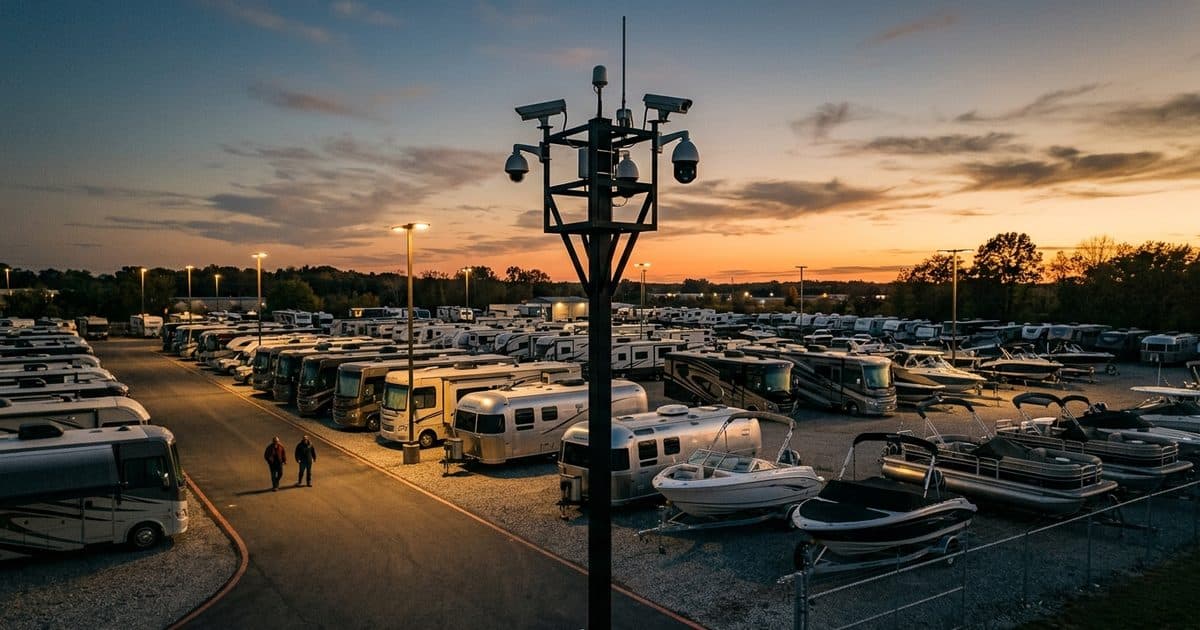
RV, boat, and powersports dealerships carry a version of the retail security problem that most retailers never face: the inventory doesn't fit inside a building. Motorhomes, pontoon boats, travel trailers, and rows of ATVs and jet-skis sit outdoors, overnight, on lots that run to several acres and are often only loosely fenced, if fenced at all. A single unit can be worth tens of thousands of dollars, and unlike a showroom full of parts or accessories, it doesn't need to be carried out the door — it just needs to be hitched or driven. That combination of high per-unit value, minimal barriers, and ground too large for a small camera cluster to watch makes the back half of the lot the softest part of the business, every night the doors are locked. This post covers the threats specific to RV, boat, and powersports dealerships, why fixed CCTV built around the showroom leaves the inventory exposed, what a coverage plan for the whole lot looks like, and how solar-autonomous surveillance with entrance LPR and live monitoring closes the gap.
The Threat Landscape at RV, Boat & Powersports Dealerships
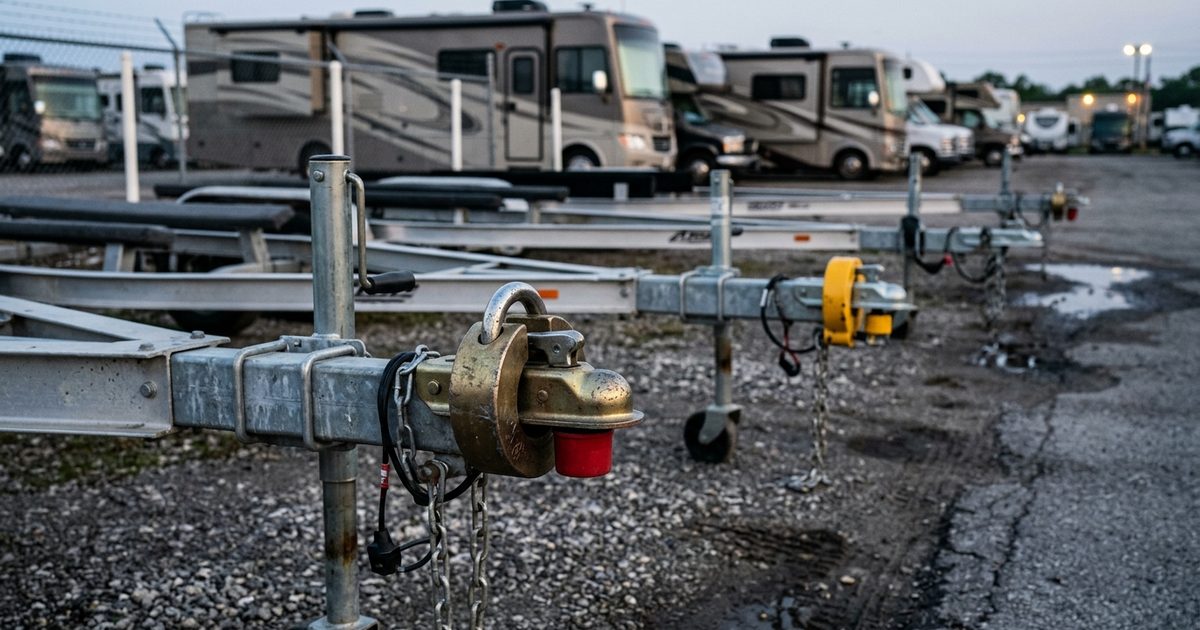
The defining risk at these dealerships is that the inventory is both valuable and mobile. A boat on a trailer, a motorhome with keys left in a lockbox, an ATV that two people can lift into a truck bed — all of it is designed to move, which is precisely what makes it easy to steal. A unit rolled off an unmonitored lot overnight can be gone before opening, with the loss running into five or six figures for a single RV or a well-equipped boat.
Below that top-line risk sits a steadier, more frequent drain: catalytic converter and parts theft off motorhomes and service vehicles, which takes a crew a few minutes with a battery saw and costs the dealership thousands per unit. Add joyriding — someone climbing into an unlocked unit for a lap around the lot or the neighborhood — after-hours trespass, and vandalism, and the picture is a lot that's exposed on several fronts at once, concentrated in the hours no one is on site.
Weather adds its own version of the same exposure. Dealerships routinely stand up overflow or storm-staging lots to move inventory ahead of a hurricane or to handle a seasonal volume spike, and those lots frequently go live with zero camera coverage, because they were never part of the original security plan. In the same way a self-storage facility is exposed the moment its office closes, and a marina is exposed on the water side land-based security was never built to watch, an RV and boat dealership is exposed on the acres of open ground surrounding a showroom that was only ever designed to protect what's inside it.
It's worth drawing the distinction from a standard car dealership here: passenger vehicle lots present a similar entrance-and-perimeter problem, which is why our auto dealership coverage follows a related model. RV and boat inventory raises the stakes — bigger units, more exposed storage patterns, higher per-unit loss, and rows that sprawl further from any building than a car lot typically does.
Why Fixed CCTV Leaves the Inventory Exposed
Most dealerships already run cameras. The problem isn't an absence of security spending — it's where that spending concentrated. Fixed CCTV goes where the wiring was cheapest to run: the showroom entrance, the service bay, maybe the main drive. Inventory rows sitting fifty or a hundred yards out, and overflow lots stood up on short notice, rarely get the same treatment, because extending a hardwired system that far means trenching, conduit, and an electrician — real money for ground that isn't the sales floor.
| Capability | Fixed CCTV | Solar Mobile Surveillance |
|---|---|---|
| Coverage | Clustered near showroom/entrance; thin across inventory rows | Elevated wide-area coverage across full inventory rows from one position |
| Back & overflow lots | Requires trenching and conduit to extend — rarely done | Solar and cellular — deploys anywhere on the property, no wiring |
| Response | Passive recording reviewed after a loss is discovered | Live SOC verification and audio warning in real time |
| New/seasonal lots | Fixed; a storm or overflow lot goes live with no coverage | Relocatable — live coverage the same day a lot opens |
| Deterrence | A camera pointed at empty ground no one is watching | Visible presence plus a live voice-down that clears people out |
The deeper problem is response, not just reach. A camera that records a motorhome being hitched at 3am produces evidence of a loss that already happened — it doesn't prevent it. What changes the outcome is a system that detects the movement as it happens, has it verified by a person, and puts a voice on the lot before the unit clears the property line. Fixed systems built to record rarely do any of that; they were never designed to.
Tip: Site coverage to look down the length of an inventory row, not just across the front of it. An elevated camera positioned to see along an entire row of RVs or boats catches someone approaching or working a unit from any angle, where a camera mounted low and pointed straight across a single aisle misses everything behind the first row. Combine that with LPR at the one entrance every vehicle has to use — even on a lot with no continuous fence, the entrance is still a chokepoint you can fully control.
What a Coverage Plan Looks Like for a Dealership Lot
A plan that actually protects the inventory, rather than just the building, covers the whole property and weights coverage toward where the value and the after-hours risk actually sit:
- The entrance, with LPR: The one point almost every vehicle passes through. License plate recognition at the entrance or service drive ties every entry and exit to a plate and a timestamp, exposes vehicles that don't belong, and flags hotlisted plates on arrival — turning an open lot into a logged one.
- RV and motorhome rows: Elevated coverage looking down the full length of each row, with object detection classifying people versus vehicles and flagging anyone approaching or hitching a unit after hours.
- Boat and powersports storage: Smaller, easier-to-move units concentrated in tight rows — the highest-frequency target on the lot — covered with loitering detection to catch anyone lingering near a unit longer than a passing customer would.
- Back and overflow lots: Secondary or seasonal storage ground that never got wired for cameras because it was never meant to be permanent, but still holds real inventory value on any given night.
What turns this from a set of cameras into actual protection is a visible on-lot presence with a real-time response behind it. A Mobile Surveillance Unit with lighting and an on-board speaker changes how the lot reads to anyone scoping it out, and because it's solar-autonomous, it goes wherever the inventory is parked this month — not just wherever conduit happens to already run.
Live Monitoring: The Night Patrol, Replaced
Paying for an overnight lot patrol is expensive and structurally limited — one person can only be standing in one place, on a lot that might run several acres deep. A camera system with no one watching it solves the cost problem and creates a worse one: recordings with no response attached to them.
Remote video monitoring is the model that beats both. When a camera flags movement near an RV row at 2am, the alert goes to a live SOC operator who verifies it in real time — confirming it isn't a late delivery or a manager doing a walkthrough — then acts: a real-time audio warning through the unit's speaker, which on its own is often enough to send someone walking back to their vehicle, followed by escalation to law enforcement with time-stamped footage and the entrance LPR record of exactly what drove onto the lot that night.
That verified-response model delivers two things a patrol can't. It watches the entire lot continuously instead of wherever one person is currently standing, and it produces a complete record for every incident — detection, verification, escalation, and plate, all logged automatically. When a claim goes to insurance or a theft goes to police, the evidence package already exists rather than needing to be reconstructed from memory. For dealer groups running multiple rooftops, the same SOC covers every location to an identical standard without hiring a patrol at each one.
Deployment That Matches How a Dealership's Lot Actually Changes
Dealership inventory doesn't sit still. New units arrive, floor plans shift with the season, and overflow lots get stood up and torn down around storms or year-end sales pushes. A fixed camera system installed once can't follow any of that — coverage stays wherever it was trenched in on day one, regardless of where the inventory ends up sitting.
A relocatable, solar-autonomous approach keeps pace instead. A unit can go live on a new overflow lot the same day it opens, shift to cover the boat rows during peak season, or reposition to the back lot after a theft — no trenching, no conduit, no waiting on a contractor. Coverage becomes something a dealership positions where the inventory and the risk actually are, rather than infrastructure frozen in place from the original install.
Common Mistakes in RV & Boat Dealership Security
- Concentrating cameras around the showroom. The losses happen in the outdoor rows and the back lot, exactly where fixed coverage typically thins out or stops entirely. Weight coverage toward the inventory, not the front door.
- Leaving overflow and storm lots uncovered. A lot stood up for a weather event or a seasonal push often carries real inventory value with zero camera coverage, simply because it wasn't part of the original build-out.
- Recording without responding. Footage that only gets reviewed after a unit is discovered missing prevents nothing. Detection needs to be tied to live verification and a real-time audio warning to actually change the outcome.
- Skipping LPR at the entrance. Even a loosely fenced lot has a real chokepoint at the entrance or service drive. Without a plate-and-time record there, an investigation into a missing unit starts from nothing.
- Treating the camera system as a one-time install. Inventory mix, lot layout, and seasonal footprint all shift throughout the year. A fixed system installed once falls behind the lot; a relocatable strategy keeps coverage where the value currently sits.
RV, boat, and powersports dealerships share the same underlying exposure as self-storage facilities and marinas: high-value assets sitting outdoors, overnight, across ground too large and too lightly secured for a fixed camera cluster near the front door to ever really cover. The fix looks the same across all three — elevated, solar-autonomous coverage that reaches the whole property, an entrance that logs every plate, and a live SOC operator behind every alert. If your lot has a back row, an overflow field, or a storm-staging area with no cameras on it today, talk to our team about what a coverage plan for your dealership would look like.