
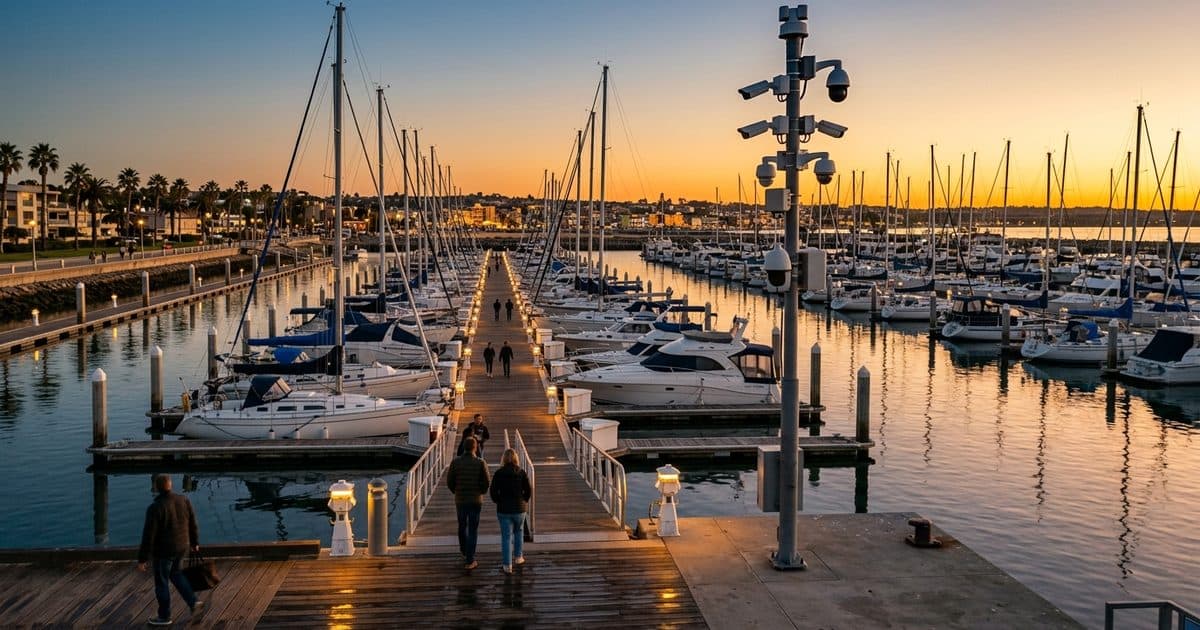
Most marina and boatyard security budgets go entirely into that land-side half — a keyed gate, a camera on the office, maybe a fence around the parking apron — and none of it does anything about the one approach every marina shares: open water. This post covers the threats specific to marinas and small ports, why fixed CCTV built for a land-side perimeter leaves the water side wide open, what a coverage plan that actually protects the whole waterfront looks like, and how solar-autonomous surveillance with waterside thermal coverage, gate LPR, and live monitoring closes the gap.
The Threat Landscape at Marinas & Ports
The marina threat model is different from almost any other commercial property, because the perimeter isn't a line you can fence. Boats, outboard motors, and marine electronics disappear from slips and dry-stack racks overnight — high-value, portable assets that a thief can be off the property with in minutes, using nothing but a second boat or a waiting trailer. Fuel docks compound the problem: left unattended after hours, they invite siphoning and pump tampering that only shows up the next morning, when the reconciliation comes up short with no idea when it happened.
The signature risk, though, is access by water. An intruder ties up at an empty slip or a gangway, does what they came to do, and leaves the same way — never touching a gate, never passing a fence-line camera, never generating the kind of footage a land-side system was built to capture. It's a scenario land-based CCTV has effectively no answer for, because the camera was aimed at the parking lot, not the water.
Small ports and boatyards carry a parallel exposure on the cargo side. Equipment and cargo staged in the open on a laydown yard walk off with no one on site overnight, vandalism and dock damage go undocumented, and when a storm or a slip accident leads to a liability claim, there's rarely footage to resolve who was responsible. The common thread across all of it is the same one that defines the vertical: a marina or small port is exposed on a side no standard commercial security plan accounts for.
Why Fixed CCTV Fails on the Water Side
Fixed CCTV at a marina almost always follows the same pattern as it does anywhere else — cameras go where the wiring is easy to run, which means the office, the gate, and the main parking apron. That's a reasonable answer to a land-side threat and no answer at all to a water-side one.
| Capability | Fixed CCTV | Solar Mobile Surveillance |
|---|---|---|
| Coverage | Clustered near the office and gate; the water approach is rarely covered at all | Thermal-capable coverage of slips, gangways, and open water from one staged position |
| Dock power & data | Docks rarely have easy power or hardwired data — extending wiring down a pier is expensive and corrosion-prone | Solar and cellular — no dock power, no data line, no marine electrical work |
| Water-borne access | Built to watch a fence line; a boat arriving and leaving by water is effectively invisible | Detects vessels and people approaching by water, day or night |
| Response | Passive recording reviewed after a loss is discovered | Live SOC verification and audio warning in real time |
| Durability | Standard gear corrodes fast in salt air | Hardened for marine conditions, relocatable as slips and risk shift |
The deepest gap isn't image quality, it's geometry. A camera mounted to watch the parking lot cannot also watch the water unless it was placed and aimed to do that job specifically — and on most properties, nothing was. The fix isn't more cameras pointed at the gate; it's coverage aimed at the approach the gate can't see.
Tip: Stage waterside coverage on the hard-standing or parking apron with a clear sightline down the fairway and across the slips — an elevated thermal-capable unit sited this way sees a vessel closing on the property well before it reaches a dock, which is the only window in which a live warning can actually prevent the theft rather than just record it.
What a Coverage Plan Looks Like for a Marina or Port
A waterfront coverage plan has to treat the water approach as a primary threat vector, not an afterthought to the gate. For a typical marina or small port, that means:
- The yard gate, with LPR: The one universal land-side chokepoint. License plate recognition at the marina or boatyard gate ties every entry and exit to a plate and a timestamp, exposes tailgating, and flags hotlisted vehicles and trailers.
- Slips, gangways, and the water approach: Thermal-capable object detection covering the fairway and dock lines, so a vessel or swimmer closing on the property is flagged before it reaches a slip — the coverage a fence line was never built to provide.
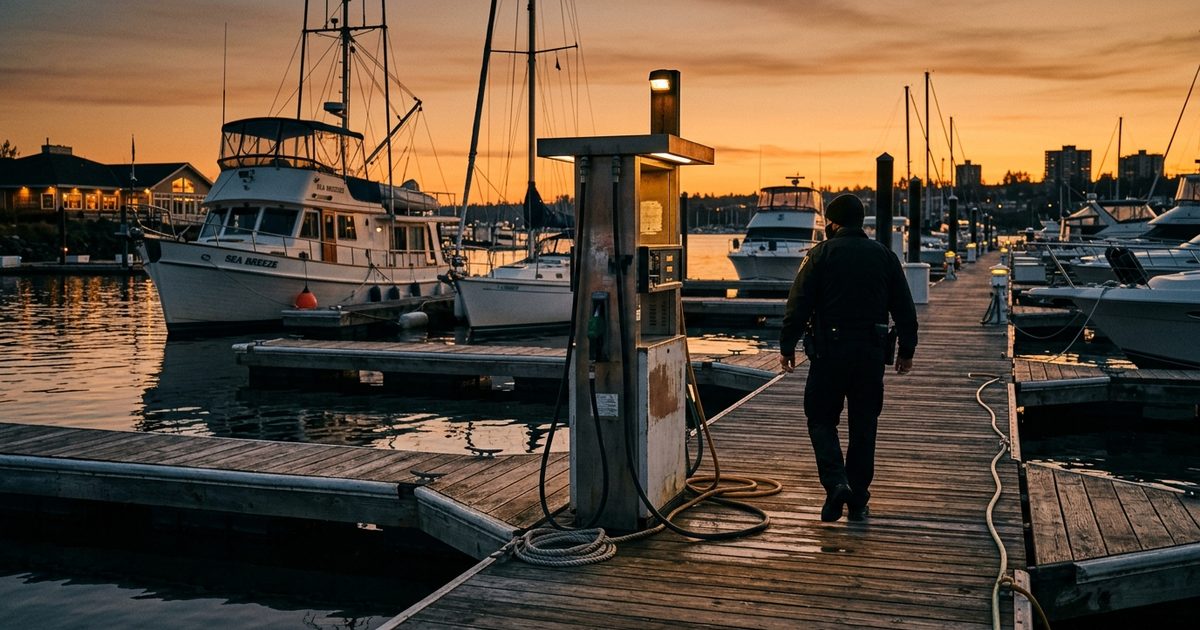
- Fuel dock: Dedicated coverage with loitering detection on unattended fueling positions, so after-hours siphoning triggers a live alert instead of a bad surprise at reconciliation.
- Dry-stack storage and the boatyard: Elevated coverage across rack rows and the cargo laydown area, watching the highest-density concentration of high-value, portable assets on the property.
The element that turns this from a camera list into protection is on-site presence backed by live response: a visible Mobile Surveillance Unit staged on the apron changes how the property reads to anyone scouting it from the water, and it covers ground a land-based install was never wired to reach — because a solar-autonomous unit goes where the slips are, not where the conduit runs.
Live Monitoring: Covering the Water Without a Night Watch
Paying someone to walk a dock all night is expensive and covers exactly one place at a time. A camera nobody is watching covers everywhere and does nothing. Live remote monitoring is the answer that actually scales across a waterfront.
Remote video monitoring routes every alert — a vessel approaching the fairway at 2am, movement between dry-stack racks, a figure lingering at the fuel dock — to a SOC operator who verifies it in real time. Confirmed as a genuine threat, the operator issues a live audio warning through the unit's speaker, which alone turns most water-borne intruders back before they ever reach a slip, then escalates to law enforcement with time-stamped footage and, where relevant, the gate's LPR record of any vehicle or trailer involved. That combination — thermal detection of the approach, plus a real human response before the boarding happens — is the one thing a fence line and a gate camera can never deliver on the water side.
It also solves the documentation problem that follows every marina incident. When an insurer needs to see what happened during a storm, or a slip-accident liability dispute needs resolving, or law enforcement needs an evidence package for a theft, the alert, the verification, the audio warning, and the footage are already logged — not reconstructed after the fact from a tenant's account of what they think went missing.
Deployment on the Water Side
Marinas and ports are hard sites to wire, which is exactly why most never get real water-side coverage in the first place. Running power and data down a pier means marine-rated conduit, corrosion-resistant fittings, and permitting that can take months — and even after all that, the install is fixed in place while slip assignments and seasonal risk keep shifting.
A solar-autonomous unit skips that entirely. It stages on the hard-standing or parking apron, covers the fairway and the gate from day one, and relocates to the fuel dock, the dry-stack yard, or a newly leased slip row as risk moves — no trenching, no marine electrical work, no waiting on a permit for a line down the dock. For port operators handling cargo alongside vessel traffic, the same unit extends to laydown areas the way it would on any exposed yard — a model shared with sites like truck and cargo terminals and open public-safety deployments that need coverage fast and without fixed infrastructure.
Common Mistakes in Marina & Port Security
- Treating the gate as the whole perimeter. A land-side gate camera and LPR cover exactly one approach. The water side — slips, gangways, the open fairway — is where the defining marina theft actually happens, and it needs its own dedicated coverage.
- Assuming standard cameras will hold up on a dock. Salt air corrodes standard gear faster than most operators expect. Coverage on a waterfront has to be built and hardened for marine conditions from the start.
- Leaving the fuel dock unattended and uncovered. An unmonitored fueling position after hours is close to an open invitation. Dedicated loitering detection there closes one of the highest-frequency loss points on the property.
- Recording without responding. Footage of a boat leaving with someone else's outboard on board documents the loss; it doesn't prevent it. Detection has to be tied to live verification and a real-time audio warning delivered while the intruder is still on the water.
- Wiring for today's slip layout only. Marinas re-lease slips, add dry-stack racks, and shift where the risk concentrates season to season. A fixed install locks coverage to where it was first run; a relocatable strategy keeps it where the exposure actually is.
Marinas and ports are a sharper version of a problem VDS sees across sprawling, low-staffed properties everywhere: the perimeter people plan for isn't the one intruders actually use. It's the same logic behind coverage on open shoreline and beach frontage and remote island properties reachable only by water — sites where the address on the deed and the actual line of approach are two different things, and where the security plan has to account for both.