
This article walks through that change stage by stage and what each one meant for the agencies using it.
The analog era: closed-circuit and videotape
Early public safety camera systems were closed-circuit television in the literal sense. Each camera had its own cable back to a control room, where its picture appeared on a monitor and was recorded to videotape.
The limits were built in:
- Resolution was low. Faces and license plates were often unreadable beyond a short distance.
- Tape was the bottleneck. To stretch a cassette over many hours, recorders captured only a few frames each second. Tapes had to be changed, labelled and stored, and they wore out with reuse.
- Finding footage was slow. Reviewing an incident meant locating the right tape and winding through it.
- Viewing was tied to one room. Seeing a camera meant being in front of the monitor it was wired to.
- Adding cameras was expensive. Every new location needed its own cable run.
Even so, these systems established the basic idea that cameras in public places could deter crime and help investigators. Evaluation research on CCTV goes back to that period; a widely cited review covers studies from 1978 onward.
Digital recording
The first major change kept the analog cameras and replaced the tape. Digital video recorders stored footage on hard drives. Investigators could jump straight to a date and time, copy a clip without degrading it, and keep recording while they reviewed. Retention became a matter of drive capacity instead of shelf space.
Image quality was still set by the analog camera, so this stage improved how video was handled more than what it showed.
Network cameras
The larger shift came when the camera itself became digital. A network, or IP, camera captures the image, compresses it and sends it as data over a standard network.
That brought several changes at once:
- Higher resolution. Megapixel sensors made identification possible at distances where analog showed only shapes.
- Shared infrastructure. Cameras could use existing data networks, and a single cable could carry both power and video.
- Remote access. Any authorized user on the network could view live or recorded video, from a district station, a command vehicle or headquarters.
- Easier growth. Adding a camera became a matter of connecting it to the network.
This is the stage at which city-wide camera networks and real-time monitoring centers became practical.
Wireless and cellular links
Fixed networks still depended on cable or fiber reaching every camera. Wireless links, and later 4G and 5G cellular, removed that requirement. A camera could be placed where incidents were happening instead of where infrastructure happened to exist.
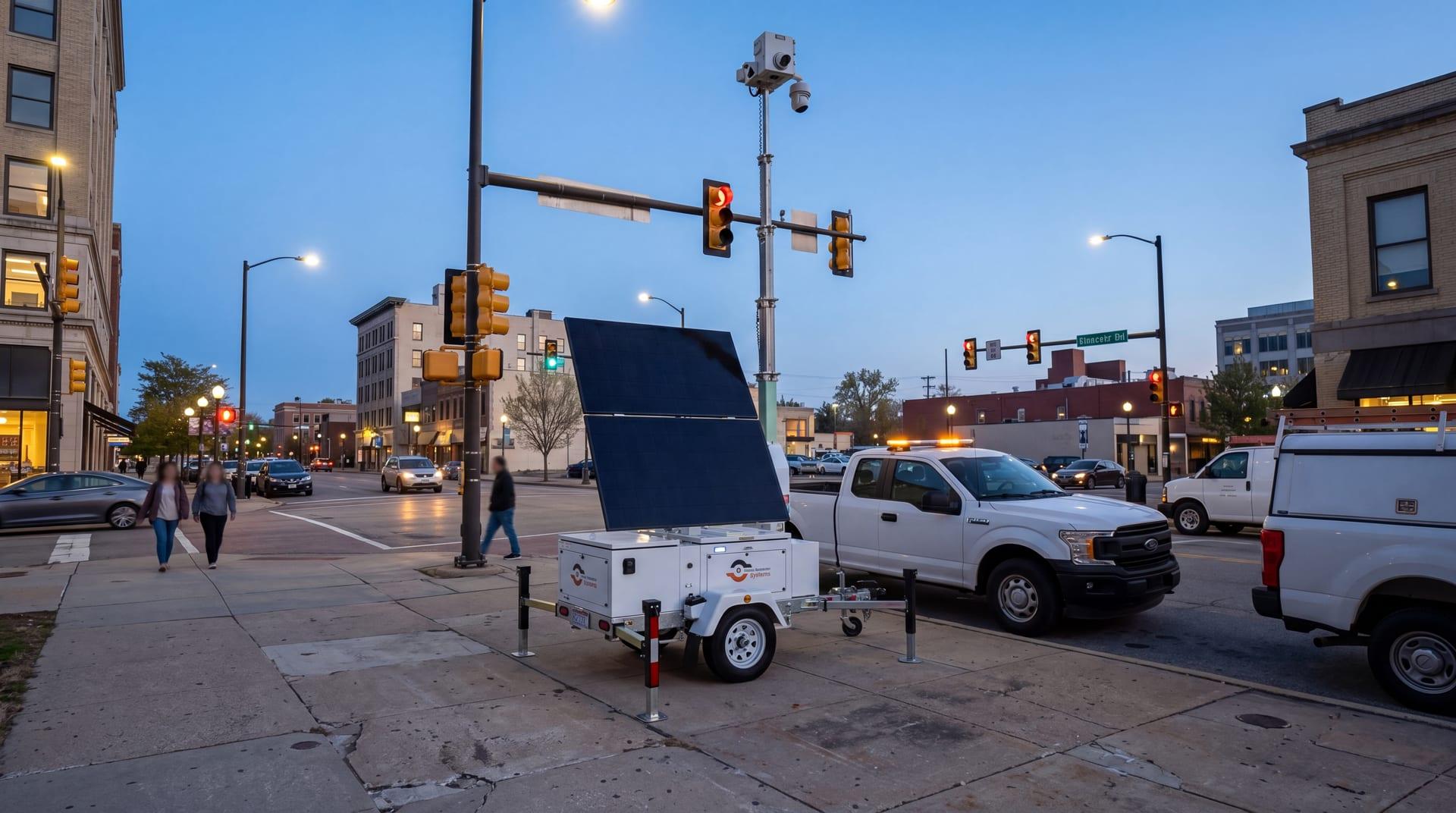
Combined with solar power and batteries, this made fully self-contained units possible. Mobile surveillance trailers carry cameras on a mast with their own power and cellular connection, and can be towed to a new location when the need changes.
Cloud storage and evidence handling
As connections improved, video storage and management moved from recorders in a closet to centrally managed and cloud-hosted systems. For agencies, the benefits are practical: footage is not lost if a local recorder fails or is damaged, retention periods can be set by policy, clips can be shared with prosecutors through a secure link, and access is logged for audit.
Video analytics and AI
The most recent change addresses a problem that grew with every earlier stage. More cameras produce more video than people can watch. Analytics software examines the video continuously and flags what matters:
- people or vehicles in a place or at a time they should not be;
- loitering and other patterns worth a look;
- license plates, read and checked against lists;
- searches of recorded video by attribute, such as vehicle type or color.
Operators then spend their attention on verified events. The research supports the value of that attention: a 2019 review of 76 studies found that actively monitored camera systems were associated with about a 15% reduction in crime, while recording-only systems showed no significant effect. See how AI video analytics fits into a monitored system.
Analog and digital compared
| Analog CCTV | Digital / IP | |
|---|---|---|
| Image quality | Low, fixed | High, megapixel |
| Recording | Tape, later hard drive | Network or cloud storage |
| Finding footage | Manual review | Search by time, event or attribute |
| Viewing | Dedicated monitors | Any authorized device |
| Adding cameras | New cable to each | Network or cellular connection |
| Automated detection | None | Analytics on camera or in the cloud |
| Security concerns | Physical access to tapes | Cybersecurity and access control |
What the change means for agencies
Monitoring is where the benefit is. Digital systems make real-time monitoring practical, and monitoring is what the research links to reduced crime.
Cybersecurity is now part of the job. A networked camera is a networked device. Strong credentials, encryption, patching and access logs matter as much as lens choice.
Equipment sourcing matters for funding. Section 889 of the National Defense Authorization Act restricts the use of federal funds on covered video surveillance equipment from certain manufacturers. Ask for written NDAA compliance documentation.
Policy has to keep pace. Higher resolution, longer retention and automated search raise privacy questions that older systems did not. Written policies on use, retention and access, shared with the public, help maintain trust.
Legacy cameras can be bridged. Encoders let existing analog cameras feed a digital system while they are replaced over time.
How VDS fits
Vision Detection Systems builds mobile surveillance units that bring the current generation of this technology to places with no infrastructure: solar power, 4G/5G cellular, a 5MP PTZ and three 8MP wide-angle cameras on a 22 ft telescopic mast (30 ft available), AI detection, and an optional 24/7 US-based security operations center. Read more about VDS for public safety agencies or talk to our team.
Sources
- Piza, E. L., Welsh, B. C., Farrington, D. P., & Thomas, A. L. (2019). CCTV surveillance for crime prevention: A 40-year systematic review with meta-analysis. Criminology & Public Policy, 18(1). onlinelibrary.wiley.com