
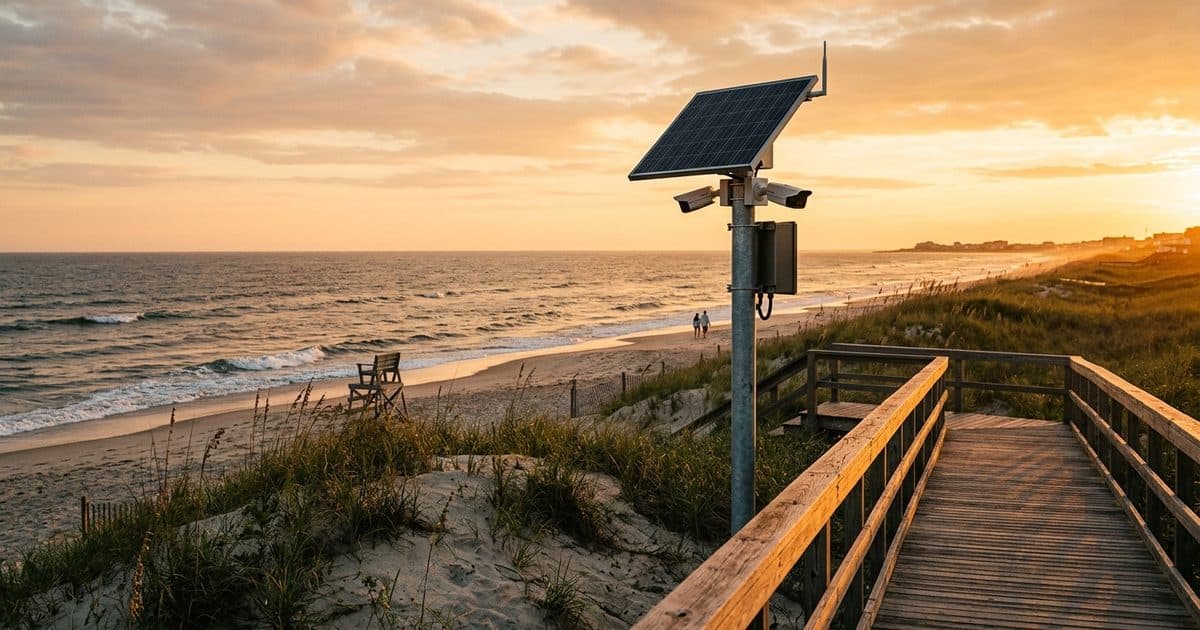
Deterrence monitoring changes that equation. Instead of trying to fence and light an entire shoreline — which is usually impossible and often illegal — the goal is to establish a visible, credible security presence at the access points and along the active zone, backed by a monitoring team that can respond in real time. This post covers the threats specific to coastal and waterfront sites, why standard CCTV fails at the shoreline, what an effective deterrence plan looks like, and how solar-autonomous mobile surveillance makes coverage possible where fixed infrastructure never will be.
The Threat Landscape at Beaches and Waterfront Sites
The risks at coastal sites cluster in the hours after the crowds leave. Municipal and resort beaches deal with after-hours trespass, alcohol and bonfire violations, illegal ATV and vehicle access on protected dunes, and the vandalism and litter that follow unsupervised gatherings. Lifeguard towers, restroom buildings, boardwalk concessions, and rental kiosks are recurring targets for break-ins and graffiti because they sit empty and isolated overnight.
Marinas and waterfront commercial sites carry higher-value exposure. Boats, outboard motors, marine electronics, fuel, and dock equipment are portable, valuable, and easy to move by water — a theft that arrives and leaves by boat leaves almost no trace. Waterfront construction and shoreline restoration projects stage expensive equipment and materials on open pads with no permanent security. Coastal parking lots and beach accesses see vehicle break-ins targeting the belongings visitors leave behind.
Beyond crime, waterfront operators increasingly need documentation for liability and environmental compliance: proof of who accessed a restricted dune or wetland, a record of a shoreline incident, or footage that supports an insurance claim after storm damage or a dock accident. The common thread across all of these is that the sites are remote from infrastructure even when they sit inside a populated town — the shoreline itself has no power poles, no fiber, and no place to mount a permanent camera that will survive the environment.
Why Standard CCTV Fails at the Shoreline
Fixed CCTV assumes three things a beach rarely provides: grid power, stable connectivity, and a durable mounting point in a non-corrosive environment. On an open shoreline, none of those are a given.
| Capability | Fixed CCTV | Solar Mobile Surveillance |
|---|---|---|
| Power source | Requires trenched grid power — rarely available past the parking lot | Solar panels with battery storage — fully autonomous, no grid required |
| Connectivity | Hardwired or fixed wireless — impractical to run to an open beach | 4G/LTE cellular — works anywhere with mobile signal |
| Environment | Standard housings corrode in salt air; blowing sand fouls lenses | Sealed, corrosion-resistant enclosures built for harsh outdoor use |
| Deployment | Permits, trenching, mounting — weeks, if it's even permissible | Hours — trailer tows to the access point, positions, powers on |
| Seasonality | Fixed year-round whether the risk is there or not | Deploy for the season or the event, then relocate |
There's also a permitting and environmental reality unique to the coast. Trenching power and mounting permanent structures on or near a protected shoreline often runs into coastal-zone regulations, dune-protection rules, and public-access requirements. A permanent camera pole on a public beach is frequently a non-starter. A mobile unit that stages on an existing parking apron or hard-standing at the access point sidesteps most of that — it introduces no permanent structure and leaves no footprint when it moves.
Tip: On the coast, mount and aim matter as much as the camera. Position units so lenses aren't taking constant direct salt spray off the water, keep solar panels angled to shed blowing sand and salt film, and specify enclosures with a high ingress-protection rating and marine-grade fasteners. A camera that's technically weatherproof but pointed straight into onshore spray will still fog and film over faster than one sited with the prevailing wind in mind.
What a Deterrence Plan Looks Like for Coastal Sites
An effective coastal plan starts from a simple truth: you are not going to fence the ocean. The objective is deterrence and detection, concentrated where people and vehicles actually enter and move.
For a typical beach, waterfront park, or marina, the plan usually covers:
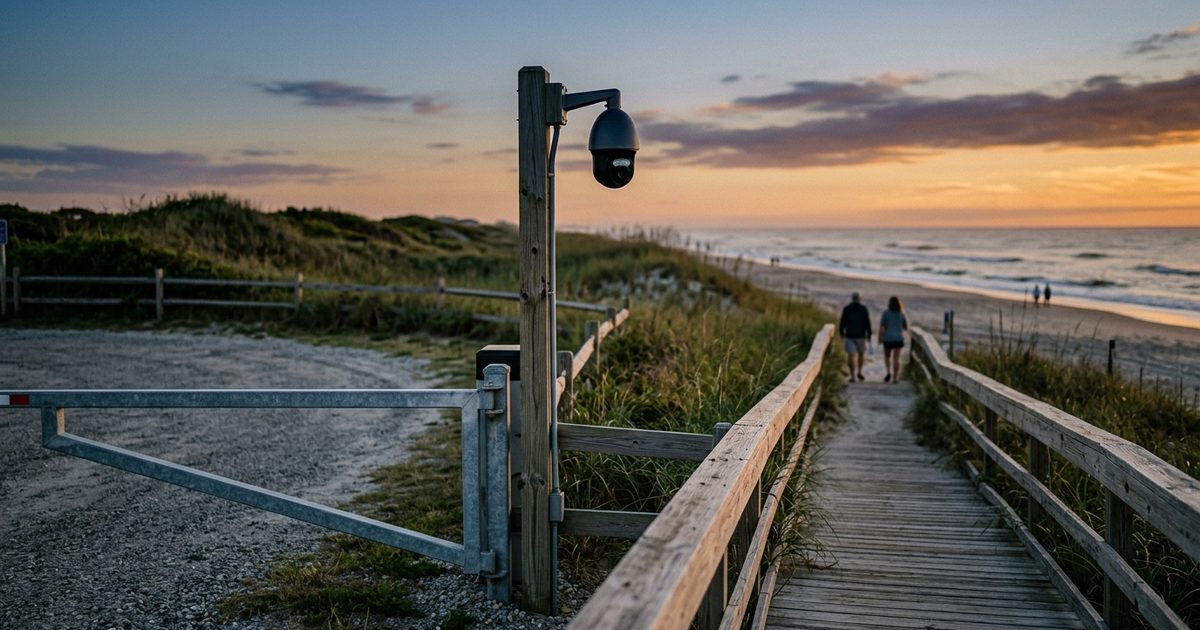
- Access points and entry roads: The chokepoints where vehicles and people come onto the site. This is the highest-value coverage position — a visible, lit Mobile Surveillance Unit here establishes presence before anyone reaches the shoreline, and captures identification-quality footage of who and what entered.
- Parking lots and beach accesses: Where vehicle break-ins concentrate. Wide-area coverage with pan-tilt-zoom lets a single position monitor a whole lot, and object detection analytics can flag a person moving between parked vehicles after hours.
- Structures and high-value assets: Lifeguard towers, restrooms, concessions, rental kiosks, docks, and staged boats or equipment. These fixed targets deserve dedicated, overlapping coverage so there's no single-camera blind spot.
- The active shoreline zone: For after-hours deterrence along the beach itself, thermal and loitering detection pick up movement in the dark where standard cameras see nothing — the moment that separates a real security tool from a camera that only works in daylight.
The element that makes coastal coverage genuinely deterrent, rather than just evidentiary, is on-site presence: visible cameras, active lighting after dark, and a speaker system. A dark beach invites the behavior operators are trying to stop. A lighting trailer or surveillance unit throwing light across the access and the near shore, with an obvious camera array, changes the character of the space and moves problem activity elsewhere before it starts.
Remote Monitoring: Turning a Camera Into a Response
A recording that's reviewed the next morning documents a problem. It doesn't stop one. The difference at a beach — where a patrol car might be twenty minutes away — is real-time verification and response.
Remote video monitoring connects the shoreline to a monitoring operations center where trained operators verify alerts as they happen. When a camera detects a vehicle driving onto a protected dune at midnight, or a group gathering around a lifeguard tower after close, the alert reaches a human operator who confirms it and executes a defined escalation: a live audio warning through the unit's speaker — often enough on its own to disperse a group — followed by contact with site management or a dispatch to local law enforcement with time-stamped footage in hand.
That verified-response model matters on the coast for the same reason it matters at any remote site: it eliminates the false alarms that make cameras easy to ignore, and it produces a documented record. Every alert, verification, and escalation is logged. When a waterfront operator needs to show a regulator that a restricted area was monitored, support an insurance claim after storm or vandalism damage, or hand law enforcement a clean evidence trail, the documentation already exists.
Seasonal and Event-Driven Deployment
Coastal risk is not constant — it spikes on a schedule. Summer season, holiday weekends, spring break, and waterfront events concentrate crowds and problems into defined windows, and then the beach empties out again. A permanent camera system sized for peak weekend risk is idle and corroding for the rest of the year.
Rapid, relocatable deployment fits the coast's rhythm. A unit can cover a beach through the summer season, shift to a different access after a rash of incidents, or drop into a waterfront festival or regatta for a weekend and leave when it's over. For temporary and event security, that flexibility is the whole point — coverage arrives when the risk does and doesn't strand capital in fixed infrastructure at a site that's quiet nine months a year.
The Solar Surveillance Kit extends the same solar-autonomous architecture to pole- and skid-mounted positions for operators who want a semi-permanent presence at a marina office, a boat-ramp, or a waterfront yard while keeping the flexibility to reposition.
Common Mistakes in Coastal and Waterfront Security
- Using land-grade cameras in a salt environment. Housings and hardware that are fine at an inland lot corrode within a season near the ocean. Salt spray and blowing sand degrade seals, foul lenses, and pit fasteners. Specify corrosion-resistant, sealed enclosures and marine-grade hardware from the start — retrofitting after failure costs more than doing it right.
- Trying to cover the whole shoreline instead of the access points. The shoreline is effectively infinite; the ways onto it are not. Concentrating coverage at entry roads, parking accesses, and chokepoints delivers far more security value than thinly spreading cameras along an open beach that no one can realistically watch end to end.
- Deploying cameras with no lighting or speaker. A camera alone, in the dark, is a passive recorder. Deterrence requires presence — visible lighting and the ability to deliver a live audio challenge. Without them, you document incidents instead of preventing them.
- Assuming cellular coverage without checking. Some stretches of coast, especially at the ends of barrier islands or below bluffs, have weak carrier signal. Verify signal strength at the exact deployment point before the system goes live rather than trusting a coverage map.
- Treating seasonal risk as permanent infrastructure. Installing fixed cameras sized for peak-season crowds means paying for and maintaining hardware that's exposed to the harshest environment on the property while sitting unused most of the year. A relocatable mobile strategy matches coverage to the season and moves assets to where the risk actually is.
For operators securing genuinely off-grid shorelines — private islands, remote resort beaches, and waterfront sites with no road access — the same solar-autonomous approach extends even further. Our guide to island and off-grid site security covers coverage where there's no infrastructure at all.