
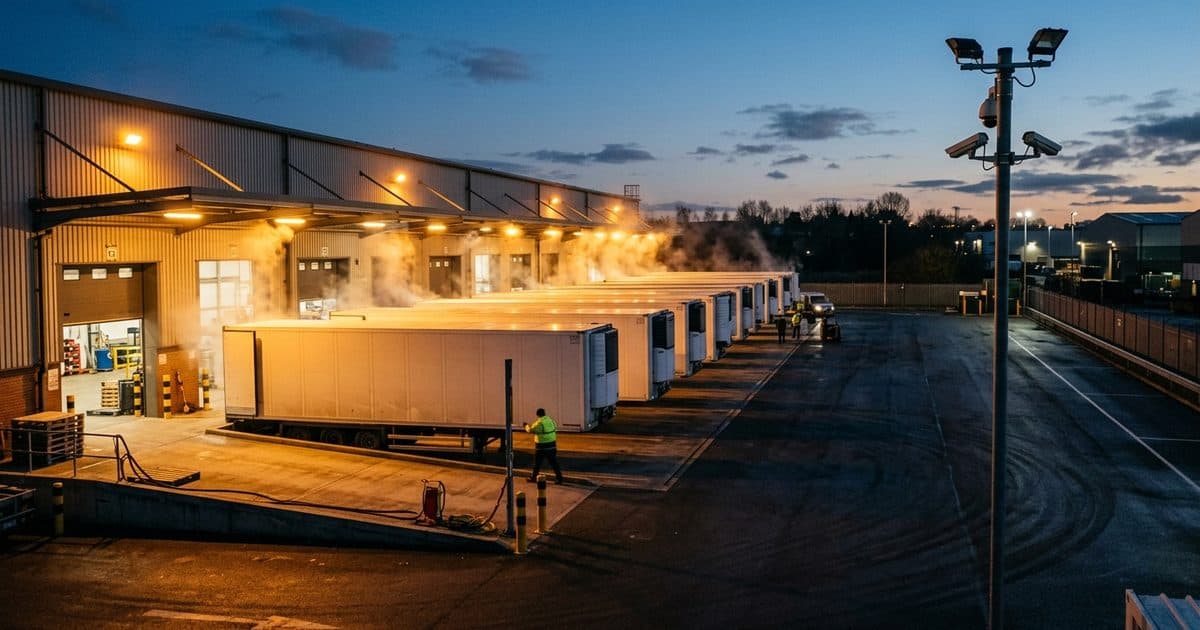
Cold storage and food distribution facilities carry a combination of risk factors that most warehouse operators never deal with at the same intensity. The yard is stacked with loaded reefer trailers worth far more than the empty box they'd be without the cargo inside. The facility runs 24/7, which means there's no clean "after hours" window — legitimate truck traffic moves through the gate around the clock, and a thief only needs to look like one more tractor in the queue. Loads of protein, seafood, and cold-chain pharmaceuticals carry six-figure values and move fast on the resale market. And the reefer units themselves burn diesel non-stop to hold temperature, which makes every unattended trailer a fuel target as well as a cargo target. This post covers the threats specific to cold storage and food distribution, why fixed CCTV can't keep pace with a yard this size and this busy, what a coverage plan actually looks like, and how gate LPR and live monitoring close the gap.
The Threat Landscape at Cold Storage & Food Distribution
The signature loss at a cold storage facility isn't a single break-in — it's a yard full of exposure that never fully closes. A loaded reefer trailer dropped in the yard overnight or over a weekend is, functionally, an unguarded asset worth tens of thousands of dollars sitting on wheels. Hitch a tractor to it and it's gone — cargo and trailer both — often before the loss is even noticed on the next shift.
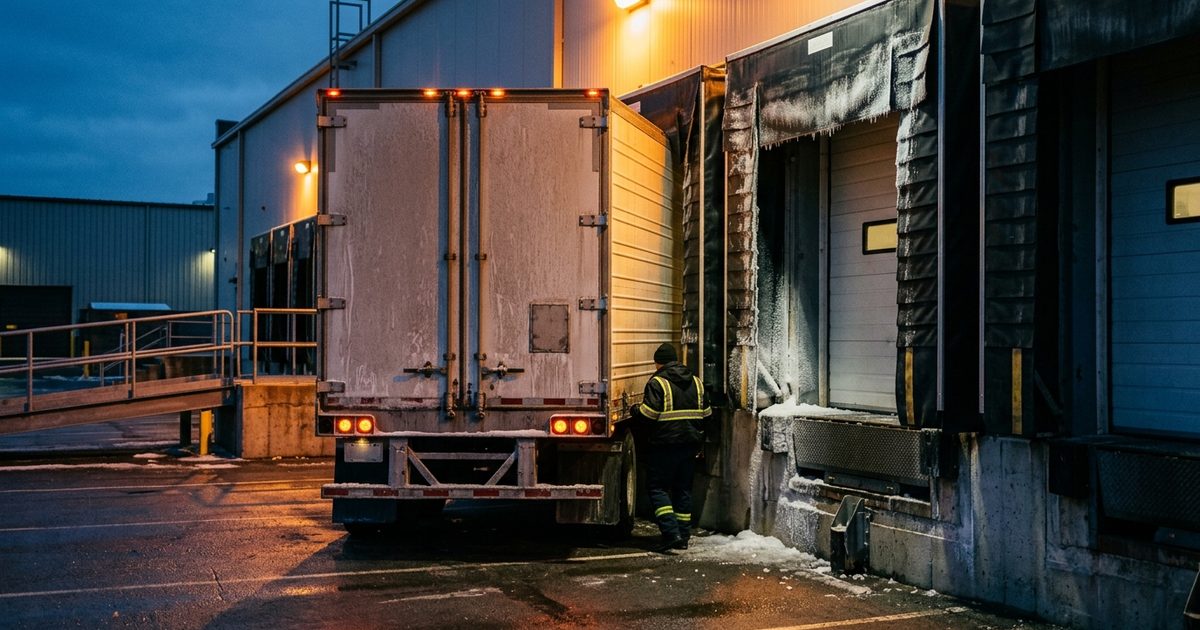
High-value perishable cargo staged at the dock or in a staging area carries the same exposure on a shorter timeline. Protein, seafood, and cold-chain pharmaceutical loads are staged for hours during shift changes and off-peak windows, and a facility running 24/7 has more of those transition windows than a standard warehouse ever does. Add fuel theft — reefer units idle continuously to hold temperature, and unattended trailers overnight are a routine target for siphoning that adds up fast across a full lot — and unauthorized access to a trailer or dock door that raises food-safety and tampering concerns on top of the direct loss, and a cold storage yard is exposed on multiple fronts simultaneously, all of it concentrated on ground that's difficult to watch continuously.
The through-line is scale and traffic. A distribution yard isn't a quiet, low-traffic lot where anything out of place stands out — it's acres of stacked trailers with a constant flow of legitimate tractors coming and going, which is exactly the cover a thief needs. The same conditions show up across logistics operations generally, and cold storage adds the extra pressure of genuinely perishable, genuinely high-value cargo sitting exposed on a clock.
Why Fixed CCTV Fails at a Cold Storage Yard
Most distribution facilities already run cameras at the dock and the office, which is why losses often come as a surprise. The problem is that fixed CCTV concentrates where conduit was easy to run and thins out fast across the acreage where trailers are actually staged — and none of it changes the outcome if the footage is only reviewed after a trailer is already missing.
| Capability | Fixed CCTV | Solar Mobile Surveillance |
|---|---|---|
| Coverage | Clustered near dock/office; thin across the drop lot and overflow yard | Elevated wide-area coverage across the whole trailer yard from one position |
| Seasonal & overflow lots | Requires new trenching and conduit to extend — rarely done | Solar and cellular — deploys anywhere trailers are staged, no wiring |
| Internet dependency | Needs a hardwired connection at every camera run | 4G/5G cellular backhaul, no hardwired internet required |
| Response | Passive recording reviewed after a trailer or load is reported missing | Live SOC verification and audio warning in real time |
| Expansion | Fixed; new trailer counts or lots mean new install work | Relocatable as volume and risk shift |
The deeper gap is response, not resolution. A camera that only produces footage for after a reefer trailer is reported missing does nothing to prevent the loss — it documents it after the fact, and by then the cargo is unrecoverable and the trailer is likely stripped or repainted. What changes outcomes is a system that detects the hitch connecting, the trailer moving, or the fence being breached as it happens — and puts a verified human response on it before the gate closes behind the thief.
Tip: Site coverage to watch the trailer rows, not just the dock apron. An elevated unit positioned to see down the lanes between stacked reefers catches someone approaching a hitch or working a fuel tank — the actual theft pattern — far better than a camera aimed at the loading doors. And put LPR at the one point every tractor has to pass regardless of where it's headed in the yard: the gate.
What a Coverage Plan Looks Like for a Cold Storage Yard
An effective plan covers the full footprint, weighted toward where trailers sit longest and cargo value is highest. For a typical cold storage or distribution yard it includes:
- The gate, with LPR: The universal chokepoint. License plate recognition at the gate ties every tractor and trailer to a plate and a timestamp, exposes mismatched or fraudulent pickups, and flags hotlisted vehicles. When a trailer goes missing, the gate log narrows the investigation to a specific window instantly.
- The reefer trailer drop lot: The highest-value ground on the property. Elevated coverage across the trailer rows with object detection to classify people versus vehicles and flag anyone approaching a hitch or fuel tank after hours.
- Dock doors and staging areas: Where perishable cargo is exposed during shift changes and loading windows — the moment a load is most vulnerable and least supervised.
- Perimeter fence line: The back and side lines around the yard where intruders bypass the gate entirely to reach staged trailers directly.
The element that converts this from recording to protection is on-lot presence backed by live response: a visible Mobile Surveillance Unit with lighting and a speaker changes how the yard reads to anyone scoping it, and it covers overflow and seasonal staging areas a fixed system was never built to reach — because a solar-autonomous unit goes where the trailers are parked this month, not where the conduit happens to run.
Remote Monitoring: A Live Operator on Every Alert
The most expensive way to watch a cold storage yard is a full-time guard force covering acres of trailers around the clock, and the least effective is a camera bank no one is actively watching during a 2am shift lull. Live remote monitoring is the middle path that beats both.
Remote video monitoring routes every alert to a SOC operator who verifies it in real time. When a camera flags someone approaching a hitch or a tank at 3am, the operator confirms it isn't yard staff doing a routine check, then acts: a live audio warning through the unit's speaker — which alone clears most people off the lot — followed by escalation to law enforcement with time-stamped footage and the gate's LPR record of what drove in and when. The person counting on acres of stacked trailers and constant legitimate traffic to provide cover instead meets an immediate, verified human response.
That model does two things a single patrol round can't. It watches the entire yard continuously instead of wherever one patrol happens to be walking, and it produces a documented record for every incident — the alert, the verification, the escalation, the plate, all logged and timestamped. When a claims adjuster asks what happened to a missing load, or law enforcement needs an evidence package to work a theft ring targeting reefer trailers, the documentation already exists. Multi-site operators get the same standard of coverage at every yard from a single SOC, without staffing each location separately — see how the same model plays out in case studies across sites.
Deployment That Matches How Cold Storage Operations Run
Distribution volume moves with the season, and trailer counts on a given yard can swing hard week to week. A fixed camera system installed for a typical volume day doesn't flex when the overflow lot fills up during a peak stretch — coverage stays where it was trenched, regardless of where the trailers actually are.
A relocatable solar-autonomous approach keeps pace with operations instead of lagging behind them. A unit covers the overflow lot the week it fills, shifts to a new staging area after a theft, or drops onto a newly leased yard while a permanent plan is designed — no trenching, no conduit, no waiting on an electrician or an ISP to run a line. Coverage becomes something you position where the trailers and the risk are this week, not infrastructure frozen in place from the original install.
Common Mistakes in Cold Storage & Distribution Security
- Clustering cameras at the dock and office. The losses happen in the trailer drop lot and the overflow yard, exactly where fixed coverage thins out fastest. Weight coverage toward where reefers actually sit, not the front office.
- Recording without responding. Footage that only gets reviewed after a trailer is reported missing prevents nothing. Detection has to be tied to live verification and a real-time audio warning to change the outcome.
- Skipping LPR at the gate. The gate is the one universal chokepoint every tractor and trailer passes through. Without a plate-and-time record, mismatched pickups and fraudulent releases stay invisible until the load is already gone.
- Treating 24/7 traffic as cover instead of a control problem. Constant legitimate truck movement makes it easy to assume anomalies will stand out on their own. They don't — without AI classification and alerting, one more tractor in the queue looks exactly like every other one.
- Leaving fuel theft unaddressed. Idling reefer units bleed diesel to thieves every night a yard goes unmonitored. It's a slower loss than a stolen trailer, but it adds up across a full lot and is just as fixable with the same coverage.
Cold storage and food distribution sit alongside truck and cargo yards as sprawling, high-value, always-open environments where the same solar-autonomous, live-monitored model closes the exposure a guard shack and a handful of fixed cameras never could. If you're ready to talk through your yard, get started or contact our team directly.