
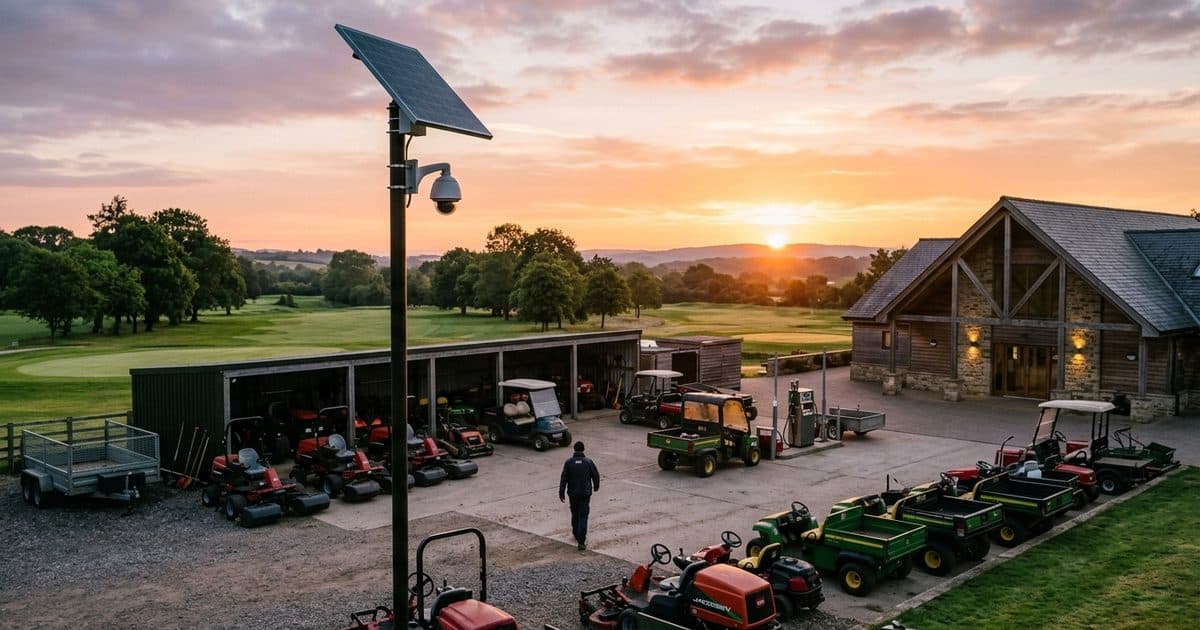
That scale is the whole problem. A country club's most valuable, most stealable assets — a fleet of golf carts, six-figure mowers and utility vehicles, bulk fuel — sit in an open-air maintenance yard every night, while the course itself is hundreds of acres of unlit, largely unfenced ground that a determined trespasser can cross in a dozen places. Add a clubhouse and pro shop holding cash and inventory after the last tee time, and a club is exposed on every front at once, usually with nothing more than a padlock and a hope that no one tries the gate. This post covers the threats specific to golf courses and country clubs, why fixed cameras can't cover ground this size, what a coverage plan actually looks like, and how solar-autonomous surveillance with gate LPR and live monitoring closes the window.
The Threat Landscape at Golf Courses and Country Clubs
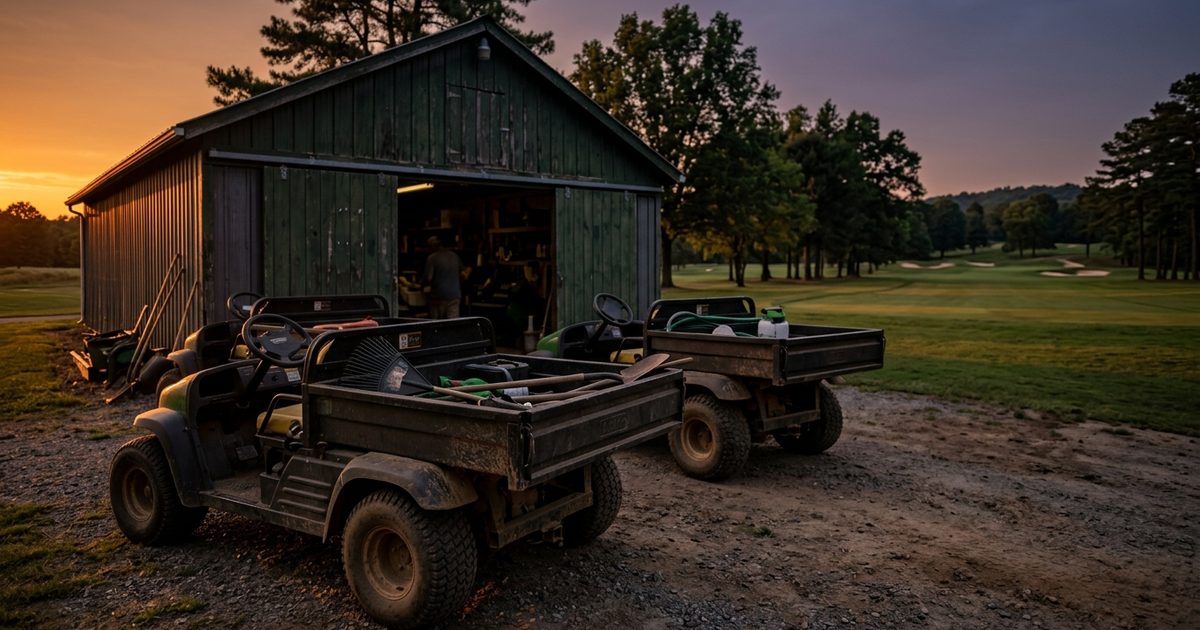
The signature loss at a golf course starts in the maintenance compound. A fleet of golf carts and a lineup of mowers, utility vehicles, and turf equipment worth well into six figures sits in an open yard overnight, often behind nothing sturdier than a chain-link gate. A cart is easy to start, easy to drive off the property on cart paths that lead straight to a public road, and easy to sell for parts. Turf equipment is worse — a stolen mower or aerator can take weeks to replace and can shut down maintenance on parts of the course in the meantime.
The course itself invites a different kind of loss: joyriding. Trespassers who cut through a tree line or an unfenced boundary take carts or vehicles across greens and bunkers for fun, and the turf damage from a set of tires across a putting green or through a sand trap can run into the tens of thousands of dollars to restore — sod, leveling, and lost play on that hole while it heals. Fuel theft from bulk tanks in the compound adds up quietly across a season, a few gallons siphoned at a time with no one ever catching it in the act. And the clubhouse and pro shop, holding cash, retail inventory, and member data, sit locked and unattended the moment the last group finishes — an obvious target once the lights go off and the parking lot empties.
The through-line is acreage. A course this size can't be fenced meaningfully, can't be lit meaningfully, and can't be patrolled meaningfully by a single night watchman walking a property that takes twenty minutes to drive end to end. Every one of these losses happens in the same unwatched hours, spread across ground no clubhouse camera was ever going to reach.
Why Fixed CCTV Can't Cover a Golf Course
Clubs that already have cameras are often surprised to keep taking losses, and the reason is straightforward: fixed CCTV goes where the wiring is easiest to run — the clubhouse, the pro shop, maybe the main entrance — and simply doesn't exist across the compound, the back nine, and the tree lines where the actual exposure sits.
| Capability | Fixed CCTV | Solar Mobile Surveillance |
|---|---|---|
| Coverage | Clustered near clubhouse/entrance; none across compound or fairways | Elevated wide-area coverage across compound and adjoining holes from one position |
| Darkness | Standard CCTV loses detail across unlit acreage at night | Thermal detection sees people and vehicles in total darkness |
| Extending reach | Requires trenching across turf and conduit runs — rarely justified | Solar and cellular — deploys anywhere on the property, no wiring |
| Response | Passive recording reviewed after the greens crew finds tire tracks | Live SOC verification and audio warning in real time |
| Seasonal flexibility | Fixed; can't follow where risk shifts through the season | Relocatable to the compound, a vulnerable hole, or the lot as needed |
The deeper gap, as with any fixed system, is response. Footage of tire tracks across the ninth green on Monday morning tells the superintendent what happened Saturday night — it does nothing to have stopped it. What changes outcomes is a system that detects the trespass as it starts, verifies it, and puts an audio warning on the course before a single tire crosses the collar of the green.
Tip: Site the primary unit at the maintenance compound first, not the clubhouse — it's where the highest-value, easiest-to-move assets sit, and a thermal-capable unit there also covers the two or three adjoining holes most exposed to a tree-line trespass. A second unit or a repositioned trailer can then follow the seasonal risk, whether that's a vulnerable back-nine hole in the fall or the parking lot during a tournament.
What a Coverage Plan Looks Like for a Golf Course
An effective plan weights coverage toward the compound and the after-hours risk, not the clubhouse frontage that already tends to be covered. For a typical course it includes:
- The entrance, with LPR: The single road onto the property. License plate recognition ties every entry and exit to a plate and a timestamp and flags any vehicle on the property after hours — the highest-value single camera position on a course with one way in.
- The maintenance compound: The cart barn, equipment shed, and fuel tanks, covered with object detection that classifies people versus vehicles and flags movement the moment the gate is approached after close.
- Remote holes and tree lines: The back-nine holes and perimeter boundaries far from the clubhouse where trespassers cut through unfenced ground, watched with loitering detection and thermal imaging that works in zero light.
- Clubhouse, pro shop, and pool: Amenity areas that see break-ins and vandalism once the last group leaves, covered as part of the same monitored system rather than a separate, disconnected alarm.
The element that turns this from recording into protection is on-property presence backed by live response: a visible Mobile Surveillance Unit parked at the compound with lighting and a speaker changes how the property reads to anyone scoping it — and holes and yard corners a fixed system never covered are suddenly watched, because a solar-autonomous unit goes where the risk is, not where the conduit happens to run. A lighting trailer or standalone solar light at the compound adds visible deterrence on top of the camera coverage without any additional wiring.
Live Monitoring: The Night Watchman, Replaced
The most expensive way to watch 150 acres is a night watchman driving a cart around a dark course, and the least effective is a camera no one is watching. Live remote monitoring is the middle path that beats both.
Remote video monitoring routes every alert to a SOC operator who verifies it in real time. When a thermal camera flags movement crossing into the compound at 1am, the operator confirms it isn't a legitimate late-night vendor or staff member, then acts: a live audio warning through the unit's speaker — which alone clears most joyriders and trespassers off the property in seconds — followed by escalation to law enforcement with time-stamped footage and the entrance's LPR record of what drove in. The trespasser who counted on 150 dark, unwatched acres instead meets an immediate, human response before a cart ever reaches the first green.
That verified-response model does two things a single watchman can't. It covers the compound, the entrance, and the exposed holes simultaneously instead of wherever one person happens to be driving, and it produces a documented record for every incident — the alert, the verification, the escalation, the plate, all logged. When a superintendent files an insurance claim for turf damage or a general manager hands law enforcement an evidence package after an equipment theft, the documentation already exists.
Deployment That Matches How Risk Moves Through a Season
Golf course risk isn't constant. Cart and equipment exposure peaks in the off-season when the compound sits fuller and staff presence drops; joyriding spikes around holidays and weekends; a tournament week concentrates risk in the parking lot and clubhouse instead of the back nine. A fixed camera system installed once can't follow any of that.
A relocatable solar-autonomous approach keeps pace with the season. A unit covers the compound through the winter, shifts to a vulnerable hole after a joyriding incident, or moves to the lot for tournament week — no trenching across turf, no conduit under a green, and no waiting on an electrician to reach a corner of the property three fairways from the clubhouse.
Common Mistakes in Golf Course Security
- Covering the clubhouse and leaving the compound bare. The highest-value, easiest-to-move assets — carts, mowers, fuel — sit in the maintenance yard, which is usually the last place a club adds a camera, not the first.
- Relying on standard cameras for a property with no lighting. Most of a course's acreage is unlit at night. Without thermal detection, a camera pointed at open fairway sees almost nothing after dark.
- Recording without responding. Footage of tire tracks on the ninth green documents a loss that already happened. Detection has to be tied to live verification and a real-time audio warning to actually prevent it.
- Skipping LPR at the one entrance. A single-entrance property is the easiest chokepoint on any type of site to secure well — skipping it there is the costliest missed opportunity.
- Treating coverage as fixed instead of seasonal. Risk moves through the calendar — compound in winter, fairways on weekends, the lot during tournaments. A fixed system installed once can't follow it; a relocatable strategy can.
Golf courses and country clubs sit alongside other sprawling, low-staffed properties where the same solar-autonomous, live-monitored model closes the after-hours gap — from gated HOA and residential communities managing the same unfenced-perimeter problem at a smaller scale, to open public parks fighting after-hours vandalism across acreage no fixed camera was ever going to reach. If your course has 150 acres and one road in, the coverage plan starts in the same place: the compound, the entrance, and a live operator watching both. Talk to our team or browse recent case studies to see how it plays out on a property like yours.