
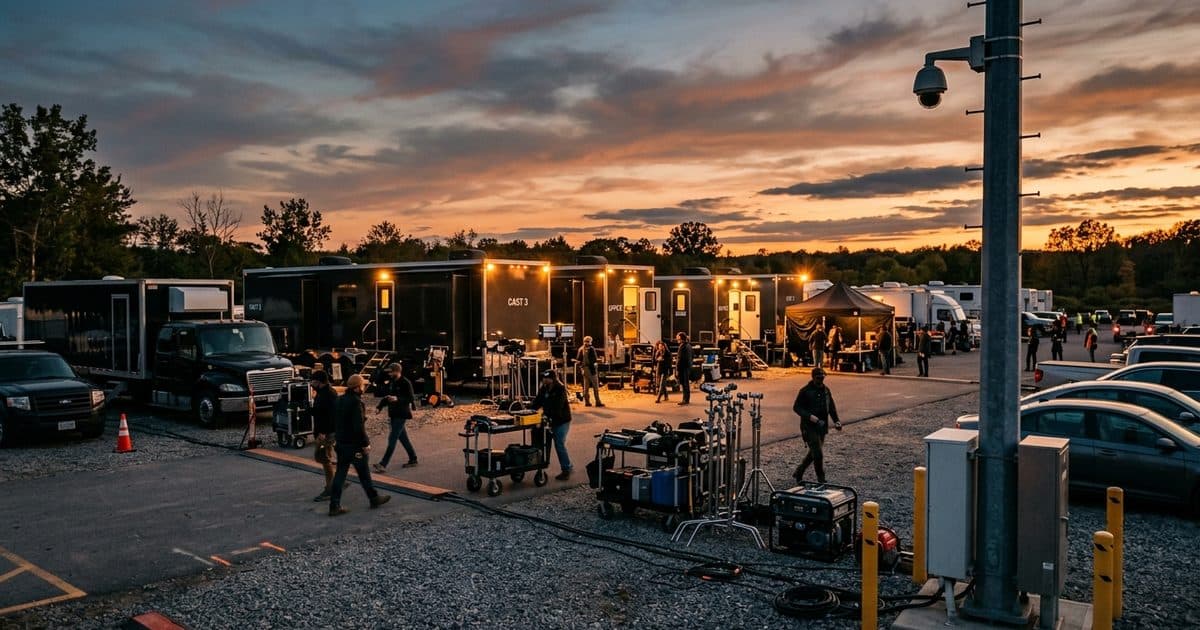
Every production faces the same structural problem. A show can carry hundreds of thousands of dollars in camera, lighting, and grip equipment into a parking lot, a backlot, or a remote field that has never needed to be secured before, hold it there for a matter of days, and then move on. Traditional security — guards, fixed cameras, hardwired alarm systems — is built for a permanent address. Production isn't one. This post covers the threats specific to film and TV sets, why traditional guard-and-camera security falls short on a location that changes every week, what a coverage plan built for a production actually looks like, and how solar-autonomous surveillance with gate LPR and live monitoring closes the gap between wrap and the next call time.
The Threat Landscape on a Production Location
The signature production loss is equipment walking off a truck. Camera packages, lighting rigs, and grip gear get staged in an open lot overnight between shoot days, and a single unlocked or unwatched truck can turn into a six-figure loss and a shut production day while the insurance claim and replacement rental get sorted out. Because the lot usually has no security history and no fence, there's often nothing between the gear and the street but distance.
Base camp carries the same exposure at a smaller scale spread over a wider area — trailers, generators, wardrobe, and the equipment village sit unattended for hours between wrap and the next call time, on ground with no lighting plan built around security. Closed sets add a different kind of threat entirely: trespassers, paparazzi, and the occasionally-too-curious local slip past a thin production assistant perimeter to get a photo, a script page, or a look at talent, and every breach is both a physical liability and an IP exposure the production didn't budget for. Layer on the dozens of crew, vendor, and rental vehicles moving through a single access point every day, and a production without a real access record has no reliable way to say who came, who went, and who shouldn't have been there at all.
The through-line is temporariness. A production is only ever at a given location for days, sometimes hours, which means every location starts from zero — no cameras, no fence, no history — and the security has to arrive as fast and complete as the rest of the show.
Why Traditional Security Falls Short on a Moving Production
Guards and fixed cameras are the default answer because they're the familiar answer, not because they fit how a production actually operates. Posted coverage has to be re-scheduled and re-briefed on a new layout every time the location changes, and paid whether or not anything happens — and a walking patrol still can't watch an entire equipment village and a closed-set perimeter at the same time. Fixed CCTV is worse: it requires power and often a wired connection, neither of which exists on a remote location or a backlot, and by the time an install is even feasible, the shoot has moved to the next address.
| Capability | Guards & Fixed CCTV | Solar Mobile Surveillance |
|---|---|---|
| Setup time | Days to schedule guards or run power/wiring for cameras | Deploys and is monitoring in under 20 minutes, any location |
| Power & connectivity | Needs grid power and often hardwired internet | Solar-autonomous with 4G/5G — no infrastructure required |
| Coverage | One guard covers one area at a time; cameras cover only where wired | Elevated wide-area coverage across base camp and the perimeter at once |
| Response | Passive recording, or a single roaming guard who may be elsewhere | Live SOC verification and real-time audio warning on every alert |
| Relocation | New schedule, new install, every new location | Breaks down and redeploys with the rest of production |
The deeper gap is the same one every temporary environment runs into: security infrastructure built for a fixed address can't move at the speed a production does, and a guard headcount large enough to watch a sprawling location around the clock is rarely in the budget. What a production actually needs is coverage that shows up as fast as the grip truck and leaves the same way.
Tip: Put the LPR camera at the single access point every vehicle has to use — not spread thin across multiple gates. On most locations there's one real chokepoint even if it doesn't feel like it; find it, and that one camera does more for your access record than three cameras scattered around the lot.
What a Coverage Plan Looks Like for a Production
An effective plan follows the call sheet, weighted toward where the value and the after-hours risk actually sit:
- The location entrance, with LPR: The single point every crew, cast, and vendor vehicle passes through. License plate recognition ties every entry and exit to a plate and a timestamp and flags any vehicle that isn't on the day's approved list.
- Base camp & the equipment village: Trailers, generators, and staged gear covered from an elevated position, with object detection classifying people versus vehicles and flagging movement near equipment after the crew clears out.
- The closed-set perimeter: Where trespassers and paparazzi try to get close. Loitering detection flags anyone lingering near the perimeter rather than passing through, giving the SOC time to respond before a breach happens.
- Standing sets left overnight: Built and dressed sets held across multiple shoot days need the same overnight coverage as the equipment village — they're just as expensive to replace and just as exposed.
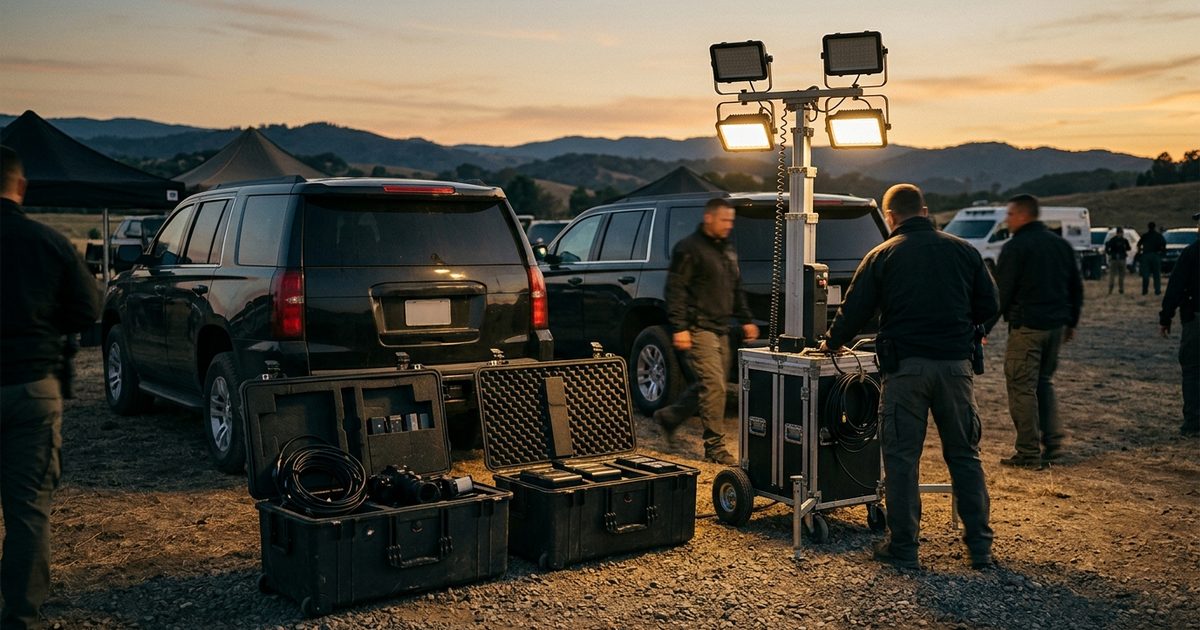
The piece that turns this into protection rather than documentation is visible, on-location presence: a Mobile Surveillance Unit with a lighting trailer and an audio speaker changes how the location reads to anyone considering a breach, and because it runs on solar power, it goes anywhere the call sheet points — not just where a generator or a wired connection happens to already exist.
Remote Monitoring: Security That Scales With the Call Sheet
Staffing a large enough guard team to watch every access point on a sprawling location around the clock is rarely realistic, and a fixed camera system that nobody is actively watching only ever produces evidence after the fact. Live remote monitoring is the model that closes both gaps at once.
Remote video monitoring routes every camera alert to a SOC operator who verifies it in real time. When a camera flags movement near the equipment village at 2am, or someone lingering at the edge of a closed-set perimeter during a take, the operator confirms whether it's a legitimate crew member or a genuine breach, then acts — a live audio warning through the unit's speaker, which alone clears most people off the location, followed by escalation to production security or law enforcement with time-stamped footage and the entrance's LPR record of what vehicle it involved. The trespasser who counted on a thin, distracted perimeter instead meets an immediate human response, without production having to schedule and brief a guard team for every new address.
That verified-response model also produces something after-the-fact reporting rarely captures consistently: a documented record for every incident — the alert, the verification, the escalation, the plate — ready to hand to production insurance, a completion bond company, or law enforcement without reconstructing the night from memory.
Rapid & Temporary Deployment, Built for How Productions Actually Move
A production doesn't get the luxury of a security plan built in advance for a permanent facility. It gets a call sheet, a location, and a matter of hours before crew, gear, and talent are all on site — and it needs security to arrive on the same timeline, then pack up and move on the same one too. This is the same underlying need temporary and event security addresses: coverage that exists for exactly as long as it's needed and nowhere near as long as a permanent install would take to plan.
A solar-autonomous MSU fits that rhythm directly. It arrives with the rest of production, deploys in under 20 minutes with no site prep, runs the length of the shoot on solar and cellular with no dependency on the location having power or connectivity, and breaks down to move to the next address the moment the last truck pulls out. Multi-location and episodic productions get the same standard of coverage at every stop instead of reinventing a security plan — and a budget — for each new location.
Common Mistakes in Production Set Security
- Assuming guards scale with the location. A walking patrol can't watch an equipment village and a closed-set perimeter simultaneously. Coverage has to be wide-area, not headcount-dependent.
- Skipping LPR at the entrance. Without a plate-and-time record of every vehicle, there's no way to say who was on location when something goes missing or a breach happens.
- Treating base camp as low-risk. Trailers, generators, and staged gear left overnight are just as valuable as anything on the actual set, and typically the least watched part of the location.
- Recording without responding. Footage that only gets reviewed after a theft is reported doesn't prevent it. Alerts need to reach a live operator who can act in the moment.
- Rebuilding the security plan from scratch at every location. A relocatable, solar-autonomous unit carries the same coverage standard from location to location instead of starting from zero every time the call sheet changes.
Film and TV production is one of the clearest cases of a high-value, temporary environment that traditional fixed security was never built for. It's the same challenge that shows up across event and temporary deployments more broadly — massive value concentrated in a short window, on ground with no existing infrastructure, that needs real coverage on day one and no lingering footprint once the last truck leaves.