
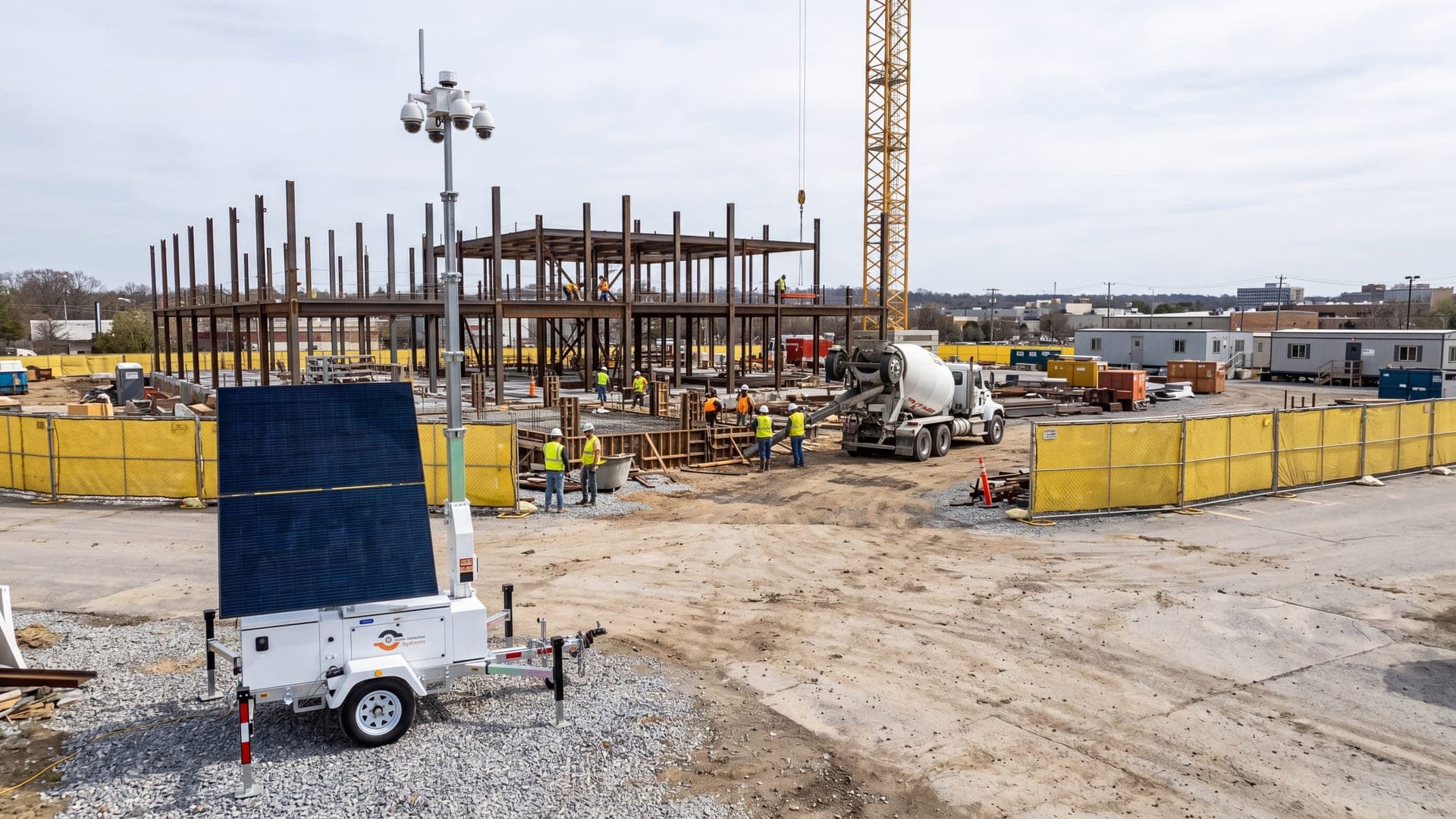
Why height changes what a camera can see
A camera at ground level is blocked by whatever is in front of it. Parked vehicles, shipping containers, stacked pallets, building materials and fences all create shadows where nothing can be seen. Raising the camera lifts its line of sight over those objects and opens up long, continuous views across a site. That is the main reason surveillance trailers use telescopic masts rather than fixed short poles.
Height also changes the geometry of the view. From higher up, the camera looks down at a steeper angle. That reveals more of the scene, but it reduces how much of a person's face or a vehicle's plate is visible at a given distance. Our guide on how high to mount security cameras explains why. The practical result is that the tallest setting is not automatically the best one.
Choosing a height for the job
Match the mast height to what the camera is there to do. Wide overview of a large yard favors more height. Close identification of a gate or entry point favors a lower, more direct angle. A trailer can often do both, using a wide-angle view for awareness and a zoom camera for detail.
- Open lots and large sites, where obstructions are common, benefit from more height.
- Gate and entry coverage often works better at a moderate height with a shallower angle.
- Sites with tall equipment, stacked stock or buildings need enough height to see over them.
- Locations near trees or power lines may limit how high the mast can safely go.
The security camera field of view guide goes deeper on how lens choice and angle affect coverage.
How wind affects a mast
Wind pushes against the mast, the cameras and the trailer body. The higher the mast, the more leverage that force has on the base. Two separate problems follow. The first is stability, meaning whether the trailer can tip, slide or shift. The second is image quality, because even a mast that is safe can sway or vibrate enough to blur a long zoom shot.
Exposed sites, such as open lots, hilltops, coastal areas and large flat yards, tend to see more wind than sheltered ones. Gusts matter as much as steady wind. A reliable setup plan accounts for the windiest realistic conditions at the site, not the typical day.
Stability and setup on the ground
A stable trailer starts with the surface it sits on. Firm, level ground gives the stabilizers a solid base. Soft soil, loose gravel, fresh fill and wet grass can all let a stabilizer sink or shift, especially under the added load of a raised mast.
- Pick the most level, firm spot that still gives the coverage you need.
- Set the trailer so the mast will rise plumb, not leaning.
- Deploy the stabilizers or jacks fully, following the manufacturer's procedure.
- On soft ground, add load-spreading pads under each stabilizer.
- Check level again after the stabilizers take weight, since they can settle.
- Raise the mast only after the trailer is stable, and confirm it stays plumb.
If the ground slopes, do not rely on the mast to compensate. Level the trailer itself, and move it if the slope is beyond what the stabilizers can correct. For a full walkthrough of the process, see how to deploy a surveillance trailer.
Weather limits and when to lower the mast
Every telescopic system has wind limits set by its maker. Treat them as real. Check the forecast before and during deployment, and lower the mast when conditions are expected to exceed the limit. Lowering the mast brings the center of gravity down, reduces the sail area and protects the equipment. Ice, heavy snow and lightning are also reasons to lower it or to take extra care.
Ask any provider how they handle severe weather. A good answer covers who monitors the forecast, how quickly the mast can be lowered and what happens to coverage while it is down. Some programs lower masts remotely or on a schedule when a storm is predicted, while others rely on on-site staff.
Quick reference
| Concern | What to check | Practical response |
|---|---|---|
| Blind spots | Obstructions between camera and target | Add mast height or move the trailer |
| Lost detail | Steep viewing angle at long range | Use zoom camera, adjust height |
| Tipping or sliding | Ground firmness, stabilizer footing | Pads, firm level spot, full stabilizers |
| Image blur | Mast sway in wind | Lower mast, rely on stabilization |
| Severe weather | Forecast vs. rated wind limit | Lower the mast per manufacturer guidance |
| Overhead hazards | Lines, trees, structures | Choose a clear spot before raising |
Trailer or fixed tower
A fixed tower is anchored into the ground, so it handles wind through its foundation rather than its stabilizers. A trailer trades that permanence for speed and mobility. Our comparison of the mobile security tower versus trailer lays out the tradeoffs, including setup effort and where each makes sense.
Set up for repeat deployments
Trailers move, and each new location brings new ground, wind and overhead conditions. Build a short setup routine and use it every time, so that nothing depends on memory. A simple routine covers a walk of the spot, a check of overhead clearance, leveling, stabilizer deployment, a second level check and only then mast extension.
Record what you find. Notes on a site's wind exposure, soft areas and clearance problems help the next deployment there, and they help the person who is setting up if it is not the same one each time. Photos of a good setup on a given site are useful reference. If a location repeatedly causes trouble, such as a persistently windy corner, that is a sign to pick a different spot or accept a lower mast position there.
How VDS fits
The VDS mobile surveillance unit raises a 5MP PTZ camera with 25x optical zoom and three 8MP wide-angle cameras on a 22 ft telescopic mast, with a 30 ft mast available. On-site setup takes one person under 20 minutes, and the unit needs no site power, internet or trenching. Site conditions such as ground, wind exposure and overhead clearance still shape where it goes, so describe your site when you ask for a quote. You can see the configuration on the mobile surveillance unit page, or talk to our team about your site.