
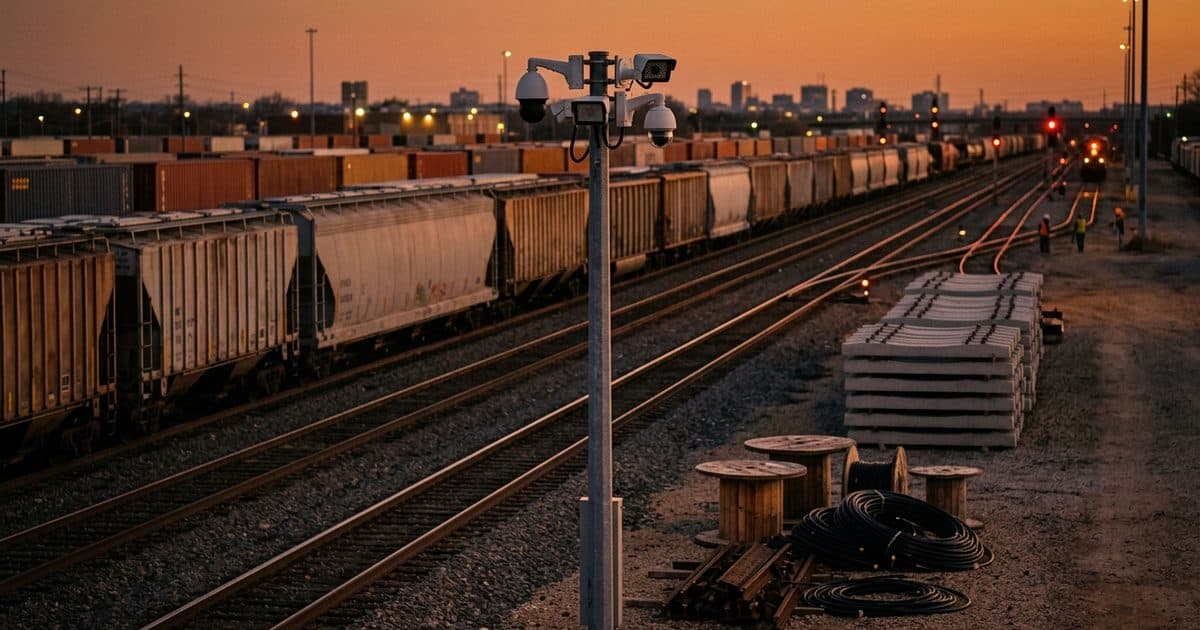
Rail infrastructure is exposed in a way few other industries are. A single operator's footprint can run hundreds of miles of right-of-way through terrain with no utility power and no cellular backhaul for a wired camera to use, punctuated by intermodal yards that move thousands of trucks a week and maintenance facilities that sit dark and empty most of the night. Copper and signal-bonding wire theft alone causes signal outages and safety-critical failures that ripple far past the value of the wire itself. Layer in container and cargo theft at the gate, trespass on active track that carries real fatality risk, and vandalism on parked rolling stock, and it's clear why rail and transit security doesn't fail for lack of effort — it fails because the network is too long, too remote, and too unpowered for fixed infrastructure to cover. This post breaks down the threat landscape specific to rail and transit, why fixed CCTV and substation-only coverage leave miles of exposure, what an actual coverage plan looks like, and how solar-autonomous surveillance with gate LPR and live monitoring closes the gap.
The Threat Landscape at Rail Yards & Transit Facilities
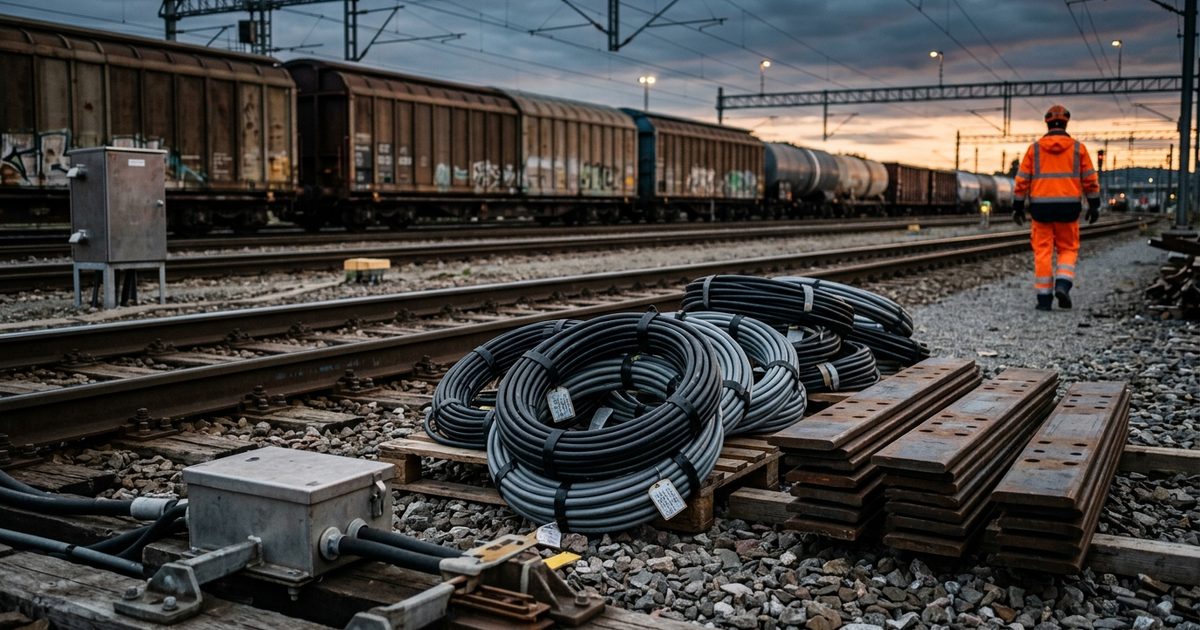
Copper and signal-wire theft is the signature loss driver on the right-of-way, and it's uniquely damaging because the theft and the consequence are separated in time and cause. Thieves target isolated stretches of track after dark — grounding wire, signal bonding, sometimes catenary hardware — because those stretches are, functionally, unwatched. The wire itself may be worth a few hundred dollars in scrap, but its absence can knock out a safety signal or a grade-crossing warning system, creating an outage or a safety hazard that isn't discovered until a crew or a train encounters it. The theft is cheap for the thief and expensive for the railroad, and it repeats at the same hot spots because nothing changes about the exposure after the first hit.
Intermodal and container yards carry a different risk profile. These sites run enormous volumes of legitimate truck traffic through the gate every day, and that volume is exactly what a cargo thief hides in. A container or chassis can leave the yard mixed in with hundreds of routine moves, and without a plate-and-time record tied to every entry and exit, investigators are starting from a gap in a manifest rather than a lead.
Trespass on active right-of-way is the threat with the highest stakes. It's not a property-loss issue — it's a safety and liability exposure that can end in a fatality, and it happens most often exactly where the corridor runs near populated areas with no fencing and no way to patrol it on foot. Rounding out the picture, unlit yards and maintenance facilities see vandalism and graffiti on railcars and locomotives, along with fuel and tool theft from equipment left overnight — the same blind spots that let copper theft and trespass go undetected.
The common thread across all four is distance from supervision. A rail network's most exposed points are rarely near the office or the yard tower — they're miles out on the line, or spread across acres of unlit yard, which is exactly where fixed security infrastructure has always struggled to reach.
Why Fixed CCTV Fails on Miles of Track
Fixed camera systems and substation-based coverage work where power and conduit already exist — which, on a rail network, is a small fraction of the exposure. The moment coverage needs to follow the track instead of the utility line, fixed systems stop scaling.
| Capability | Fixed CCTV / Substation-Only | Solar Mobile Surveillance |
|---|---|---|
| Coverage | Clustered at yards and substations; corridor miles between sites are dark | Deploys directly at right-of-way hot spots and yard corridors, no site required |
| Power & connectivity | Requires grid power and often hardwired backhaul to install | Solar and 4G/5G cellular — no utility work, no trenching |
| Remote hot spots | Rarely covered; too costly to run power and fiber for one segment | Positioned at the exact mile marker where theft is recurring |
| Response | Passive recording reviewed after an outage or a loss is discovered | Live SOC verification and audio warning in real time |
| Relocation | Fixed once installed; a new hot spot means a new install project | Repositioned within hours as theft patterns shift down the line |
The gap isn't just physical coverage — it's response time. A camera that records a copper crew stripping wire at mile marker 114 does nothing to prevent the outage that follows; the value only shows up after the fact, in an investigation. What actually changes outcomes is detection that happens as the theft is occurring, gets verified by a person, and triggers a real-time response before the wire is cut or the trespasser reaches the track.
Tip: Map your copper and signal-wire theft incidents by mile marker before you plan coverage. Losses at this kind of infrastructure are rarely random — they cluster at a handful of accessible, isolated segments near roads or grade crossings. Put solar units at those specific hot spots first; it delivers more theft reduction per dollar than spreading thin coverage evenly across a corridor that mostly doesn't need it.
What a Coverage Plan Looks Like for a Rail Network
An effective plan treats the network as three distinct environments, each with a different risk and a different coverage approach.
- Right-of-way copper and signal-wire hot spots: The segments with recurring theft history, usually near road access or grade crossings. Object detection with thermal imaging flags a person or vehicle working the line in zero light, long before a foot of wire is cut.
- Intermodal gates and container yards: The universal chokepoint for cargo movement. License plate recognition at the gate ties every truck entry and exit to a plate, driver, and timestamp, exposing discrepancies against the manifest and flagging hotlisted vehicles.
- Yards and maintenance facilities: Sprawling, unlit ground where loitering detection flags trespass, dwell time near parked rolling stock, and after-hours movement that shouldn't be there.
- Trespass-prone crossings and populated corridor segments: Where the consequence of a miss is measured in safety, not dollars — coverage here prioritizes early detection and immediate audio intervention over evidence collection alone.
A visible, NDAA-compliant Mobile Surveillance Unit at these points does two things a static camera can't: it changes how the site reads to someone scoping it out, and it goes exactly where the risk is instead of where a utility line happens to run. For agencies and Class I or short-line operators alike, that compliance detail matters — public and commercial rail buyers both need hardware that clears federal procurement requirements without a separate sourcing exercise.
Live Remote Monitoring: A Human Response on Miles of Empty Track
The hardest problem on rail infrastructure isn't detection — modern sensors are good at flagging movement in the dark. It's response. A remote alert with no one to act on it is just a timestamped record of a loss already in progress.
Remote video monitoring solves that by routing every alert to a live SOC operator, regardless of how far the unit sits from the nearest yard office. When a thermal camera flags a person near an isolated stretch of track at 2am, the operator verifies it's not a maintenance crew or a legitimate trespass-adjacent activity, then acts — a real-time audio warning through the unit's speaker, which is often enough on its own to clear someone off active track, followed by escalation to rail police or local law enforcement with time-stamped footage. At an intermodal gate, the same model applies to a truck that doesn't match its manifest: the operator flags the discrepancy immediately rather than after the container is already gone.
That verified-response model is what makes remote coverage viable across a network too large to staff with guards or patrols. One SOC can monitor corridor hot spots, yard entrances, and intermodal gates across an entire operating division to the same standard, with every alert, verification, and escalation logged — documentation that supports both the incident investigation and any claim that follows. It's the same operating model that protects critical infrastructure sites with comparable remote, unpowered exposure.
Deployment That Follows the Theft, Not the Utility Line
Rail networks don't get more secure by installing more fixed cameras at the yards that already have them — they get more secure by putting coverage exactly where the current losses are happening, and moving it when the pattern shifts.
A relocatable solar-autonomous unit reaches a copper hot spot the week after the first theft, moves to a different segment when a crew changes tactics, or sits at an intermodal gate during a peak cargo season and repositions afterward — all without trenching, utility coordination, or a permitting delay. For yards that also need after-dark visibility for personnel and equipment, a companion lighting trailer pairs with the surveillance unit to add deterrence on top of detection. Coverage becomes a resource you deploy against this month's exposure, not infrastructure frozen at the location it was first installed.
Common Mistakes in Rail Yard and Right-of-Way Security
- Concentrating coverage at yards and substations. The losses happen miles out on unpowered right-of-way, exactly where fixed infrastructure has never reached. Map incidents by mile marker and place coverage against the actual hot spots.
- Treating detection as sufficient without a live response. A recorded theft or trespass event that's reviewed after the fact prevents nothing. Detection has to be paired with real-time verification and an audio warning to change the outcome.
- Skipping LPR at intermodal gates. High truck volume is cover for cargo theft unless every entry and exit is tied to a plate, driver, and time. Without that record, an investigation starts from nothing.
- Underestimating trespass as a safety issue, not just a security one. Right-of-way trespass carries fatality risk and direct liability exposure; it deserves the same urgency as copper theft, not less.
- Installing fixed systems that can't follow the threat. Theft hot spots and operational risk shift along a corridor over time. A relocatable strategy keeps coverage current; a one-time fixed install falls behind within a season.
Rail and transit sit alongside other sprawling, high-value, low-supervision environments where the same solar-autonomous, live-monitored model closes the exposure — from copper theft at substations to cargo theft at truck yards. The infrastructure differs, but the underlying gap is the same: miles of unpowered, unwatched ground that fixed cameras were never built to reach.