
That distinction shapes everything else in this article. For a broader view of public safety camera programs, see how police security cameras enhance public safety.
What the research measured
Two studies are cited more than any others.
A 2019 systematic review in Criminology & Public Policy analyzed 76 studies conducted between 1978 and 2017. It found:
- CCTV was associated with roughly a 13% reduction in crime in target areas compared with control areas.
- Parking lots saw the largest effect, about a 37% reduction.
- Actively monitored systems were associated with about a 15% reduction. Passive, recording-only systems showed no significant effect.
- Programs that combined cameras with several other interventions, such as lighting, signage or patrols, were associated with about a 34% reduction.
A 2011 Urban Institute evaluation looked at public camera programs in Baltimore, Chicago and Washington, D.C.:
- Where cameras were concentrated and routinely monitored by trained staff, the effect on crime was significant.
- In Baltimore, the analysis estimated about $1.50 in savings for every $1 spent on cameras, counting victimization and criminal justice costs.
- There was no evidence that crime was displaced to surrounding areas.
- In Washington, D.C., where a restrictive policy meant cameras were not actively monitored, no significant reduction was found.
Taken together, the two studies say the same thing: the camera is the starting point, and the results come from what is done with it.
Five benefits in high-crime areas
1. Deterrence where offenders make quick decisions
Much street-level crime is opportunistic. A visible camera, especially one with lights and signage, raises the perceived chance of being identified. The strong result for parking lots in the 2019 review fits this: vehicle crime is fast, and offenders choose locations where they expect not to be seen.
2. Response while it is still happening
A monitored camera lets an operator see an incident develop and direct officers to it with a description, a direction of travel and a live view. That changes the call from a report taken afterward to a response in progress.
3. Better use of limited patrol hours
No agency can keep an officer on every hot spot. Cameras extend the reach of the officers a department has, so that patrol time goes to verified incidents instead of routine checks of empty lots.
4. Evidence that holds up
Time-stamped video establishes what happened, in what order, and who was present. It supports investigations and prosecutions, and it can clear people who were wrongly suspected.
5. Information for deployment decisions
Footage and incident logs show when and where problems occur. Over a few weeks, that data tells commanders whether a deployment is working and where coverage should go next.
Where cameras help most
| Location | Why it is a good fit |
|---|---|
| Parking lots and garages | Strongest measured effect in the research; vehicle crime is fast and location-driven |
| Commercial corridors | Repeated incidents at known corners and storefronts |
| Transit stops and stations | Predictable crowding and repeat offenders |
| Parks and public housing common areas | After-hours activity with few witnesses |
| Emerging hot spots | Short-term spikes that need coverage before fixed infrastructure can be built |
What makes a program work
Concentrate coverage. A single camera on a long block tells an operator little. Enough cameras to follow an event through the area is what the Urban Institute found effective.
Monitor actively. Staff the cameras during the hours when incidents happen, and give operators a direct line to dispatch.
Combine with other measures. Lighting, signage, environmental design and patrols all add to the effect. The 2019 review found the largest reductions where several interventions were used together.
Measure. Compare incident counts before and after, and against similar areas without cameras.
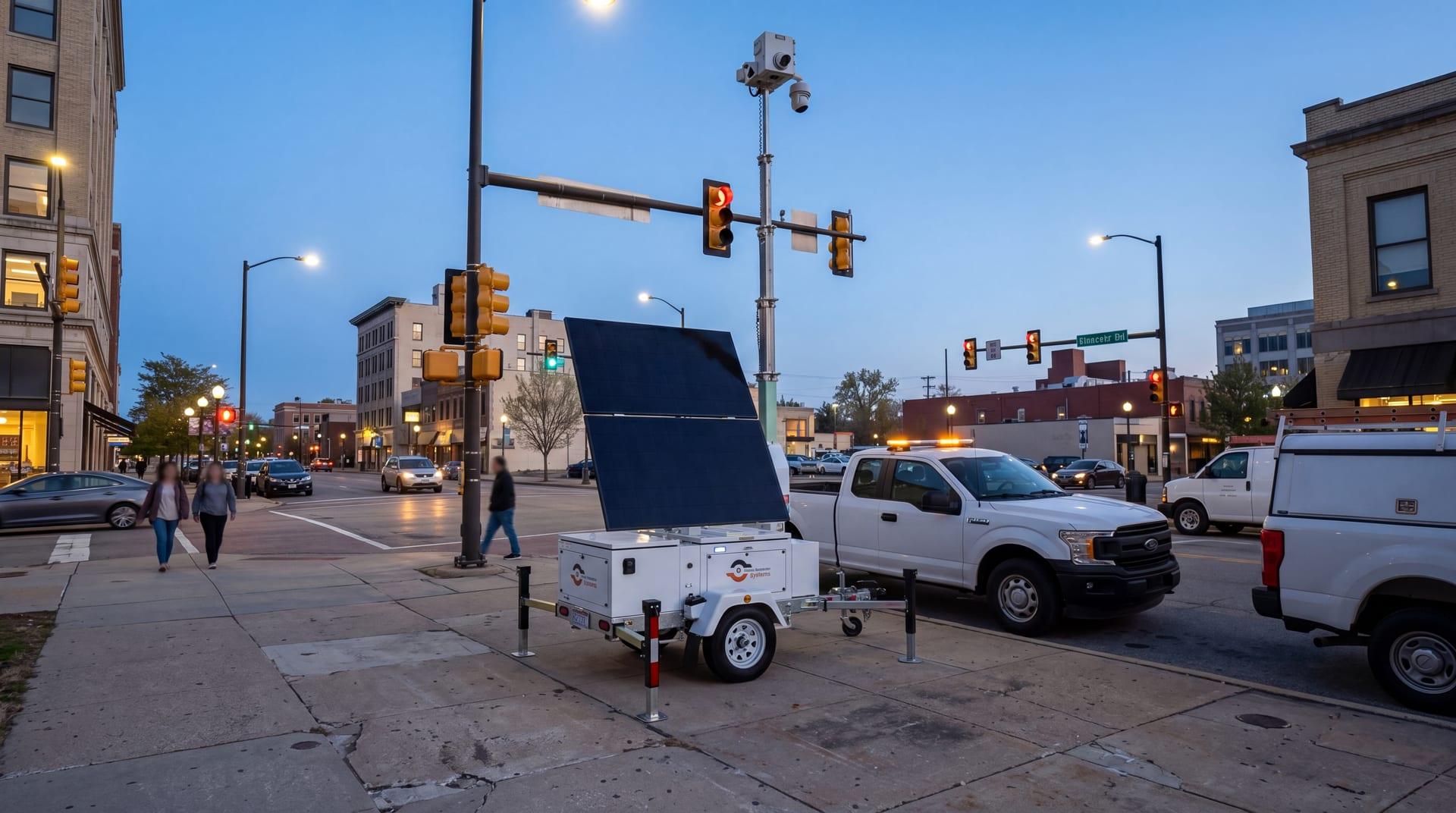
Be able to move. Hot spots shift. A fixed network covers the places that are always busy; mobile surveillance trailers cover the ones that change.
Privacy and community trust
Cameras in public places raise legitimate questions, and programs that answer them openly last longer. Good practice includes a written policy on what is recorded and why, limits on how long footage is kept, controls and audit logs on who can view it, and public notice through signage and published policy. Community input before deployment tends to reduce conflict later. Laws on recording, retention and specific technologies vary by state, so agencies should review their program with counsel.
Funding and equipment rules
Many camera programs are paid for with federal grants. Section 889 of the National Defense Authorization Act prohibits the use of federal funds on covered video surveillance equipment from certain manufacturers. Ask vendors for written documentation covering cameras, recorders and communications components. More on NDAA compliance.
How VDS supports hot-spot deployments
Vision Detection Systems builds mobile surveillance units for locations without power or network: solar-powered trailers with a 5MP PTZ and three 8MP wide-angle cameras on a 22 ft telescopic mast (30 ft available), connected over 4G/5G cellular. A 24/7 US-based security operations center can verify incidents and escalate through live talk-down and police dispatch, or an agency can view the cameras directly. Units relocate as hot spots shift. See how VDS works with public safety agencies or request a deployment plan.
Sources
- Piza, E. L., Welsh, B. C., Farrington, D. P., & Thomas, A. L. (2019). CCTV surveillance for crime prevention: A 40-year systematic review with meta-analysis. Criminology & Public Policy, 18(1). onlinelibrary.wiley.com
- La Vigne, N. G., Lowry, S. S., Markman, J. A., & Dwyer, A. M. (2011). Evaluating the Use of Public Surveillance Cameras for Crime Control and Prevention. Urban Institute. urban.org