

Cemeteries and memorial parks carry a kind of vulnerability most commercial properties don't have to think about: they're open by design, rarely fenced in full, unstaffed for most of the day and all of the night, and dotted with bronze fixtures that carry real scrap value. A grieving family visiting a loved one's resting place and finding the vase gone, the plaque pried off, or a headstone toppled isn't just dealing with a property crime — they're dealing with a wound reopened. That's the stake operators are managing here, alongside the very real financial and reputational cost of leaving grounds exposed. This post covers the specific threats cemeteries and memorial parks face, why standard fixed cameras rarely solve the problem, what a coverage plan actually looks like, and how live monitoring closes the gap between detection and response — all without breaking ground on land where digging is rarely an option.
The Threat Landscape at Cemeteries and Memorial Parks
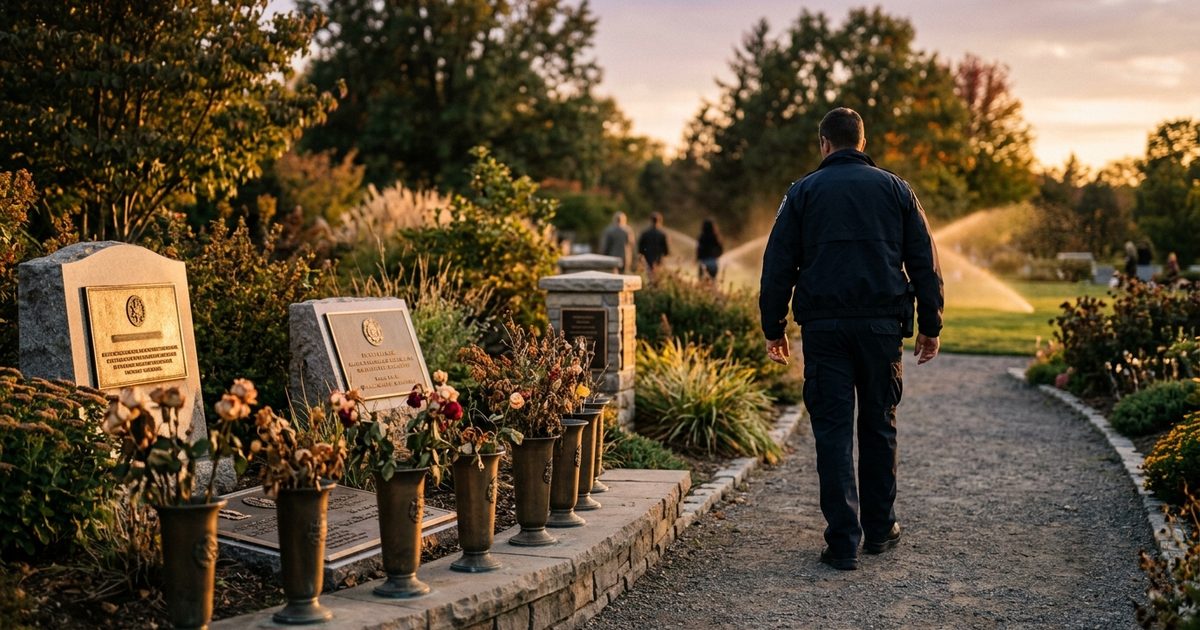
Bronze theft is the signature crime at cemeteries, and it's driven by simple economics: bronze vases, commemorative plaques, and decorative fixtures have real scrap value, and a thief working methodically through a section after dark can clear dozens of markers in a single night. Because the theft happens on ground with no natural surveillance and often no lighting, it frequently isn't discovered until a family visits days or weeks later — by which time there's no trail to follow and no way to recover what was taken.
Vandalism sits alongside theft as a distinct and often more painful problem. Toppled headstones, graffiti, and defaced monuments cause damage that in many cases can't be fully undone, and the emotional impact on families and the surrounding community is significant. A cemetery with a reputation for unaddressed vandalism also carries real reputational risk for the operator, at a time when families are choosing where to lay a loved one to rest based partly on how well the grounds are cared for and protected.
Copper wiring theft — from irrigation systems, path lighting, and maintenance infrastructure — and the theft of groundskeeping equipment left on-site overnight round out the property-crime picture, and both usually depend on a vehicle driving straight onto unmonitored grounds. Illegal dumping and after-hours trespass add a different kind of problem: open, unfenced acreage bordering roads or vacant land is an easy place to dump debris or gather after close, and neither is compatible with the dignity the grounds are meant to hold. Every one of these threats shares the same enabling condition — large, open, low-staffed ground with no one watching once the office closes.
Why Fixed CCTV Rarely Covers a Cemetery Property
Even cemeteries that have invested in security cameras often find they're still taking losses, and the reason is structural. Fixed cameras get installed where power and conduit already exist — near the office, the chapel, maybe the main entrance — and that's rarely where the vulnerable bronze fixtures or the older, unlit sections actually are. Extending wired coverage to a back section means trenching across the grounds, which is expensive, disruptive, and in many cases something operators are understandably reluctant to do near burial sites at all.
| Capability | Fixed CCTV | Solar Mobile Surveillance |
|---|---|---|
| Coverage | Clustered near the office/chapel; thin or absent across older and outer sections | Elevated wide-area coverage positioned over the sections at risk |
| Ground disturbance | Requires trenching and conduit to extend to new sections | Solar and cellular — no digging, no ground disturbance |
| Night visibility | Depends on site lighting, which most cemeteries don't have across the grounds | Full-darkness detection with no lighting infrastructure required |
| Response | Passive recording, reviewed only after a family reports a loss | Live SOC verification and an audio warning in real time |
| Adaptability | Fixed in place; theft waves move to the section without cameras | Relocatable to whichever section is currently being targeted |
That last row matters more at a cemetery than almost anywhere else. Theft doesn't stay in one place — once a section's bronze markers have been stripped, activity typically shifts to the next section over, and a fixed camera installation simply can't follow it. The deeper issue, though, is the same one that limits fixed CCTV everywhere: a recording of a section being stripped overnight documents the loss, it doesn't prevent it. Preventing it requires detecting the activity while it's happening and putting a response in motion before the damage is done.
Tip: Prioritize coverage by fixture density and light level, not by distance from the office. The sections with the most bronze vases and plaques — often the older parts of the property — and the sections with no ambient lighting at all are where a thief will go first. A single relocatable unit positioned there does more good than several fixed cameras clustered near the entrance.
What a Coverage Plan Looks Like for a Cemetery
A workable plan treats the grounds the way they actually get used and targeted, not the way the original camera install happened to be laid out. For most properties that means:
- The main entrance, with LPR: Nearly every cemetery has a single road system every visitor and every vehicle uses. License plate recognition there ties every entry and exit to a plate and a timestamp, which deters vehicle-dependent crimes like dumping and equipment theft and gives investigators a real starting point when something is reported.
- High-density bronze and older sections: The areas with the most vases, plaques, and legacy fixtures — and often the least lighting — need dedicated coverage with object detection that distinguishes a person moving between rows from routine daytime visitor traffic.
- Mausoleums and memorial buildings: Structures that hold valuable fixtures and can shield activity from the road benefit from loitering detection that flags someone lingering after the grounds should be empty.
- Open perimeter and boundary lines: Unfenced edges bordering roads or vacant land are where foot and vehicle traffic slips onto the property unseen, and they deserve coverage even though — especially because — there's no fence to lean on.
The unit itself matters here too. A Mobile Surveillance Unit with a mast, cameras, and a speaker changes what a section looks like to someone scoping it out, and because it runs on solar power with cellular backhaul, it reaches the far corner or the older section a wired system was never going to be extended to. A companion lighting trailer or standalone solar light can add visible deterrence to a section without running a single wire.
Live Monitoring: A Response the Grounds Don't Currently Have
Most cemeteries have no overnight staff at all, and even where a guard walks the property periodically, acres of open ground can't be watched by one person at any given moment. That gap — detection with no one to act on it — is exactly what live monitoring is built to close.
Remote video monitoring routes every alert to a SOC operator who verifies it in real time. When a camera flags a person moving through a section after the grounds should be empty, the operator confirms what's actually happening, then responds — a live audio warning through the unit's speaker is often enough on its own to clear someone off the property before a vase is touched or a headstone is disturbed. When it isn't, the operator escalates to law enforcement with time-stamped footage and, if a vehicle was involved, the entrance LPR record of what drove in and when.
That verified-response model gives cemetery operators something a periodic patrol can't: continuous coverage of the whole property instead of wherever a person happens to be standing, and a documented record of every incident — useful for law enforcement, and just as important for reassuring a family that what happened to their loved one's resting place was seen, responded to, and taken seriously. The park security teams handling vandalism on other kinds of open public land face a strikingly similar problem, and the same verified live-response model applies.
Deployment That Respects the Property
Any security conversation at a cemetery has to start from the fact that the ground itself is not a place to disturb. That rules out a large share of standard commercial security work — trenching for power, running conduit for cameras, digging for lighting circuits — before it can even begin.
A solar-autonomous approach sidesteps that constraint entirely. The trailer arrives, the mast raises, cameras and LPR come online, and SOC monitoring begins — all without a shovel touching the ground. If a theft wave shifts from one section to another, the unit relocates rather than requiring a new install. A solar kit or standalone lighting can supplement a section that needs deterrent visibility without the operator ever running an electrical line across the property. For a case-by-case look at how this plays out for other operators, VDS maintains a library of case studies, and any property team can reach out directly to talk through a specific layout.
Common Mistakes in Cemetery Security
- Concentrating cameras near the office or chapel. The highest-value fixtures and the least lighting are usually in the older, outer sections — exactly where fixed coverage tends to thin out or disappear.
- Treating a camera install as permanent. Theft moves from section to section as fixtures get stripped. A fixed system can't follow it; a relocatable one can.
- Skipping LPR at the entrance. With one main road onto most properties, a plate-and-time record of every vehicle is one of the highest-value pieces of coverage available, and it's frequently left out.
- Recording without responding. Footage that only gets reviewed after a family reports a loss documents the damage — it doesn't prevent it. Detection has to be tied to a live, real-time response.
- Ruling out security because of ground disturbance. Many operators assume any camera system means trenching near burial sites, and shelve the project. Solar-autonomous coverage removes that constraint entirely.
Cemeteries carry a weight most properties don't — every incident is also a moment of harm to a family already grieving. A coverage plan that closes the gap between detection and response, without disturbing the ground it protects, is how operators meet that responsibility while still addressing the very real financial exposure metal theft and vandalism create.