
Construction site security in Texas.
Texas builds at a scale few states match, from refinery turnarounds and data center campuses to master-planned subdivisions spreading across former ranchland. Sites are often enormous, remote and far from the nearest patrol, so fencing and lighting alone leave long stretches of perimeter unwatched after the crews go home.
VDS puts solar-powered, cellular-connected surveillance trailers on Texas construction sites. AI detection flags people and vehicles, operators verify alerts and talk down live, and your team gets video of every verified event. No site power, trenching or internet required.
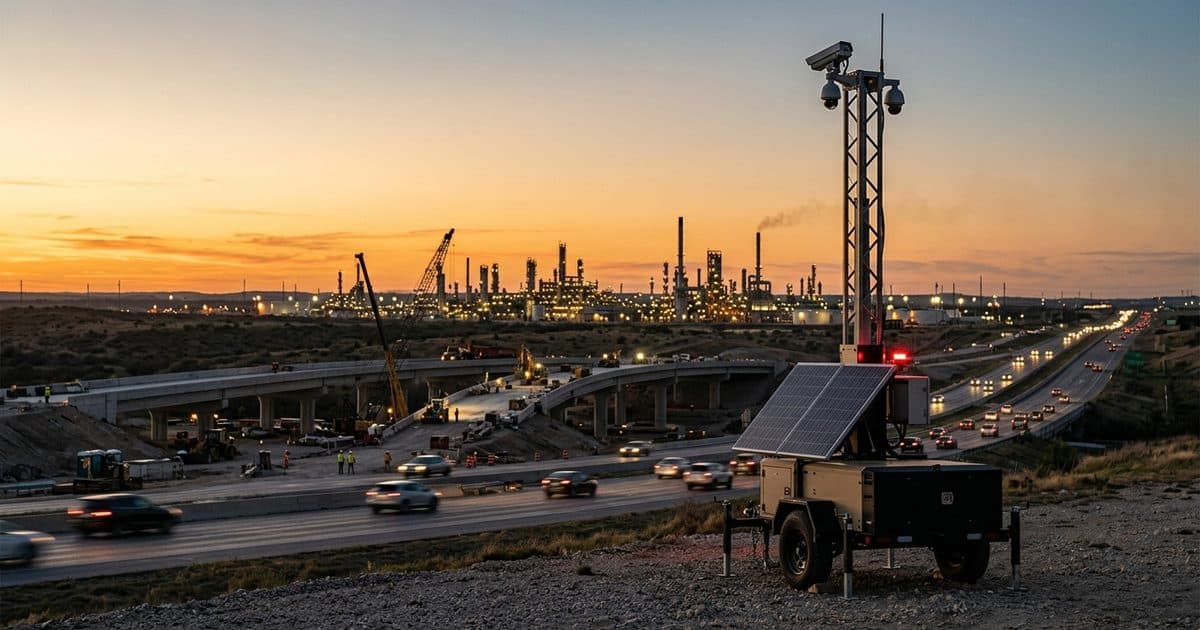
Projects we cover in Texas.
Different project types carry different risks. Here is how coverage plays out on the work that drives Texas construction.
Master-planned subdivisions
Framed homes sit open for months with appliances, copper and lumber inside. Trailers at the entrance and far corner watch streets that have no walls yet.
Data center campuses
Large pads hold high value electrical gear and cable stock. A trailer covers gates and staging yards while temporary fencing and site power are still being built out.
Refinery and plant turnarounds
Short, crowded shutdown windows bring many outside crews and materials. Trailers give the owner's rep a verified record of who entered laydown yards after shift change.
Wind and solar farm builds
Panels, cable and inverters pile up across open acreage with no grid power. A solar trailer runs where no outlet exists and watches the laydown yard overnight.
What gets targeted.
Copper wire pulled from new homes and electrical rooms is the classic Texas loss, along with catalytic converters cut from parked pickups and equipment. Diesel drained from tanks at remote sites, tools from job boxes, air conditioning condensers and appliances at new houses, and stacked conduit or rebar also walk off. Losses cluster overnight, on long holiday weekends and between the Friday shift and Monday morning.
Weather and power.
Texas summers are hard on electronics, though the sun is plentiful, so panels rarely starve. Shade and airflow around any gear you add yourself help. Gulf storms and spring hail or thunderstorm wind are the bigger planning items: lower the mast when severe weather is forecast, since raising it again takes under 20 minutes. Out in the Panhandle and Permian, steady wind and blowing dust mean setting the trailer on firm ground and wiping panels clean now and then.
Where we deliver in Texas.
VDS delivers across the DFW Metroplex, Houston and the Gulf Coast, the Austin to San Antonio I-35 Corridor, the Permian Basin and the Panhandle, including project sites well outside city limits where road crews and patrols rarely pass.
See it on your site.
Type your address, and the designer opens on a live map of your property — place trailers, draw the perimeter, and get a coverage plan in minutes. No call required.
Common questions.
Can we run cameras on a rural Texas site with no power?
Yes. The trailer is solar powered and cellular connected, so there is no outlet to find and no trench to dig. Ask about cell signal on your specific parcel before you commit, because very remote ranch roads can vary, and confirm any placement requirements with the local authority or your general contractor.
What do we do when a hurricane or hailstorm is forecast?
Plan ahead with your VDS contact. The mast can be lowered before severe weather and raised again in under 20 minutes. On the coast, discuss moving the trailer to higher, firmer ground or a sheltered spot before an evacuation order, not after it.
How fast can a trailer reach a job in West Texas?
Delivery is typically about a week at most, though long distances to the Permian or Panhandle can affect timing. Give your site address and access gate details early so the trailer arrives ready to set up on the first day.
Can a construction site in Texas get cameras before power is connected?
Yes. Each trailer runs on solar power with cellular connectivity, so it works on a bare lot with no utilities, no trenching and no site internet. One person levels the unit and raises the mast in under 20 minutes.
Can one trailer move between phases or sites?
Yes. Trailers relocate as work moves, from site clearing to foundations to framing to finish, and between projects. Term options run from short rentals to annual subscriptions.
Cost & buyer guides
General Contractor Site Security: Access, Liability and Schedule
General contractor site security explained: control subcontractor access, document incidents for liability, and protect the schedule from theft and damage.
Site Security Plan: A 6-Step Framework for Construction and Commercial Sites
Build a site security plan that satisfies insurers, bonding requirements, and compliance audits. A 6-step framework covering risk assessment through reporting.
Night Shift Construction Security: Lighting, Visibility and Worker Safety
Night shift construction security covers lighting, visibility, worker safety and trespass control for sites that stay active after dark. A practical guide.
Protect your Texas site this week.
Tell us the address, phase and timeline. We will quote the trailer, monitoring plan and delivery.