
Construction site security in California.
California construction runs from dense Bay Area infill and Los Angeles mid-rises to giant warehouse and housing tracts in the Inland Empire and farm country. Tight urban lots and permitting delays leave empty buildings sitting for long stretches, while sprawling sites inland stay quiet at night, and both draw thieves who know the schedule.
VDS puts solar-powered, cellular-connected surveillance trailers on California construction sites. AI detection flags people and vehicles, operators verify alerts and talk down live, and your team gets video of every verified event. No site power, trenching or internet required.
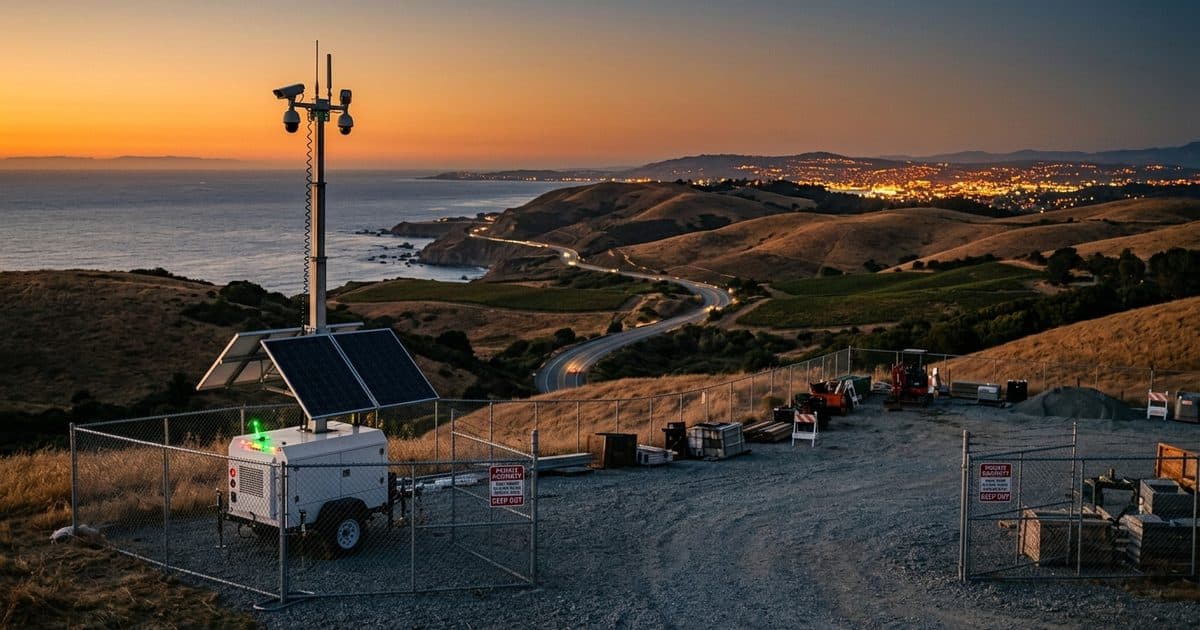
Projects we cover in California.
Different project types carry different risks. Here is how coverage plays out on the work that drives California construction.
Urban mid-rise and mixed use
Tight lots with street frontage mean passersby see everything. A trailer on the sidewalk side watches scaffolding, hoists and ground floor storage, and helps document after-hours entry.
Logistics and warehouse parks
Huge concrete pads and tilt-up walls leave wide fences and dark corners. Trailers cover entrances and material yards where one guard cannot see the whole perimeter.
Housing and townhome tracts
Framed units hold copper, fixtures and appliances before locks go on. Mobile coverage follows the active phase from street to street without trenching cable.
Water, rail and highway work
Linear projects stretch for miles through unlit corridors. A relocatable trailer follows the active work zone and watches equipment staged overnight.
What gets targeted.
Copper wire and plumbing fittings are prime targets in California, as are catalytic converters taken from trucks and equipment parked on site. Tools and generators vanish from job boxes, and finished fixtures disappear from townhomes before move in. Urban sites also see graffiti and people sleeping inside unfinished floors. Losses spike on weekends, holidays and any time a site sits idle between trades.
Weather and power.
Most of California offers strong sun and dry weather, which suits solar. The planning items are regional: coastal fog and winter overcast in the Bay Area and Los Angeles reduce charging, so ask about extra battery reserve. Wildfire smoke can dim panels for days and blur camera views. Santa Ana and valley winds argue for lowering the mast in gusty forecasts, and raising it again takes under 20 minutes. Mountain passes bring winter cloud and snow.
Where we deliver in California.
VDS delivers to California projects in the Bay Area, the Los Angeles Basin, the Inland Empire, the Central Valley and San Diego, from downtown infill lots to warehouse land and highway work outside the cities.
See it on your site.
Type your address, and the designer opens on a live map of your property — place trailers, draw the perimeter, and get a coverage plan in minutes. No call required.
Common questions.
Do we need an outlet or generator on a California site?
No. The trailer runs on solar and connects by cellular, so a gravel lot or an unfinished building with no power is fine. If a city or owner requires anything for temporary equipment on public frontage, confirm requirements with the local authority or your general contractor.
How does wildfire smoke or fog affect the cameras?
Heavy smoke or marine fog can reduce how far the cameras see and how much the panels charge. Mention your region when ordering so battery reserve and mast placement can be planned. Panels can be wiped after ash falls, and the trailer keeps working on stored charge.
Can you cover a tight downtown lot in San Francisco or Los Angeles?
The trailer has a compact footprint and a mast that raises in under 20 minutes, so it often fits a corner, alley or sidewalk staging area. Check street use and placement with the local authority or your general contractor. Delivery is about a week at most.
Can a construction site in California get cameras before power is connected?
Yes. Each trailer runs on solar power with cellular connectivity, so it works on a bare lot with no utilities, no trenching and no site internet. One person levels the unit and raises the mast in under 20 minutes.
Can one trailer move between phases or sites?
Yes. Trailers relocate as work moves, from site clearing to foundations to framing to finish, and between projects. Term options run from short rentals to annual subscriptions.
Cost & buyer guides
General Contractor Site Security: Access, Liability and Schedule
General contractor site security explained: control subcontractor access, document incidents for liability, and protect the schedule from theft and damage.
Site Security Plan: A 6-Step Framework for Construction and Commercial Sites
Build a site security plan that satisfies insurers, bonding requirements, and compliance audits. A 6-step framework covering risk assessment through reporting.
Night Shift Construction Security: Lighting, Visibility and Worker Safety
Night shift construction security covers lighting, visibility, worker safety and trespass control for sites that stay active after dark. A practical guide.
Protect your California site this week.
Tell us the address, phase and timeline. We will quote the trailer, monitoring plan and delivery.