
Why Warehouses Are High-Risk Environments
Cargo theft in the United States has reached historic levels. CargoNet tracks cargo theft trends across the supply chain, and the numbers are consistent: annual losses run well into the billions, with distribution centers and logistics yards among the highest-frequency targets. What makes warehouses particularly exposed isn't just the value of inventory—it's the structure of the environment itself.
A typical 200,000 square foot distribution facility needs somewhere between 80 and 150 cameras for genuine coverage. Most operations have a fraction of that. The result is a facility where cameras cover the obvious points—dock doors, the main entrance, maybe the parking lot—while interior aisles, staging areas, and secondary access points stay unmonitored.
The other factor that gets underweighted: most warehouse theft is internal or insider-facilitated. External perimeter cameras catch tailgate entries and unauthorized vehicles, but they don't catch an employee walking product out through a side exit or a staged trailer drop arranged with a driver. Coverage has to go deeper than the fence line.
Timing matters too. Shift changes and meal breaks are peak vulnerability windows—the moments when attention is divided, supervisors are occupied, and gaps in line-of-sight are widest. A monitoring plan that doesn't account for those windows isn't a complete plan.
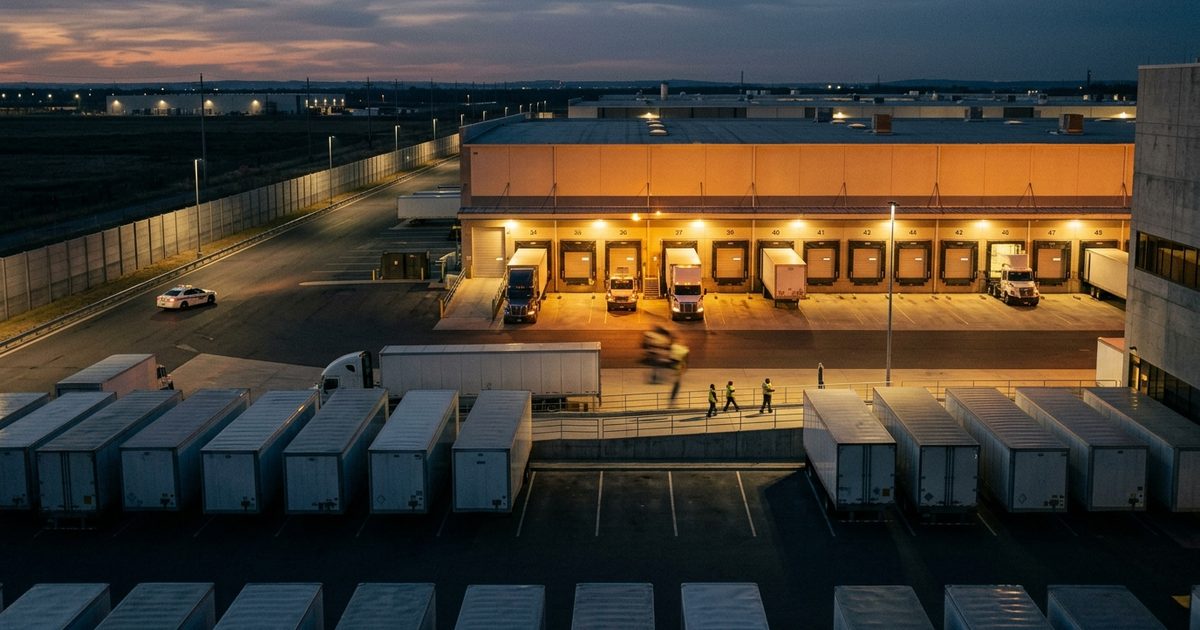
And then there's the loading dock—the single highest-risk point in most warehouse facilities. Staged theft, unauthorized trailer drops, driver access to areas they shouldn't reach, discrepancies between manifest and actual load: nearly all of it moves through the dock.
Camera Placement Strategy for Warehouses
Before committing to a camera count, the right first step is a blind spot audit—a systematic walk of the facility that documents every unmonitored zone. What you find is almost always different from what you expect. Assumptions about coverage tend to miss secondary exits, equipment bays, stairwells, and areas behind tall racking.
With that baseline, a functional warehouse camera plan covers four zones:
Perimeter and Parking
Exterior corners, parking lot approaches, and any vehicle staging areas outside the building. The goal here is detection of unauthorized access before it reaches the building and documentation of vehicle activity—what came in, what left, and when.
Loading Docks
This zone needs multiple camera angles: an overhead wide-angle capturing dock door activity and bay status, a dock-level camera covering driver interaction and product movement, and license plate recognition at entry and exit points for trailer tracking. License plate recognition at dock entry is particularly useful for matching inbound and outbound trailers against manifests and flagging vehicles that return outside of scheduled windows. Standard cameras aren't built for LPR—it requires a fixed mount configured for the specific lighting conditions at that entry point.
Interior Coverage
Aisle coverage at inventory locations, high-value storage areas, break room entry points, and staging areas where product is assembled for outbound loads. Access control integration matters here: a door camera at every interior access point—stairwells, side exits, equipment bays—creates a documented record of who moved through the building and when.
Overflow Yards and Expansion Areas
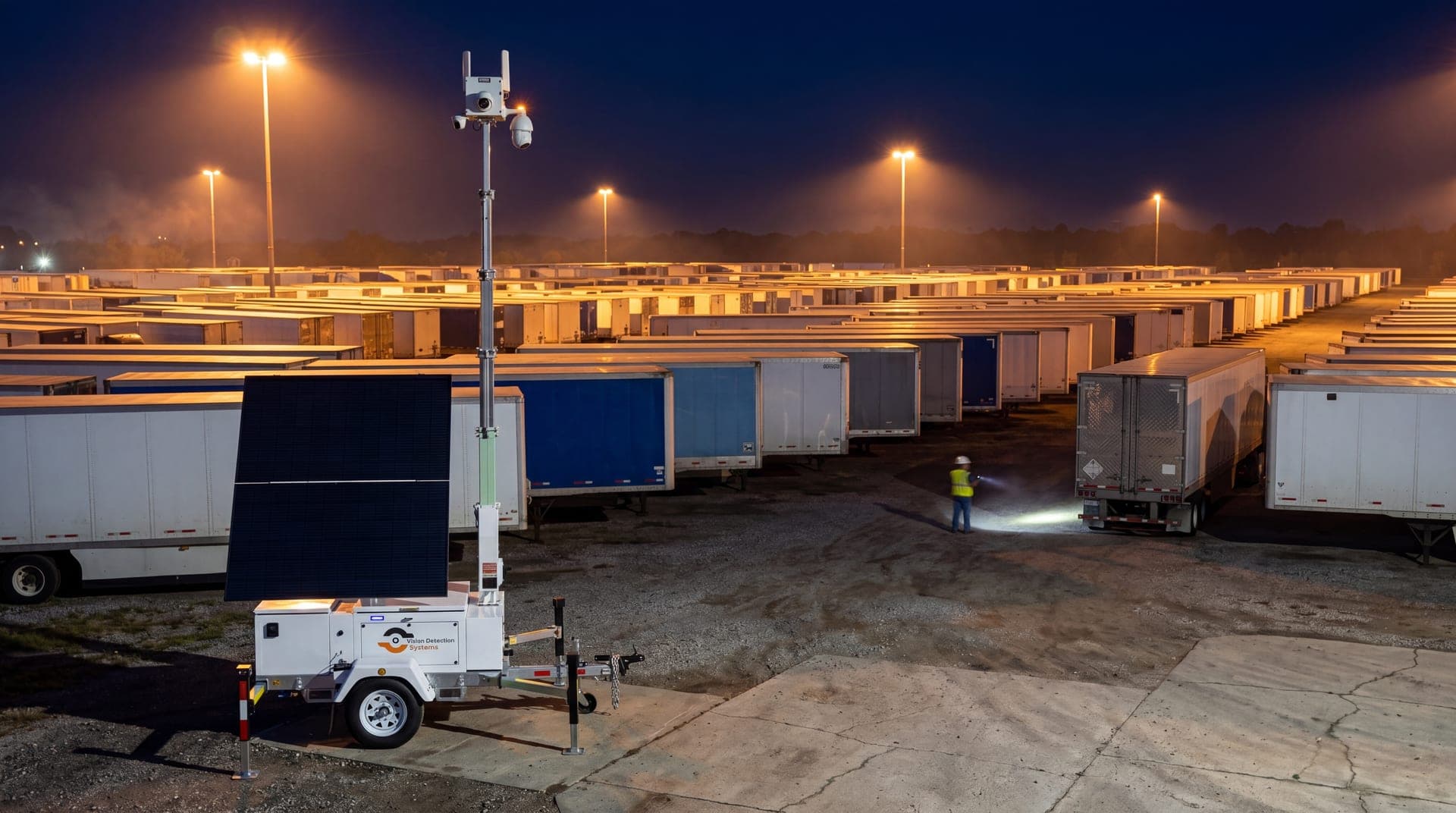
For facilities with exterior storage yards, trailer drops, or expansion phases where infrastructure isn't in place yet, a mobile surveillance unit can cover those areas immediately without waiting on conduit runs or pole installations. This is common in distribution environments where yard capacity fluctuates seasonally and permanent infrastructure doesn't make sense for a temporary footprint.
Camera Specifications That Actually Match the Environment
Generic camera recommendations don't hold up in warehouse conditions. A few specs that matter:
- Indoor cameras: 2MP minimum. Wide dynamic range is important for dock areas where you have bright exterior light coming through open dock doors and dim conditions inside—a standard camera will blow out one end of that range.
- Outdoor and perimeter cameras: 4MP or higher, IR night vision, IP67 weatherproof rating. Parking lots and exterior yards need resolution that holds up at distance.
- LPR cameras: Fixed mount, optimized for the specific lighting and angle at the capture point. These are purpose-built, not repurposed from the general camera spec.
- PTZ cameras: Useful in large open interior areas and parking lots. A single PTZ can supplement four to six fixed cameras in open-span areas where continuous pan coverage makes more sense than tiling fixed views.
What Cameras Alone Can't Do
Here's the operational reality most camera vendors don't address: cameras record. Monitoring catches. Those are different functions, and most warehouse facilities only have the first one.
When an incident happens at 2 a.m. and nobody is watching the feed, the footage exists—but it doesn't trigger any response. By the time the incident is discovered (often when someone notices missing inventory or a discrepancy in a manifest), hours or days have passed. Cargo has moved. Personnel have rotated. The practical window for intervention is gone.
Remote video monitoring closes that gap. A third-party operations center monitors live feeds against defined rules—after-hours motion in restricted zones, dock access outside scheduled windows, activity in high-value storage areas—and responds to events as they happen, not after they're discovered. The key operational difference is verified response: a monitoring center that can review the live feed and confirm a real incident before escalating means fewer wasted dispatches and faster response to incidents that are real.
Response Workflow for Warehouse Environments
A monitoring deployment without a defined workflow is just an expensive alert system. For warehouse operations, the workflow should cover five stages:
- Detect: Camera analytics flags a defined event—motion in a restricted zone after hours, door access at an unauthorized entry point, vehicle activity at a closed dock.
- Verify: The monitoring center reviews the live feed. Is this a real incident or a false alarm? A verified event moves forward. An unverified one gets logged and dismissed—no wasted dispatch.
- Escalate: Verified incident triggers a defined response—PA warning to the site, dispatch to on-site security or law enforcement, direct notification to the facility manager or security director.
- Document: Timestamped incident report, video clip export, chain of custody documentation that can survive a legal hold request.
- Review: Weekly or monthly pattern review against incident data. Repeat events at the same dock door, the same access point, the same time window are a systemic signal—not a random event.
Multi-Facility Consistency
For logistics networks and third-party logistics operators running multiple distribution centers, the camera count at any single facility matters less than the consistency of the monitoring protocol across all of them. When each site has different rules, different escalation contacts, and different reporting formats, there's no real visibility into network-wide patterns. Standardizing the monitoring layer—same alert rules, same incident documentation, same escalation workflow—is what turns a collection of individual camera systems into an actual security operation.
Our warehousing and logistics security programs are built around this multi-site consistency model, with standardized reporting that gives operations and security leadership a single view across locations.
Evidence Readiness: What Makes Footage Actually Usable
For internal investigations and prosecution, footage has to meet a higher bar than “it exists somewhere on the DVR.” Three things determine whether footage is usable:
- Accurate timestamps: Footage with incorrect system clocks is routinely challenged in legal proceedings. Clock synchronization isn't optional if evidence readiness is a goal.
- Sufficient retention: Thirty days is a common default. It's often not enough. Internal theft is frequently discovered during cycle counts or audits that happen weeks after the event. Ninety-day retention is a stronger standard for facilities with high-value inventory.
- Export workflow: Footage that requires IT involvement to retrieve, or that has no documented chain of custody process, creates delays and gaps that undermine its use. The retrieval workflow needs to be defined before an incident happens, not after.
If your warehouse camera system is recording incidents but not catching them, the coverage plan needs a second look. Vision Detection Systems works with single-site distribution centers and multi-location logistics networks to build out camera placement, remote monitoring programs, and incident response workflows that hold up operationally and legally. Contact us for a warehouse security assessment—we'll walk the site, identify the gaps, and put a coverage plan together that actually fits how your facility operates.