
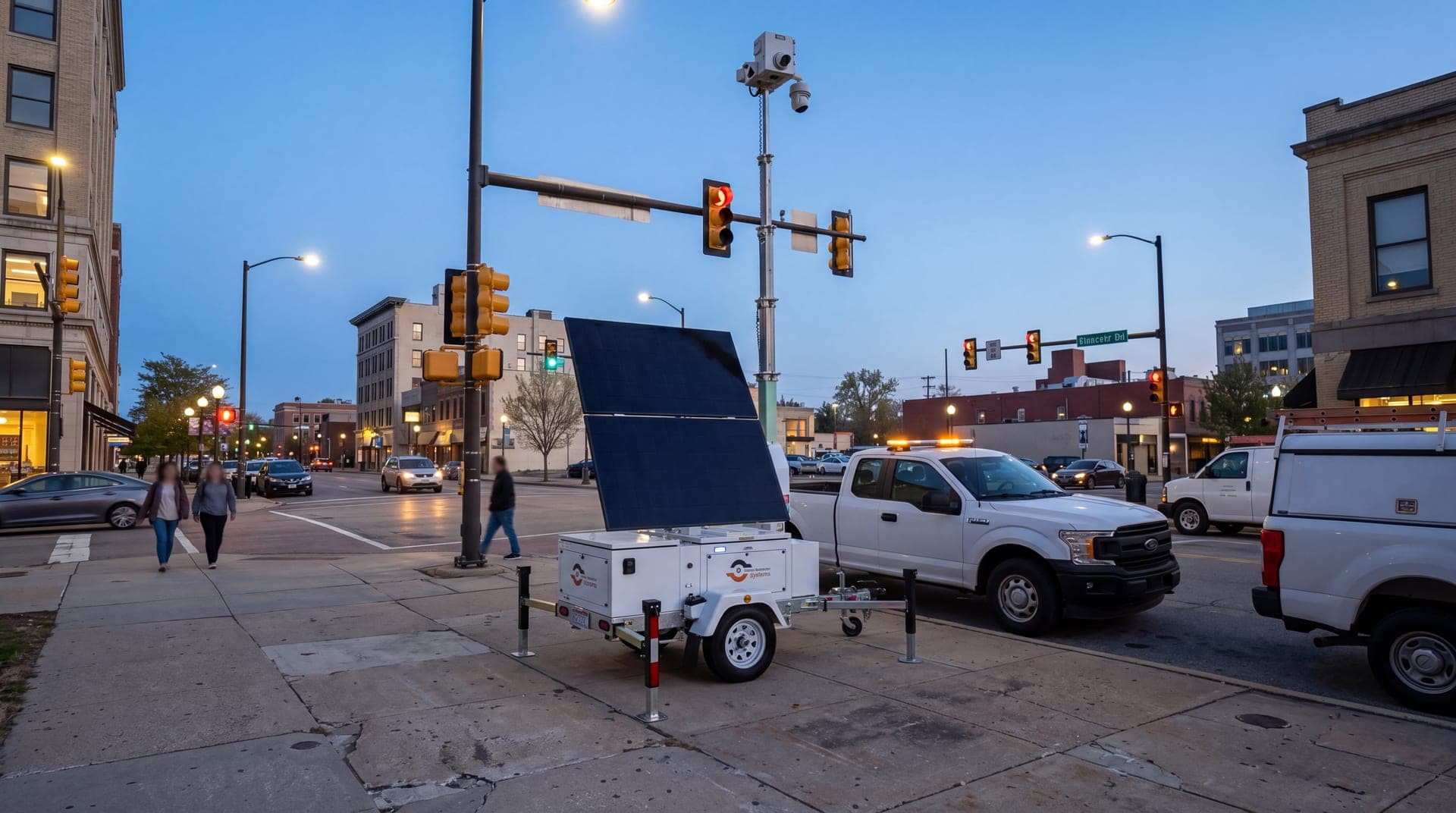
This guide explains how deployments typically work, what police prioritize first, how monitoring and alerts are structured, and how agencies keep footage operationally and evidentially useful.
Quick Police Deployment Checklist
Define the mission and success metrics (deterrence, intelligence, evidence, response time)
Select the highest-leverage zone (approach routes, chokepoints, repeat problem areas)
Confirm constraints (power, connectivity, line-of-sight, permitted placement)
Place for “approach + action + exit” coverage, not just a wide overview
Validate night footage for identification detail and glare control
Set retention and access rules, and document the retrieval/export workflow
Configure alerts and escalation responsibilities (who responds, how, and when)
Re-evaluate placement based on observed activity patterns
Why Police Use Mobile Surveillance Trailers
Law enforcement uses mobile trailers because they solve time-to-coverage problems without a permanent buildout. Common drivers include:
Temporary coverage for events, construction detours, or seasonal activity
Rapid deterrence in hotspots after theft, vandalism, or violent incidents
Visible presence where staffing is constrained
Flexible relocation as patterns shift
Faster deployment than permitting and installing fixed poles/cameras
When agencies want a deployment-ready platform built for fast setup, relocation, and outdoor reliability, they typically start with mobile surveillance trailers.
Common Police Use Cases for Mobile Surveillance Trailers
Hotspot Deterrence and Directed Patrol Support
Trailers are positioned to create visible deterrence and provide actionable visibility in areas with repeat incidents. High leverage zones include:
Known repeat corners/blocks
Parking lots and transit-adjacent areas
Parks after hours
Retail corridors with repeat theft or assault calls
Special Events and Crowd Management
Agencies deploy trailers to improve situational awareness during:
Festivals, parades, sporting events
High-footfall downtown corridors
Temporary road closures and reroutes
Pop-up venues and public gatherings
Traffic Safety and Vehicle-Related Enforcement
Trailers support traffic operations by providing:
Visibility at intersections and corridor chokepoints
Evidence for incidents and disputes
Support for targeted enforcement zones
If vehicle identification is part of the mission, deployments often include a controlled capture point where license plate recognition cameras can reliably log vehicles entering or exiting a defined zone.
Investigation Support and Evidence Collection
When a case requires time-bound visibility, mobile deployments can provide:
Coverage of approach routes and likely movement paths
Evidence capture during specific windows
Rapid deployment near incident areas
How Police Choose Placement and Coverage Zones
The goal is to capture movement through predictable paths rather than hope incidents occur in the center of a wide shot.
Placement priorities typically follow this order:
Chokepoints and approach routes that repeat
Areas with consistent movement paths (entries/exits, corridors)
Zones where the agency needs identification-level detail
Zones where visibility supports deterrence and response
Practical rule: a trailer should be placed so it can capture approach, action, and exit with overlapping views when feasible.
What Police Mobile Surveillance Trailers Should Cover First
Primary approach routes into the problem area
Chokepoints (entrances/exits, intersections, corridor pinch points)
Repeat incident locations (validated by calls-for-service)
Escape routes and vehicle turnarounds
Lighting-challenged corners where incidents cluster at night
Deployment Steps
Step 1: Define the Mission and Operational Owner
Before deployment, agencies align on:
Why the trailer is being deployed
What “success” looks like (reduced incidents, faster response, evidence capture)
Who owns the operational workflow (watch commander, detail lead, event ops)
Step 2: Site Walk and Constraints Check
A fast site assessment confirms:
Safe placement location and line-of-sight to priority zones
Power and connectivity approach based on environment
Lighting conditions and headlight glare risk
Any physical obstructions that will block views (trees, signage, parked trucks)
Step 3: Positioning for Evidence-Ready Footage
Agencies validate that:
The footage is usable for identification, not just general awareness
Night performance is acceptable for the mission
Key zones are covered with the right balance of context and detail
Step 4: Configure Monitoring, Alerts, and Escalation
A deployment becomes more effective when “what happens next” is defined. Monitoring workflows typically include:
What triggers an alert (time windows, motion zones, loitering patterns)
Who receives notifications (on-duty supervisor, event ops, dispatch workflow)
What the response action is (dispatch, verbal warning, unit assignment, documentation)
What gets recorded and reported (clip export, incident report, timestamps)
For agencies that need verified response, documented escalation, and consistent reporting across deployments, remote video surveillance monitoring turns trailers from “footage later” into “action now.”
Step 5: Documentation, Retrieval, and Retention Setup
Police deployments should document:
Retention window and export procedure
Access controls for who can view and export footage
How footage is labeled, retrieved, and stored for investigations
How timestamps are verified and kept accurate
Night Performance and Visibility Testing
Night is where many deployments fail if testing is skipped. Agencies should:
Review short night clips from critical angles
Check glare and washout from headlights and streetlights
Confirm motion doesn’t blur identification detail
Confirm priority zones remain visible even with passing traffic
How LPR Fits into Police Mobile Deployments
License plate recognition is most effective when the capture environment is controlled—speed, direction, and lighting are predictable—and when the watchlist and escalation workflow are defined. In those conditions, license plate recognition cameras can support vehicle logging, alerts for vehicles of interest, and faster investigative follow-up.
Where conditions are uncontrolled, broad expectations can underperform. A more reliable approach is to start with one strong capture point, validate performance, then expand coverage based on results.
Common Mistakes Agencies Can Avoid
Placing trailers for convenience rather than chokepoints and approach routes
Relying on one wide shot that cannot identify people or vehicles
Skipping night validation and glare testing
No defined escalation workflow, so footage is only reviewed after the fact
Unclear retrieval/export process, causing delays when evidence is needed
Leaving deployments static even after patterns shift
Police Mobile Surveillance Trailer FAQs
How fast can a mobile surveillance trailer be deployed?
Deployment speed depends on placement constraints and configuration, but mobile systems are used specifically because they can provide coverage far faster than permanent builds.
Where should police place a surveillance trailer first?
Start with a chokepoint or approach route tied to the mission, then validate night performance and adjust based on actual movement patterns.
Do police always need monitoring for trailers?
Not always. Monitoring becomes most valuable when the goal includes faster response, after-hours incidents, or consistent escalation and reporting—especially when paired with remote video surveillance monitoring.
Can police use LPR with mobile deployments?
Yes, when the capture point supports it and the workflow is defined using license plate recognition cameras.
Police Mobile Surveillance Trailers: Get a Deployment Plan
If your agency needs rapid visibility for a hotspot, event, or targeted enforcement window, a mobile surveillance trailer is often the fastest way to establish coverage without waiting on permanent infrastructure. The key is deploying with a mission-first plan, choosing chokepoints that capture approach and exit routes, validating night performance, and defining an escalation workflow so footage turns into outcomes.
For deployment-ready hardware that’s designed to move with shifting priorities, start with law enforcement mobile surveillance trailers. When response time and consistency matter, bu