
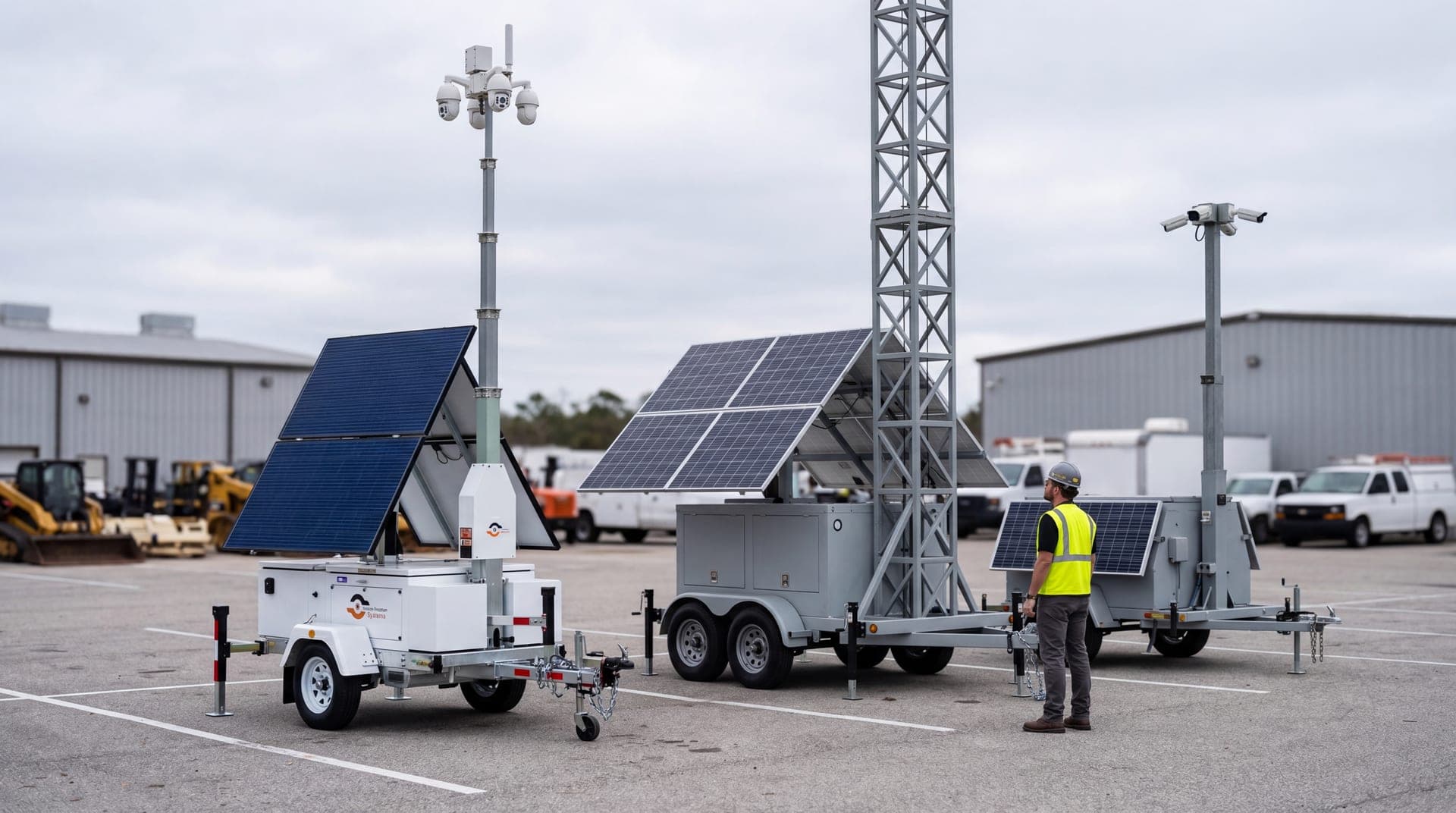
Identifying which category a provider falls into before signing a contract is the most important step in the evaluation process. Here's what separates genuinely capable mobile surveillance companies from the rest.
The landscape, honestly
No independent review site covers this category, so most "top 10" lists are written by vendors ranking themselves. The market breaks into a few recognizable groups: national premium brands (LVT is the best-known — publishes rates from roughly $2,395/month and holds a GSA Schedule), trailer OEMs that supply rental chains (WCCTV supplies a national equipment-rental fleet), construction-camera platforms (TrueLook leads on documentation and time-lapse rather than active security), enterprise camera brands adjacent to the space (Verkada publishes a $65,000 trailer MSRP in its public catalog), plus a long tail of regional rental operators and equipment-only vendors.
None of those groupings tells you what you'll actually get at 2 AM. The criteria below do — apply them to every provider on your shortlist, including us.
| Criterion | The question that reveals it |
|---|---|
| Staffed SOC vs. dispatch | "How many operators are on duty between midnight and 5 AM?" |
| AI + human verification | "What is your documented false-alarm rate?" |
| Equipment & maintenance | "What's the SLA when a camera goes offline overnight?" |
| Hardware provenance | "Who manufactures your cameras — and will you attest in writing?" |
| Deployment engineering | "Can I see the coverage map before the trailer arrives?" |
| Response protocols | "Does law enforcement get live video during an incident?" |
| Incident documentation | "Show me a sample incident report." |
| Contract flexibility | "What happens if my project ends early?" |
Criterion 1: Staffed Monitoring Center vs. Alert Dispatch
This is the single most important differentiator. A staffed security operations center (SOC) has trained operators watching live camera feeds, reviewing AI-flagged events within seconds, and intervening via two-way audio when an intrusion is confirmed. An alert dispatch service sends automated notifications to a call list when motion is detected—and waits for someone else to respond.
The response time difference is measured in minutes, not seconds. For crime prevention, the difference between a 20-second audio challenge and a 5-minute phone tree is the difference between catching a theft in progress and finding your equipment missing in the morning.
Questions to ask: "Where is your monitoring center located? How many operators are on duty between midnight and 5 AM? What is your average time from alert trigger to operator response?"
Providers with genuine monitoring operations answer these specifically. Those without them give vague answers about "24/7 monitoring" that don't hold up to follow-up questions.
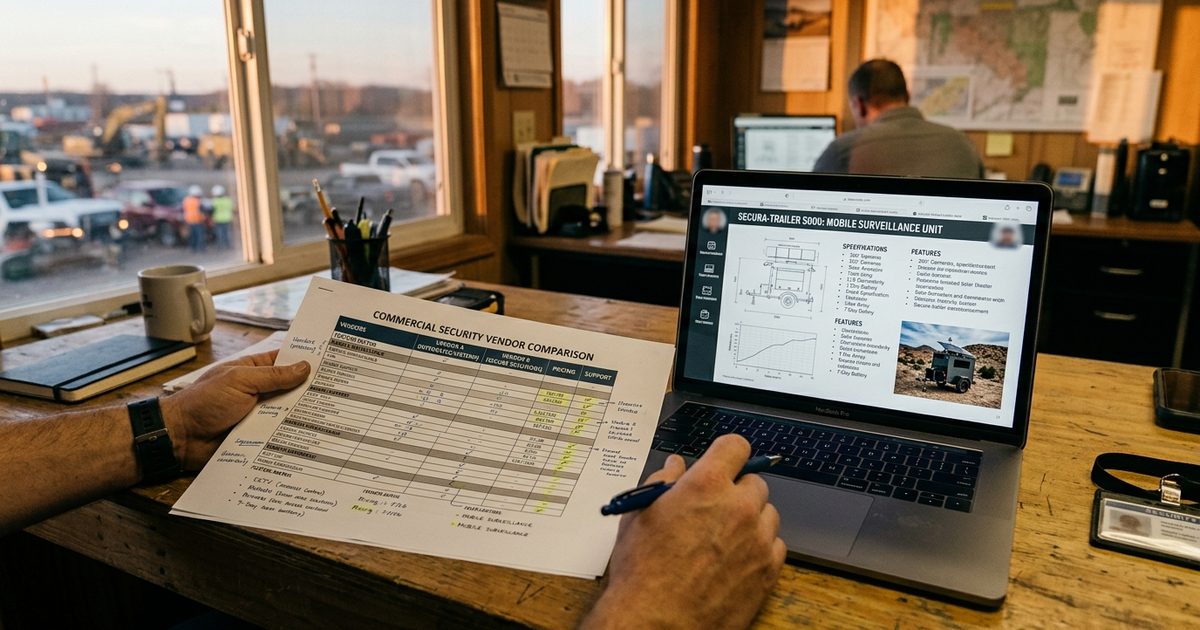
Criterion 2: AI Analytics with Human Verification
The best mobile surveillance companies use AI-based video analytics to pre-filter events before human review. This can eliminate up to 85–95% of motion events caused by weather, wildlife, and lighting changes, so operators spend their time on genuine security events.
Without AI pre-filtering, operators face alert fatigue from hundreds of false notifications per night, and real events get missed in the noise. Without human verification after AI flagging, you get the opposite problem: AI systems send law enforcement notifications for non-events, damaging your credibility with local agencies.
The right architecture is AI filtering followed by human confirmation before any intervention. Ask providers specifically how their analytics work and what their documented false alarm rate is. Top providers can give you a number (under 5% is achievable); providers who can't quantify this don't have meaningful analytics in place.
Criterion 3: Equipment Quality and Maintenance Standards
Surveillance trailers vary enormously in build quality, camera resolution, and power system design. What to look for:
| Component | Minimum Standard | Best Practice |
|---|---|---|
| Camera resolution | 2MP (1080p) | 4MP+ with low-light capability |
| Night vision | IR up to 50 ft | Color night vision up to 100 ft |
| Solar panel capacity | 200W | 400W+ with battery backup |
| Battery autonomy | 3 days | 5–9 days without sun |
| Cellular connectivity | Single carrier | Dual-carrier with failover |
| Local recording | 30-day onboard | 60-day onboard + cloud |
Maintenance matters as much as initial specifications. Ask how frequently equipment is inspected, what the SLA is for a camera that goes offline, and whether the provider keeps spare units available for immediate deployment if a trailer is damaged or fails.
Tip: Reputable providers will share maintenance logs or at minimum describe their inspection schedule. Providers who are vague about maintenance are telling you something important.
Provenance belongs in the same conversation. NDAA Section 889 bans federal procurement of equipment from certain manufacturers — Hikvision and Dahua for video surveillance — and covered equipment is widely resold under other brand names. Even if you never sell to the government, a provider that can attest component origins in writing has engineering discipline the others don't. Our NDAA compliance guide includes a five-step verification checklist that works on any vendor.
Criterion 4: Deployment Engineering vs. Drop-and-Go
Drop-and-go providers deliver a trailer, find a flat spot, and leave. Engineered deployment starts with a site survey—physical or virtual—that maps camera fields of view, identifies coverage gaps, accounts for construction phasing, and positions trailers for maximum coverage of identified risk zones.
The difference in coverage quality is substantial. A trailer positioned without a coverage plan often has significant blind spots that experienced thieves identify and exploit. An engineered deployment uses overlapping fields of view, prioritizes material staging and equipment storage, and accounts for how coverage needs will change as construction progresses.
Ask whether the provider conducts a site assessment before deployment and whether they can share a coverage map. The best providers give you a visual showing what each camera covers before equipment arrives.
Criterion 5: Response Protocols and Law Enforcement Relationships
When an intrusion is confirmed, what happens next? Top mobile surveillance companies have documented escalation protocols:
- Audio challenge via site speakers
- If no compliance, law enforcement notification with live camera feed access
- Continuous monitoring until law enforcement arrival or incident resolution
- Post-incident documentation package
Some providers have established relationships with local law enforcement that result in faster response to camera-verified incidents. Law enforcement agencies prioritize confirmed-intrusion calls with live video over unverified alarm notifications—a relationship that takes time to build.
Ask providers whether they provide law enforcement with live access to camera feeds during incidents, and whether they have experience working with agencies in your jurisdiction.
Criterion 6: Incident Documentation and Reporting
After an incident, the quality of documentation determines whether prosecutions succeed and insurance claims are paid. The best providers deliver:
- Time-stamped video clips of the incident
- Operator log with observations during the event
- Escalation timeline showing when each action was taken
- Chain-of-custody documentation for video evidence
Note: Ask for a sample incident report before signing a contract. The quality and completeness of what a provider shows you as a sample is a reliable indicator of what you'll receive if an incident actually occurs.
Criterion 7: Flexible Contracts Matched to Construction Timelines
Construction schedules change. A surveillance provider that locks you into rigid contracts with severe early termination fees creates risk for projects where timelines shift. The best providers offer:
- Month-to-month terms (at a premium, but available)
- Pro-rated early termination
- Coverage adjustments as site phases change
- Multi-site discounts for general contractors managing multiple projects
Criterion 8: References from Similar Sites
Request references from clients with sites similar to yours—same industry, similar scale, comparable risk environment. Ask references specifically about incidents: did they occur? How did the provider respond? Was the documentation useful?
Red flags in reference calls: vague answers, redirects to marketing materials, or references who can speak to equipment quality but not monitoring response.
Red Flags to Walk Away From
Beyond the positive criteria, watch for these warning signs:
- "24/7 monitoring" with no staffing details: Marketing language covering a dispatch service
- No documented false alarm rate: Means they haven't measured it—or the number is bad
- Minimum 12-month contracts for temporary sites: Misaligned with your needs
- No site assessment before deployment: Drop-and-go operation
- Bundled pricing that obscures monitoring costs: Makes it hard to compare apples to apples
- No response when you call at 2 AM as a test: Reveals actual monitoring availability
Before comparing vendors, it helps to know what's inside a mobile security trailer component by component, so quotes can be compared on equal terms.
The Bottom Line
The best mobile surveillance companies invest in monitoring infrastructure, hire and train operators, engineer their deployments, and build law enforcement relationships. They charge accordingly—typically $2,000–$3,500/month for a fully monitored setup at published market rates (see our full cost guide for the tier-by-tier breakdown)—but deliver protection that's meaningfully better than equipment-only alternatives.
VDS operates a fully staffed Security Operations Center, deploys all equipment after site-specific coverage engineering, and maintains documented incident response protocols. If you're evaluating providers, we welcome the questions above and will answer each of them specifically. Contact us to start the conversation.