
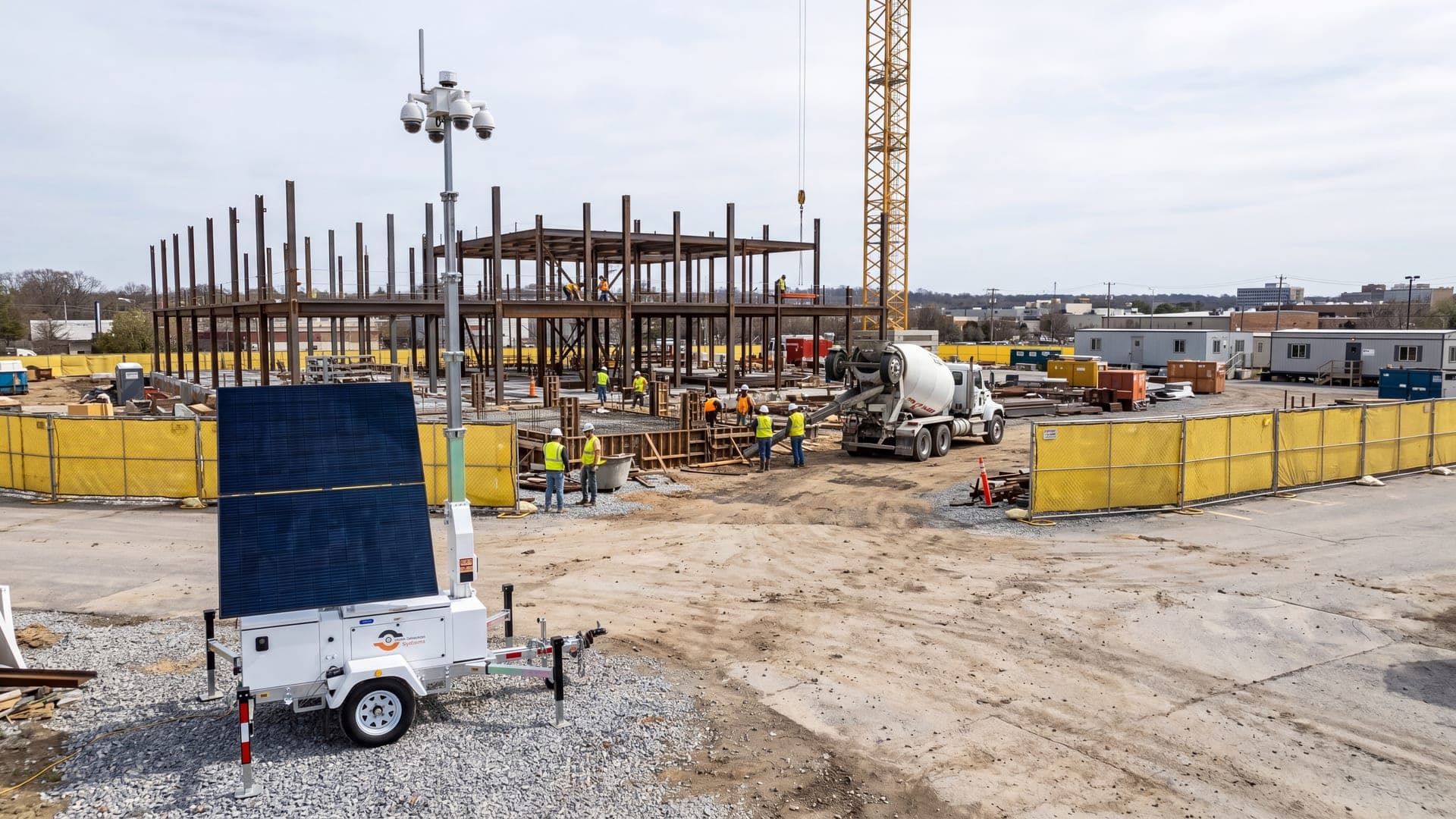
This matters more in 2026 than it did a few years ago. Material theft and equipment vandalism on construction sites remain a persistent cost for contractors nationwide, and insurers increasingly expect documented coverage before they'll write favorable policies for open-air sites. A camera that goes dark during a three-day storm, or that nobody is watching when an alert fires at 2 a.m., isn't security—it's a liability with a lens on it. For how long a charged unit really runs, see our guide to solar security camera battery life.
What Makes a Solar Security Camera Actually Work for Business Sites
A solar security camera works for commercial use when three things line up: enough energy harvest to outlast your worst weather week, battery capacity that covers multiple cloudy days without brownout, and a monitoring layer that turns motion into a verified response instead of a folder of unreviewed clips.
Most buyer's guides stop at megapixels and night vision range. Those matter, but they're not where commercial deployments fail. Deployments fail when the panel is undersized for the site's latitude and season, when the battery can't bridge a multi-day storm system, or when motion alerts pile up unreviewed because nobody owns the escalation workflow.
If you're comparing options for a single residential driveway, a plug-and-play consumer unit is fine. If you're covering a construction perimeter, a multi-acre lot, or a logistics yard, the camera is only one part of a coverage plan that includes power sizing, placement, and a monitoring team that actually answers alerts.
Solar Panel Wattage and Battery Capacity: What You Actually Need
Panel wattage has to match your camera's draw, your region's average sun hours, and your tolerance for gaps during winter or extended cloud cover. A camera drawing 15–20 watts continuously needs considerably more than a basic 30-watt panel once you factor in night recording, infrared illumination, and cellular transmission overhead.
Battery capacity is what actually determines whether your system survives a bad week, not a good one. Lithium iron phosphate (LiFePO4) batteries in the 100–200Ah range are now standard on commercial-grade trailers because they handle deep discharge cycles without the capacity loss that plagues cheaper lead-acid setups.
| Use Case | Recommended Panel Wattage | Minimum Battery Reserve | Typical Runtime (No Sun) |
|---|---|---|---|
| Single fixed camera, light use | 30–60W | 50–100Ah | 2–3 days |
| Construction perimeter, moderate alerts | 100–200W | 100–200Ah | 4–6 days |
| Mobile trailer, 24/7 monitoring + LPR | 300W+ | 200–400Ah | 6–10 days |
Geography matters too. A site in Phoenix sees roughly double the usable sun hours of a site in Seattle during winter months, which means identical equipment performs very differently depending on where it's deployed. Any vendor quoting a single "one size fits all" wattage number for a national footprint is skipping a step.
Mobile Trailers vs. Fixed Solar Cameras vs. Consumer Units
These are three different products solving three different problems, and conflating them is the most common mistake buyers make. A consumer solar camera is designed for a single fixed point with low power draw and no real monitoring behind it—fine for a shed, not for a jobsite entrance.
Fixed commercial solar units make sense where infrastructure is permanent and the risk period is long-term: a warehouse yard, a utility substation, a property management lot. They install once and stay, trading mobility for stability.
Mobile surveillance trailers solve the problem neither of the other two can: elevated risk that moves. Construction phases shift. Event perimeters change week to week. A trailer with a 300W+ panel array, rugged LiFePO4 battery bank, and cellular connectivity can relocate as the risk does, without waiting on electrical contractors or permits.
Fleet operators and multi-site contractors often run a mix: trailers for active work zones, fixed units for permanent chokepoints, and LPR cameras at entry and exit points to track vehicle activity across both.
Key Features to Demand From a Commercial Solar Camera System
Image resolution and night vision range get the headlines, but a handful of less obvious specs determine whether a solar camera actually performs on a working site.
- True standalone runtime: Ask for documented days-of-autonomy figures, not just peak wattage. A spec sheet that only lists panel size without battery capacity is incomplete.
- Cellular failover, not just Wi-Fi: Jobsites and remote lots rarely have reliable Wi-Fi. Cellular connectivity with signal boosting keeps the system online when nothing else is nearby.
- Weatherproof rating (IP66 or higher): Solar units live outdoors permanently. Anything less than IP66 risks moisture ingress during storm seasons.
- Tamper and theft deterrence: Locked enclosures, GPS tracking on trailers, and visible signage reduce the odds the unit itself becomes a target.
- Verified monitoring, not just recording: A camera that records but isn't watched means incidents get discovered hours or days late, often after footage has already been overwritten.
- Retention and export workflow: Evidence only helps if it can be retrieved quickly and in a usable format when an incident, insurance claim, or subpoena requires it.
Common Mistakes When Buying Solar Security Cameras for Business Use
- Undersizing the panel for winter conditions: Buyers size equipment for summer sun hours and then get blindsided by December outages.
- Ignoring battery chemistry: Lead-acid batteries lose usable capacity fast under repeated deep discharge, shortening runtime within a single season.
- Treating recording as monitoring: A camera with footage nobody reviews is a camera that reports incidents after the fact, not one that prevents them.
- Skipping retention planning: Short retention windows mean footage gets overwritten before anyone knows an incident occurred.
- Buying consumer hardware for commercial exposure: A $200 solar camera built for a porch was never engineered for a six-week jobsite with equipment worth six figures sitting behind it.
- Assuming one unit covers the whole perimeter: Blind spots from single-camera coverage are the single biggest driver of "we had cameras but still got hit" complaints.
Most of these mistakes trace back to buying equipment in isolation instead of building a coverage plan that accounts for power, placement, and response together.
Get Your Solar Surveillance Quote Today
If you're weighing a solar security camera against repeated theft, vandalism, or after-hours incidents on a jobsite, parking lot, or remote yard, the equipment is only half the answer. Vision Detection Systems pairs rugged solar-powered mobile trailers and fixed units with verified remote monitoring, defined escalation rules, and evidence-ready retention—so alerts turn into documented response instead of unreviewed footage.
Request a free site assessment and quote through our get started page and we'll size the right panel, battery, and monitoring plan for your specific location.