The "solar-powered" label on security cameras covers an enormous range of actual capability—from consumer cameras that need recharging every two days in good weather to professional surveillance systems that operate for a week or more without any sun. Understanding what determines battery life helps you avoid deploying equipment that fails precisely when you need it most: during an extended overcast period or a busy stretch when nobody's checked the system in days.
How Solar Camera Systems Work
A solar security camera system has three key components that work together: the solar panel that generates power, the battery that stores it, and the camera and connectivity equipment that consumes it.
The panel charges the battery during daylight hours. The battery powers the system at night and during low-solar periods. Battery life without sun is determined by how much energy is stored versus how much the system draws.
This is simpler than it sounds, but the math reveals why so many systems underperform:
- A 1080p camera with IR night vision draws approximately 5–8 watts
- Adding cellular connectivity (4G LTE) adds 2–5 watts
- A single camera system might draw 8–12 watts continuously
- At 10W continuous draw, a 100Wh battery lasts 10 hours—not even one full night
Consumer solar cameras "solve" this by using motion-triggered recording rather than continuous monitoring, sleeping most of the time to extend battery life. For security applications, this means coverage gaps exactly when intrusions tend to occur—during quiet periods when motion is infrequent.
Professional surveillance systems are designed for continuous operation. That requires larger batteries, larger panels, and careful power budgeting.
Battery Autonomy Calculations: The Real Numbers
Battery autonomy is how long the system operates on stored power alone—no solar input at all. This is the number that matters for security deployments in variable weather.
To calculate it:
Daily energy consumption (Wh) = Power draw (W) × 24 hours
Days of autonomy = Battery capacity (Wh) ÷ Daily consumption (Wh)
| System Type | Power Draw | Battery Capacity | Autonomy (No Sun) |
|---|---|---|---|
| Consumer solar camera | 8–12W | 50–100Wh | 4–12 hours |
| Small commercial camera | 15–25W | 200–400Wh | 8–26 hours |
| Single-camera pro unit | 20–30W | 500–800Wh | 1.5–2.5 days |
| 4-camera surveillance trailer | 60–90W | 3,000–5,000Wh | 2–4 days |
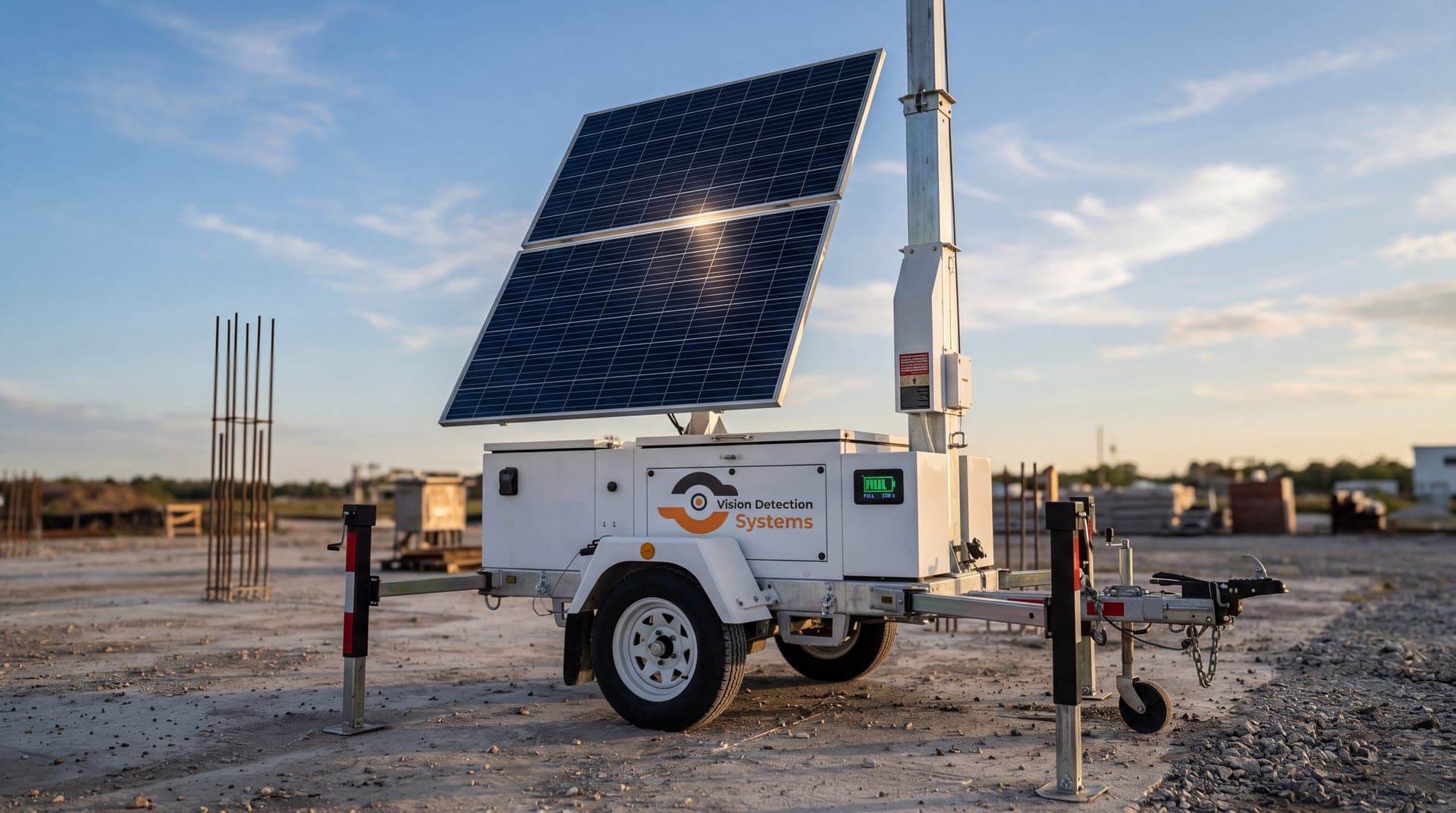
| VDS mobile surveillance unit | 70–100W | 5,000–9,000Wh | 5–9 days |
The 5–9 day autonomy of VDS systems isn't a specification chosen arbitrarily. It reflects the realistic worst-case scenario for a professional site security deployment: a week of fully overcast weather, or a situation where access to the site is restricted for an extended period and the unit can't be serviced.
Battery Chemistry: Why It Matters
The type of battery used is a bigger performance and longevity differentiator than most buyers realize.
Lead-acid batteries are the lowest-cost option and are used in many entry-level surveillance trailers. They're heavy, sensitive to deep discharge (which permanently damages capacity), perform poorly in cold weather, and last 500–1,000 charge cycles before significant degradation.
Lithium iron phosphate (LiFePO4) batteries are the standard for professional surveillance deployments. Key advantages:
- 2,000–4,000+ charge cycles (5–10 years of daily cycling)
- Tolerates deep discharge without permanent damage
- 80–90% usable capacity (vs. 50% for lead-acid, to avoid damage)
- Better cold-weather performance
- Significantly lighter for equivalent capacity
The usable capacity difference is critical. A 100Ah lead-acid battery provides about 50Ah of usable capacity (deeper discharge causes sulfation). A 100Ah LiFePO4 battery provides 80–90Ah. For the same listed battery size, you get 60–80% more effective storage with LiFePO4.
Tip: When comparing solar surveillance systems, ask specifically about battery chemistry and rated usable capacity, not just total capacity. A provider listing "200Ah battery" with lead-acid chemistry delivers less usable storage than one listing "150Ah" with LiFePO4.
Solar Panel Sizing: Matching Generation to Consumption
Battery autonomy tells you how long you last without sun. Panel sizing determines how quickly you recover during good weather and whether you can sustain continuous operation in typical conditions.
For a system drawing 80W continuously:
- Daily consumption: 80W × 24 = 1,920Wh
- A 400W panel in a region with 5 peak sun hours generates: 400W × 5 = 2,000Wh/day
- This roughly balances: enough to sustain operation plus marginal battery recovery in typical conditions
- In poor solar conditions (2 peak sun hours): 400W × 2 = 800Wh/day—running on battery deficit, drawing down reserves
Professional surveillance systems in northern latitudes or frequently overcast climates are sized to maintain positive energy balance even in worst-case winter solar conditions. This typically means panel capacity of 3–5× the average daily consumption, combined with large battery banks.
Seasonal Factors and Regional Variation
Solar availability varies dramatically by latitude and season:
| Location | Summer Peak Sun Hours | Winter Peak Sun Hours |
|---|---|---|
| Phoenix, AZ | 7–8 hrs | 5–6 hrs |
| Denver, CO | 6–7 hrs | 4–5 hrs |
| Seattle, WA | 5–6 hrs | 1.5–2.5 hrs |
| Minneapolis, MN | 5–6 hrs | 2–3 hrs |
| Atlanta, GA | 5.5–6.5 hrs | 4–5 hrs |
A system adequately sized for Seattle's winter operates with substantial power surplus in Seattle's summer and in any sunnier climate. Professional providers size equipment for the worst-case regional conditions rather than average conditions.
Note: Panel tilt angle matters significantly for winter performance. A panel mounted at a shallow angle (optimized for summer sun angle) may generate 30–40% less power in winter when the sun is lower in the sky. Professional installation accounts for this with adjustable mounting or site-specific tilt optimization.
What to Look for in Off-Grid Surveillance Specifications
When evaluating any solar surveillance system for serious site security use, the minimum specifications for reliable off-grid operation:
- Battery autonomy (no sun): 5+ days minimum. Less means the system may fail during extended overcast weather.
- Battery chemistry: LiFePO4. Lead-acid is a compromise on longevity and cold-weather performance.
- Panel capacity: At minimum 200W for single-camera units, 400W+ for multi-camera trailers
- Dual-carrier cellular: Power problems are often accompanied by weather events that stress connectivity too; redundancy matters
- Battery management system (BMS): Protects against overcharge, deep discharge, and thermal events
VDS mobile surveillance units are engineered to these standards, with 5–9 day battery autonomy specifically because off-grid reliability is non-negotiable for sites where you can't check the equipment every day. Contact the team to discuss system specifications for your specific deployment location and climate.