
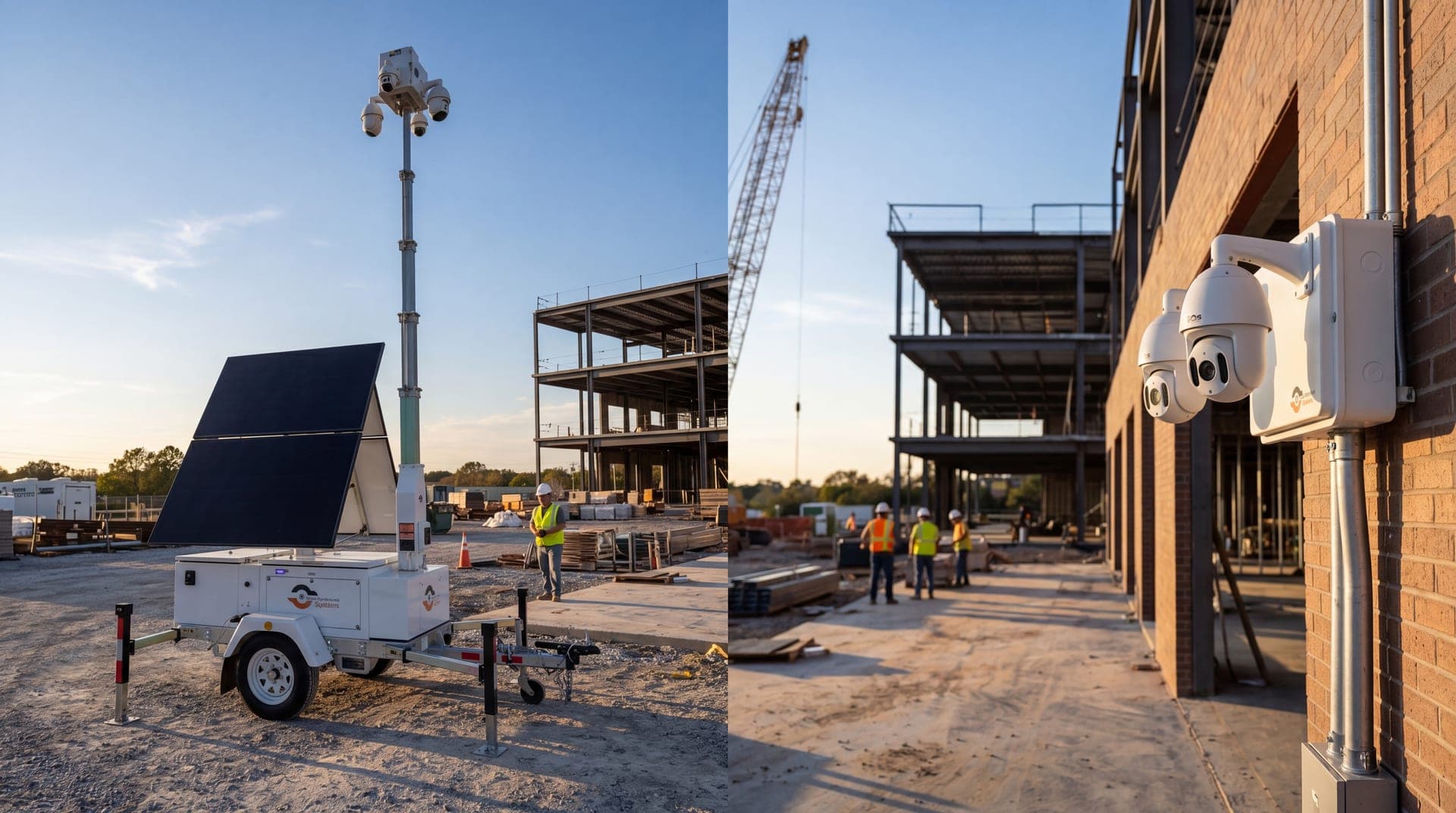
Remote surveillance trailer solutions (often called mobile security trailers) and installed camera systems can both protect a site—but they solve different problems. If you’re deciding between a trailer-based surveillance setup and a fixed installation, the best choice usually comes down to three things:
How fast you need coverage
How stable your site layout and infrastructure are
Whether you need response (monitoring) or just recording
This guide breaks down the practical differences, the best-fit use cases, and a simple decision checklist you can use to choose the right approach without overbuying.
Remote Surveillance Trailer vs Installed Cameras: Quick Comparison
Choose a remote surveillance trailer when you need rapid deployment, your site layout is changing, you don’t want permanent installation work, or you don’t have reliable power/internet available.
Choose installed cameras when the site is permanent, you need indoor coverage, you have stable power/network infrastructure, and you want a long-term fixed solution designed around a consistent perimeter.
In many real-world deployments, the best approach is hybrid: use a trailer to secure the early-phase or high-risk period, then transition to a fixed system once construction stabilizes or infrastructure is in place.
What Is A Remote Surveillance Trailer?
A remote surveillance trailer is a mobile, deployable security system designed to provide camera coverage without permanent installation. It’s commonly used for construction sites, parking lots, logistics yards, events, and temporary risk periods.
A typical trailer deployment is designed to be:
Fast to deploy
Easy to relocate
Usable without permanent site infrastructure (depending on configuration)
Compatible with remote access and/or monitoring workflows
Mobile security trailer vs remote surveillance trailer
People often use “mobile security trailer,” “security camera trailer,” and “remote surveillance trailer” interchangeably. In practice, they all describe the same category of solution: deployable surveillance designed for speed, flexibility, and visibility.
What Is An Installed Video Surveillance System?
Installed surveillance refers to fixed cameras mounted to buildings, poles, or interior locations. These systems are designed around a permanent site layout and typically require planned installation work—power, network connectivity, placement, retention, and coverage design.
Installed systems can be:
Indoor or outdoor
Integrated with existing site infrastructure
Designed for long-term perimeter coverage
When A Remote Surveillance Trailer Is The Best Choice
If any of the following are true, a trailer is usually the right starting point.
Construction Sites And Temporary Projects
Construction site security changes by the week. Risk often peaks during early phases (before fencing, access control, and permanent systems are finalized) and after-hours.
A trailer-based setup works well because:
You can deploy quickly at the start of a project
You can relocate coverage as the project footprint changes
You can avoid re-installation costs every time the site evolves
Best-fit outcomes
Deter theft and unauthorized entry
Document incidents with usable footage
Support multi-site oversight
Parking Lots And Retail Properties
Parking lots are large, exposed, and difficult to cover with one fixed approach—especially when risk is seasonal or concentrated in specific zones.
A trailer can help when:
You need extra coverage during peak risk periods
You’re solving a known problem area (drive lanes, entrances, loading zones)
You want visibility quickly without permanent work
Remote/Off-Grid Locations
If you’re protecting a site without reliable power or networking, a trailer is often the only practical option. That includes rural operations, remote staging yards, and temporary infrastructure projects.
Emergency Response After Theft Or Vandalism
When a site experiences theft or vandalism, the priority is speed. A trailer-based solution can provide fast deterrence, visibility, and a clear workflow for incident review while you assess longer-term plans.
When Installed Cameras Are The Best Choice
If your site is stable and long-term, fixed systems can be the better investment.
Permanent Facilities And Indoor Coverage
Installed systems are ideal when you need:
Indoor camera coverage (offices, warehouses, internal corridors)
Permanent entry-point monitoring
Stable coverage across consistent pathways
Long-Term Fixed Perimeters
If your perimeter doesn’t change, fixed cameras can be designed for:
Consistent coverage angles
Stable lighting and retention configurations
Long-term maintenance planning
Cost And Timeline Differences
Pricing and timeline aren’t just “trailer vs fixed.” They’re driven by deployment complexity and operational requirements.
Trailer deployments are typically influenced by:
How long you need coverage (short-term vs seasonal vs longer deployments)
Site layout complexity (perimeters, entrances, lighting)
Configuration requirements (coverage vs detail capture)
Monitoring needs (hours covered, escalation, reporting)
Installed systems are typically influenced by:
Installation scope (mounting, cabling, power, network)
Camera count and placement complexity
Retention/storage requirements
Integration needs (existing systems and workflows)
If procurement strategy matters, clarify whether you’re evaluating purchase, lease, or rental before you compare apples to apples.
Ready to Choose the Right Approach?
If you need coverage quickly, start with remote surveillance trailers. If you need responsive workflows and escalation, explore remote video monitoring. For procurement teams, speak with our teams about purchase, lease, and rental options.
Monitoring And Response Workflows
A key reason many organizations upgrade from “cameras” to “security” is the difference between recording and response.
With either trailers or installed cameras, the question is:
What happens when activity is detected?
Who is notified?
What is the escalation path?
How is footage retrieved and reported?
If your incidents happen after-hours, remote video monitoring can materially improve outcomes by reducing time-to-awareness and standardizing response.
The Hybrid Approach
The most common high-performing approach is:
Deploy a trailer during early-phase or elevated-risk periods
Use the data and incident patterns to design the permanent system correctly
Transition to installed cameras when the site stabilizes
Maintain monitoring workflows across both environments
This hybrid model avoids two expensive mistakes:
Waiting too long for coverage while incidents occur
Overbuilding a permanent system before you understand the real risk zones
Decision Checklist
Choose a remote surveillance trailer if you need:
Coverage within days (or faster)
Flexibility to relocate as risk zones change
Temporary security during construction phases or incident response
Solutions for sites with limited infrastructure
Choose installed cameras if you need:
Indoor coverage
Permanent perimeter coverage
Long-term infrastructure-backed surveillance
Stable, designed-for-life system placement
If you’re unsure, start with a trailer for rapid coverage and plan the fixed system once you’ve validated the real risk and traffic patterns.
Remote Surveillance Trailer Vs. Fixed Camera FAQs
What is a remote surveillance trailer?
A remote surveillance trailer is a deployable mobile security system designed to provide camera coverage without permanent installation, commonly used for construction, parking lots, and temporary risk sites.
Is a mobile security trailer better than installed cameras?
It depends on your site. Trailers win when speed and flexibility matter. Installed cameras win when the site is permanent and requires indoor or long-term fixed coverage.
Can trailers be used for long periods?
Yes. Many organizations use trailers for seasonal risk, long-duration projects, or rotating coverage across multiple sites—especially when the footprint changes over time.
Do trailers require permanent power or internet?
Not always. Many deployments are designed to operate without relying on permanent infrastructure, depending on your configuration and site constraints.
Should I add remote video monitoring?
If incidents happen after-hours or you need a defined response workflow, remote video monitoring can improve outcomes by enabling alerts, escalation, and reporting.
Remote Surveillance Trailer vs Installed Cameras: Next Steps
If you need security coverage quickly, a remote surveillance trailer is usually the fastest way to add visibility and deterrence—especially for construction sites, parking lots, and temporary risk periods. If your site is stable, has permanent infrastructure, and requires indoor coverage, installed cameras may be the better long-term fit. Many organizations use a hybrid approach: deploy a trailer now, then transition to a fixed system once the site layout and risk zones are proven.
To find the right solution for you, we review the following cri